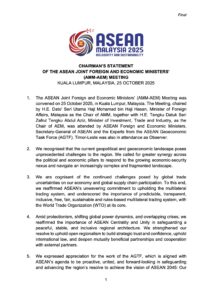

Recently held in Kuala Lumpur, Malaysia, the 46th ASEAN Summit marked a critical moment for advancing ASEAN’s collective agenda amidst shifting geopolitical and economic landscapes. The “Kuala Lumpur Declaration” signed at this summit emphasized deepening regional integration, accelerating digital and green economic transformation, and strengthening supply chain resilience.
It reaffirmed ASEAN’s commitment to its Vision 2045, a long-term strategic blueprint to elevate ASEAN as a global economic powerhouse, in conjunction with ASEAN’s ambition to become the 4th fourth-largest economy globally, and a central force in Indo-Pacific affairs.
Note that ASEAN’s combined GDP was about $3.9 trillion in 2023, already positioning it as the world’s fifth-largest economy, just behind Germany. Accordingly, with a population of over 670 million, a rapidly expanding middle class, and a thriving digital economy, ASEAN is poised to surpass Japan and Germany by 2040–2045, potentially becoming the 4th largest economy globally.
However, the most notable question is, how feasible is ASEAN’s goal of becoming the fourth-largest economy amidst global uncertainty, geopolitical challenges, and tensions within and beyond the ASEAN region?
Drivers
ASEAN’s ambition to become the world’s fourth-largest economy by 2030 is bold but feasible, provided the bloc can harness its collective potential and navigate global uncertainties strategically.
Despite global slowdowns, ASEAN economies have shown strong post-pandemic recovery, bolstered by trade integration through the Regional Comprehensive Economic Partnership (RCEP) and the ASEAN Free Trade Area (AFTA). ASEAN’s demographic dividend is also one of its advantages. Thus far, it has a combined population of over 680 million, with a young, growing, and increasingly urbanized workforce. This offers a sustained consumer base, a large labor pool, and a tech-savvy generation that can power innovation and consumption.
Likewise, ASEAN’s strategic location and geopolitical rebalancing are other advantages. ASEAN lies at the heart of Asia Pacific supply chains. This has led to surging foreign direct investment. Also, ASEAN is now experiencing momentum toward digital transformation. Its digital economy is projected to reach $1 trillion by 2030. Countries like Singapore, Malaysia, and Indonesia are rapidly adopting fintech, e-commerce, and AI, fostering digital trade and startups. Critical sectors include the digital economy, innovation, e-commerce, fintech, AI, cloud services, and digital health, which drive ASEAN economic growth. ASEAN is also becoming a hub for electronics, EVs, semiconductors, and apparel. Tourism’s post-pandemic rebound is also a major growth driver. Cultural industries, digital content, and regional film/media collaboration hold soft power potential.
In the agriculture and agri-tech sector, ASEAN is a global food basket, but climate change and inefficiencies pose challenges. Hence, precision agriculture, smart farming, and regional food security strategies are key priorities. Furthermore, ASEAN’s growing middle class is spurring demand for insurance, credit, and investment services. Capital market integration and fintech ecosystems are boosting SME access to finance.
Conclusion
Given all these, ASEAN countries can navigate geopolitical neutrality smartly, overcome internal disparities, and deepen unity without sacrificing sovereignty. ASEAN’s goal of becoming the fourth-largest economy by 2030 is within reach.
Source: The Lobbyist
https://www.thelobbyist.biz/perspectives/article-details/prime%20insight/thelobbyist-prime-insight