

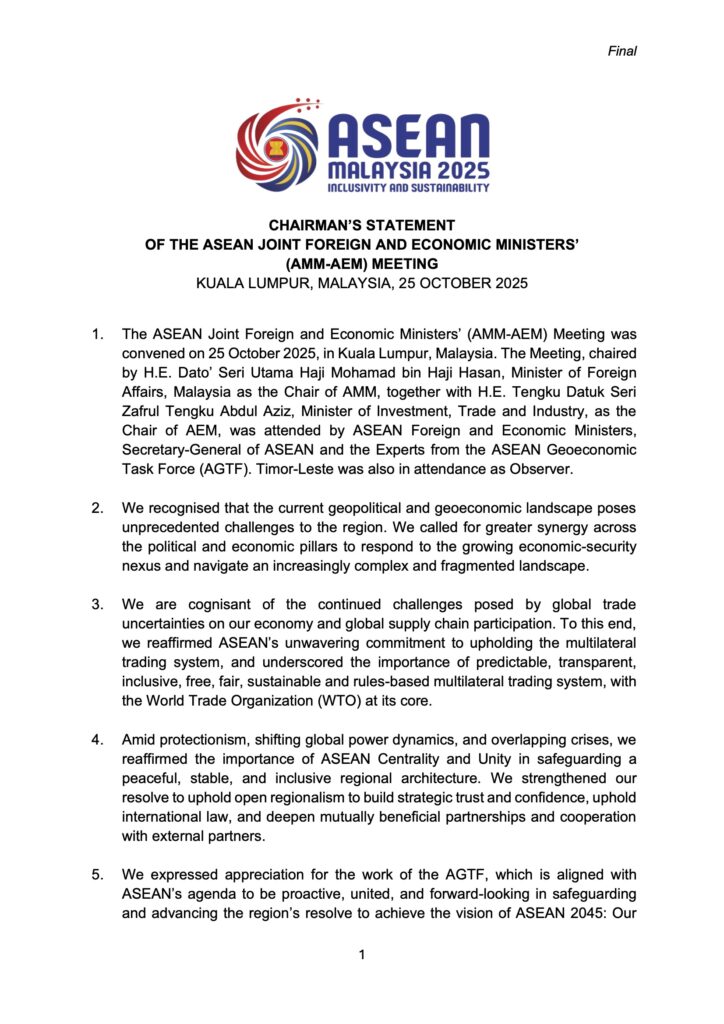
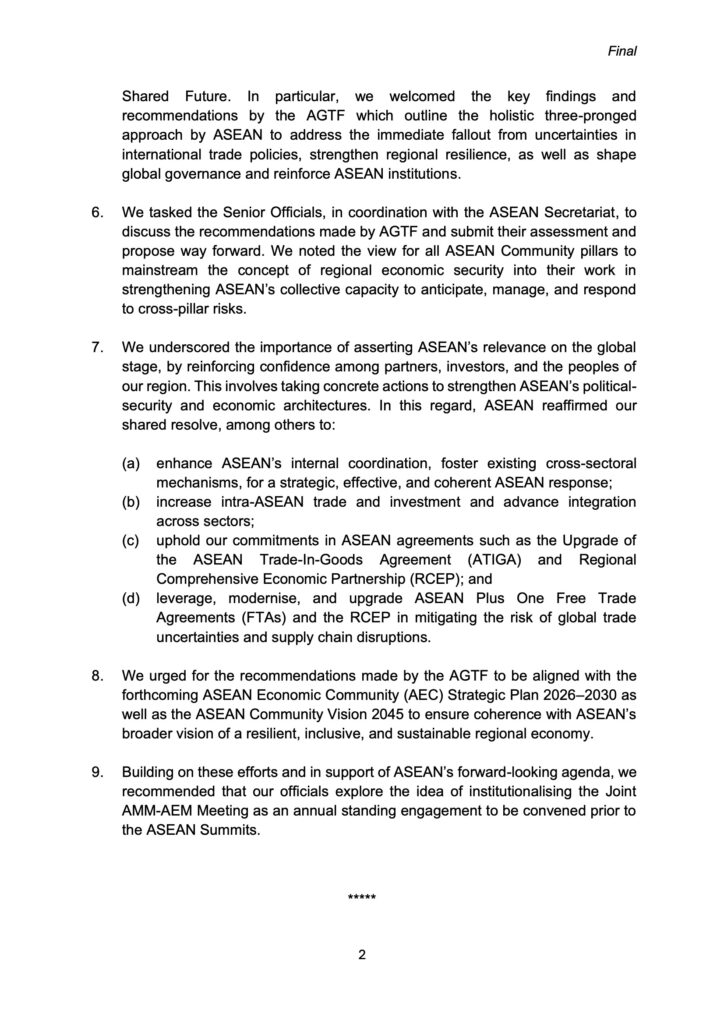
Yesterday, October 25, 2025, the foreign and economic ministers of ASEAN gathered in Kuala Lumpur for the first-ever joint ASEAN Ministerial Meeting (AMM-AEM). The event seemed routine at first glance. Yet, behind the diplomatic language of “cooperation” and “resilience,” lies a strategic message that could define Southeast Asia’s next decade. The Chairman’s Statement issued after the meeting marks a quiet but decisive geoeconomic awakening for ASEAN, one that recognizes the indivisibility of politics, economics, and security in an increasingly fractured global landscape.
The Dawn of a Geoeconomic ASEAN
For decades, ASEAN diplomacy has revolved around the political-security and economic pillars as separate tracks, one focused on peace and stability, the other on trade and development. The Kuala Lumpur meeting, however, breaks that compartmentalized mold. It explicitly acknowledges that the economic-security nexus has become inseparable, and that ASEAN must “mainstream the concept of regional economic security” across all community pillars.
This is not just bureaucratic language. It signals a paradigm shift: ASEAN now sees the strategic risks of trade disruptions, technology decoupling, and supply-chain weaponization as security issues rather than merely economic ones. In effect, the ASEAN Geoeconomic Task Force (AGTF), whose findings guided the meeting, has become the bloc’s new strategic compass in navigating the turbulent intersection of power and prosperity.
In the post-pandemic era, “geoeconomics” — the use of economic instruments to achieve geopolitical aims has become the defining language of power. The United States wields tariffs and technology sanctions; China leverages market access and infrastructure; and the European Union uses carbon standards and supply-chain rules as tools of influence. ASEAN, long cautious and consensus-driven, now finds itself compelled to adapt.
By recognizing this reality, ASEAN is effectively stating: if economics has become a theater of competition, then economic governance must also become a tool of collective resilience.
Centrality Under Pressure
The statement also reaffirms ASEAN Centrality, Neutrality, and Unity —a familiar phrase now carrying a more profound urgency. Amid intensifying great-power rivalries, ASEAN’s centrality has come under unprecedented strain. The Indo-Pacific has become a crowded geopolitical theater, with overlapping frameworks like the QUAD, AUKUS, U.S.–Japan–Philippines defense pacts, and the U.S.-led Indo-Pacific Economic Framework (IPEF) vying for influence, while China deepens its Belt and Road Initiative (BRI) footprint across the region.
By reasserting “open regionalism,” ASEAN is drawing a red line against the region’s fragmentation into rival blocs. It seeks to remain an equidistant bridge, not a battleground of alignments. This balancing act is delicate: while ASEAN values its partnerships with both Washington and Beijing, it is determined to ensure that no external power dictates the region’s agenda.
The statement’s emphasis on “upholding international law” and “mutually beneficial partnerships” mirrors ASEAN’s long-standing diplomatic DNA. Yet the context is new, the world is witnessing a steady erosion of global norms, from the weakening of the World Trade Organization (WTO) to the return of protectionism and economic nationalism. In that environment, ASEAN’s reaffirmation of rules-based multilateralism is both defensive and visionary, an assertion of order amid systemic disarray.
The Philippines’ Moment of Leadership
This forward-looking posture carries particular weight as the Philippines prepares to assume the ASEAN chairmanship in 2026. Manila’s leadership will be tested not just by maritime tensions in the South China Sea (SCS), but also by the challenge of steering ASEAN through its next economic integration cycle under the ASEAN Economic Community (AEC) 2026–2030 plan.
The Kuala Lumpur statement’s call to “institutionalize” the AMM-AEM joint meeting as an annual event offers the Philippines an opportunity to champion coherence between ASEAN’s economic and security architectures. As a frontline state in both geopolitical competition and economic vulnerability, the Philippines is uniquely positioned to advance this agenda. The Philippines’ ASEAN Chairmanship next year (2026) under Marcos Jr. is expected to pursue a similar strategic line, anchored on ASEAN Centrality, Neutrality, and Unity, as guiding principles for navigating the region’s increasingly complex geoeconomic and geopolitical environment. As major powers intensify their competition for influence in the Indo-Pacific, these pillars will be crucial for preserving ASEAN’s cohesion and strategic autonomy.
Under its chairmanship, the Philippines can anchor its leadership around three themes that flow naturally from this statement:
- Economic Security and Supply Chain Resilience: Positioning ASEAN as a trusted hub amid global realignments.
- Inclusive Growth through Intra-ASEAN Integration: Deepening trade and investment ties to reduce external dependency.
- Strategic Autonomy and Centrality: Reaffirming ASEAN’s role as a stabilizing force in a multipolar Indo-Pacific.
If ASEAN’s 2026 summit in Manila can institutionalize these priorities, it could cement the bloc’s transition from a reactive association into a strategically coherent community, one that shapes rather than merely adapts to global currents.
Moreover, if Marcos Jr. could ensure that discussions on the Code of Conduct (COC) in the SCS and related matters are insulated from great-power rivalries and external interference, shielding the COC process from the zero-sum logic of major-power competition would help maintain ASEAN’s credibility as an honest broker and avoid further complicating an already intricate and sensitive maritime dispute.
Trade as Strategy, Not Just Commerce
Another key takeaway from the statement is ASEAN’s plan to upgrade the ASEAN Trade in Goods Agreement (ATIGA) and the Regional Comprehensive Economic Partnership (RCEP) moves aimed at insulating the region from external trade shocks. These initiatives are not just about lowering tariffs; they are strategic hedges against the weaponization of interdependence.
In an age where access to semiconductors, critical minerals, and green technologies defines power, ASEAN’s intra-regional trade and diversified partnerships can serve as economic shock absorbers. By fostering greater intra-ASEAN investment and enhancing its own supply chain connectivity, the region reduces its exposure to trade wars and decoupling policies by larger powers.
This also has implications for the Philippines’ domestic agenda. Manila’s overreliance on external markets and remittances leaves it vulnerable to global disruptions. By spearheading ASEAN’s integration push, the Philippines can align its industrial strategy with the region’s collective economic security goals — turning regional cooperation into a multiplier of national resilience.
Institutional Maturity and Vision 2045
The statement’s reference to ASEAN Vision 2045 is not mere symbolism. It represents a generational blueprint, one that envisions a resilient, innovative, inclusive, and sustainable ASEAN community. Linking the AGTF’s recommendations to the forthcoming AEC Strategic Plan (2026–2030) shows growing institutional maturity within ASEAN.
The bloc’s strength has always been its ability to adapt incrementally, through consensus, not confrontation. Yet the world of 2025 demands more agility. The proposal to make the joint AMM-AEM meeting a permanent, annual pre-summit mechanism is precisely the kind of institutional innovation ASEAN needs. It reflects an understanding that foreign policy and economic policy must now move in tandem.
Such a move also gives ASEAN a stronger collective voice when engaging with external powers and institutions, from the G20 to the WTO. It allows the region to articulate its own priorities in global governance, whether in digital trade, climate finance, or technology regulation, rather than being a passive rule-taker.
Navigating a Fragmented Future
Ultimately, the Kuala Lumpur statement is a reminder that ASEAN’s greatest strength —its unity in diversity —is also its greatest test. The region sits at the crossroads of global power competition and at the center of global opportunity. With its combined GDP exceeding $4 trillion and a population of 680 million, ASEAN is now the world’s fifth-largest economy.
Yet, size alone does not confer influence. Relevance does. And ASEAN’s relevance depends on its ability to act as a cohesive, credible, and confident community, one that can withstand the crosswinds of U.S.-China rivalry, technological bifurcation, and climate disruption.
The ASEAN Geoeconomic Task Force is an essential institutional innovation precisely because it offers a mechanism to anticipate and manage these cross-pillar risks. Its existence acknowledges that the region can no longer rely solely on diplomacy to ensure stability, economic strategy must now be part of the security toolkit.
Conclusion: A New ASEAN for a New Era
The 2025 AMM-AEM Joint Meeting’s statement is not just another communiqué; it is a quiet declaration of strategic renewal. It captures a bloc in transition: from reactive diplomacy to anticipatory governance; from economic cooperation to economic security; from regional talk shop to global actor.
As the Philippines prepares to take the helm in 2026, it inherits not just a ceremonial chairmanship but a strategic responsibility to translate ASEAN’s geoeconomic vision into tangible action. Manila’s leadership could define whether ASEAN emerges from this era of fragmentation as a mere spectator or as a decisive shaper of Asia’s future order.
In a world of multiplying crises and shrinking certainties, ASEAN’s message from Kuala Lumpur is clear: unity, openness, and resilience are no longer just ideals; they are survival strategies. And for the Philippines, the forthcoming chairmanship offers a rare moment to help steer that collective course toward 2045, a shared future where Southeast Asia is not the periphery of great-power rivalry but the pivot of regional peace, security, and prosperity.
Indeed, the ASEAN Chairman’s Statement conveys a clear strategic message: ASEAN seeks to redefine its role in an era of great-power fragmentation by institutionalizing geoeconomic resilience, reinforcing unity, and asserting regional centrality as the anchor of a multipolar Asia-Pacific.
It reflects ASEAN’s collective intent to remain proactive rather than reactive, strengthening internal coordination, institutional resilience, and open regionalism to preserve its agency amid intensifying U.S.–China competition, economic protectionism, and global supply chain realignments.