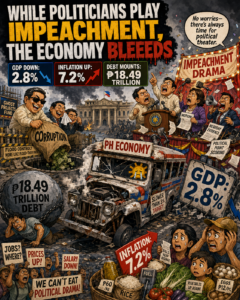

While the Philippines is being told to remain calm, the country’s economic indicators paint a very different picture. One does not need a complex econometric model to understand what is happening. Sometimes, the signs are painfully obvious: rice prices climbing to ₱70 per kilo, electricity rates poised to surge by as much as 16 percent, the stock market shedding ₱671 billion in value in a single trading day, and the peso weakening under the pressure of global oil shocks.
But apparently, all of this is just another normal day in economic paradise. Let us begin with the most basic staple of Filipino life: rice. Reports from Cebu show some local rice varieties already selling for above ₱70 per kilo as supply tightens and fuel costs push up distribution expenses. For millions of Filipino households, rice is not a luxury commodity; it is the center of daily survival. When rice prices spike, the impact ripples through every kitchen, every market stall, and every household budget. In economic terms, rice inflation is not just another data point. It is a political and social alarm bell.
Then comes energy. The Department of Energy has already warned that electricity rates may jump by around 16 percent next month due to the global oil crisis. Meanwhile, Meralco has announced an increase of ₱0.64 per kilowatt-hour, adding to the burdens of households already struggling with rising living costs.
Electricity, much like rice, is a non-negotiable expense. When power prices rise, the chain reaction spreads quickly: manufacturing costs increase, transport becomes more expensive, and small businesses already operating on thin margins are squeezed even further.
And then there is the financial market. The Philippine Stock Exchange Index (PSEi) plunged to the 6,000 level, wiping out ₱671.7 billion in market capitalization in a single day. The trigger? Escalating tensions in the Middle East are pushing oil prices upward, combined with a weakening peso (59.50 PHP to 1USD) and investor panic selling.
Financial markets are often described as forward-looking indicators. When investors begin to exit aggressively, they are not reacting to yesterday’s news. They are reacting to what they believe is coming next.
The picture becomes even more troubling when fiscal realities are taken into account. The Philippines is now facing a budget deficit of roughly US$26.5 billion, a record level that reflects both structural fiscal weaknesses and expanding government obligations. High deficits during times of economic stress reduce the state’s ability to respond effectively to shocks. In simpler terms, the government’s fiscal cushion is getting thinner.
Put all these pieces together, and the pattern becomes difficult to ignore. Rising food prices, escalating energy costs, financial market volatility, currency weakness, and widening fiscal deficits are not isolated events. They are interconnected signals of mounting economic pressure.
And yet, in the middle of this gathering storm, one cannot help but ask a rather simple question: Where is the sense of urgency in leadership under a Marcos Jr. presidency?
Source: The Lobbyist
https://www.thelobbyist.biz/perspectives/article-details/prime%20insight/storm-signals-rice-at-peso70-power-surging-stocks-crashing-but-where-is-the-leadership