

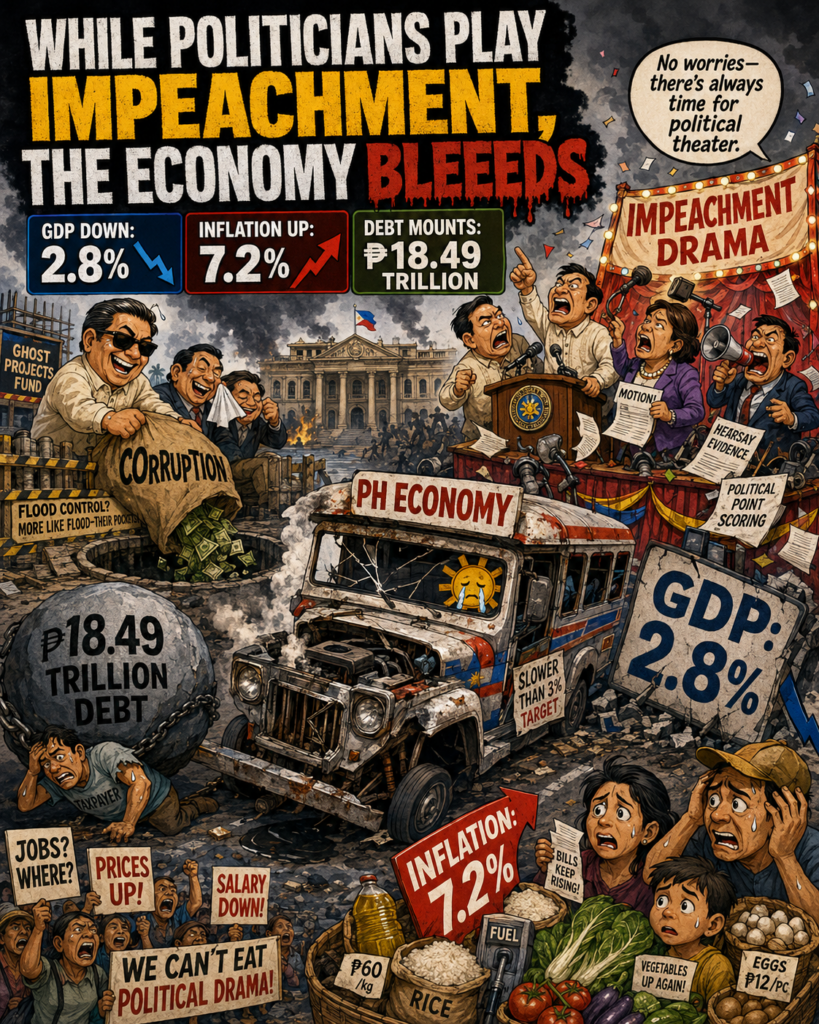
The picture is grim. Philippine GDP growth slowed sharply to 2.8% in the first quarter of 2026, far below the government’s 5–6% target and weaker than expected. The Philippine Statistics Authority (PSA) reported that household consumption grew only 3.0%, while gross capital formation declined by 3.3%, a worrying signal because investment is not just a number; it is confidence made measurable. When investment falls, it means businesses are hesitating, consumers are tightening their belts, and the future is being postponed.
Then comes inflation: 7.2% in April 2026, up from 4.1% in March. This is not abstract economics. This is rice, fish, vegetables, electricity, transport, and cooking fuel becoming heavier on the pockets of ordinary Filipinos. PSA data show that food, transport, and housing/utilities were the main contributors to April inflation, with rice inflation alone rising to 13.7%.
Debt is also ballooning. National government debt reached a record ₱18.49 trillion by the end of March 2026, partly driven by peso depreciation and domestic securities issuance. BusinessWorld reported that debt-to-GDP rose to 65.2%, the highest since 2005. In simpler terms, the country is borrowing more while growing more slowly. That is not a growth strategy. That is a fiscal treadmill with the speed increasing and the runner getting tired.
Taken together, all these do not merely show bad economic numbers. They show an economy gasping while the political class performs its usual circus act: grand speeches, selective outrage, impeachment drama, and the eternal Filipino miracle of making corruption look like public administration.
Of course, the convenient excuse is global uncertainty: the Middle East conflict, oil shocks, supply chain pressures, and a weak peso. These are real factors. But blaming everything on external shocks is like blaming the rain while your roof was stolen by contractors, padded by officials, and approved through “public service.” The Philippines is vulnerable to oil shocks because it is import-dependent, yes. But it is even more vulnerable because the state leaks money like a broken pipe and then wonders why the floor is flooded.
The corruption scandal in infrastructure and flood-control projects is not a side story. It is central to the economic rot. The ₱545 billion in flood-control spending since 2022 is riddled with alleged irregularities, including projects that were reportedly never built. In many ways, the productive capacity of the Philippines had been “muted” by corruption, while authorities investigated flawed flood-control projects. The tragedy is almost poetic: money meant to prevent floods appears to have drowned in the swamp of kickbacks.
And now, while GDP weakens, inflation burns, debt swells, and corruption erodes confidence, the political establishment appears consumed by the impeachment of Vice President Sara Duterte.
Don’t get me wrong, I do believe that accountability matters. Allegations of misuse of funds and unexplained wealth should be investigated. But accountability that looks selective, dynastic, and politically choreographed risks becoming NOT justice but a political theater with legal stationery.
The real scandal the Philippines is facing is that the country faces an economic emergency, but the political system behaves as though the biggest national priority is factional political survival.
The Marcos Jr. administration should be obsessed with food security, fuel-price cushioning, fiscal discipline, rebuilding investor confidence, prosecuting corruption, restoring public works credibility, and protecting ordinary households from price shocks. Instead, the nation is treated to elite political combat, the Marcos camp versus the Duterte camp, while Filipinos pay the entrance fee through higher prices, weaker purchasing power, and heavier public debt. Note that the House justice committee found probable cause to impeach Sara Duterte, elevating the complaints to the full House (plenary debate), amid a broader Marcos-Duterte feud that continues to destabilize governance.
Moreover, the Marcos Jr. administration cannot speak of “Bagong Pilipinas” while old-style corruption, patronage, and political vendetta remain the operating system. Nor can it claim economic stewardship when growth is slowing, debt is rising, inflation is punishing the poor, and public confidence has been damaged by scandals in precisely the sectors meant to build national resilience. Infrastructure should multiply productivity. Corruption turns it into decorative concrete, ghost projects, and campaign machinery.
The danger is not merely recessionary pressure. The danger is a weakening national immune system. High inflation erodes social patience. Rising debt narrows fiscal space. Weak investment reduces future growth. Corruption destroys trust. Political instability raises risk premiums. Together, these form a toxic cocktail: not yet collapse, perhaps, but certainly deterioration.
The Philippines does not lack talent, workers, entrepreneurs, farmers, engineers, or ambition. What it lacks is a governing class capable of treating the economy as a national lifeline rather than as a funding source, a campaign machine, or a battlefield for dynastic revenge.
The country does not need another slogan. It needs competent economic management, aggressive anti-corruption prosecution, disciplined public spending, serious food and energy security planning, and political leaders who understand that governance is not a teleserye. Because right now, the economy is sending distress signals in bold red numbers: 2.8% growth, 7.2% inflation, ₱18.49 trillion debt.
And while the house is burning, the political class is still arguing over who gets to hold the microphone. Goodness gracious… What a tragedy unfolding…