
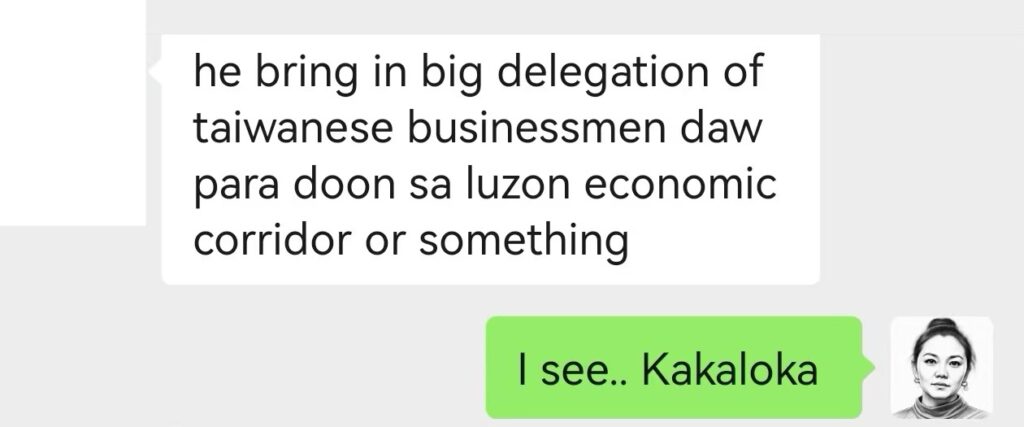
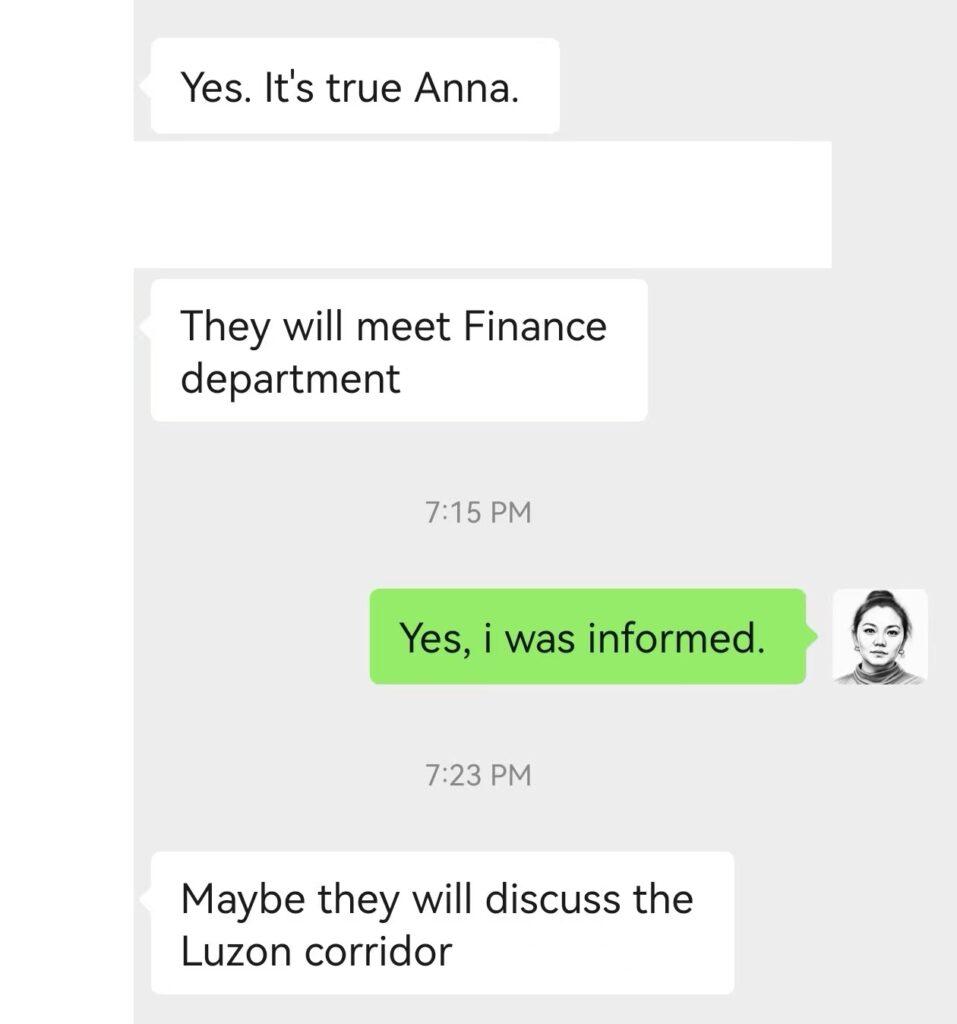
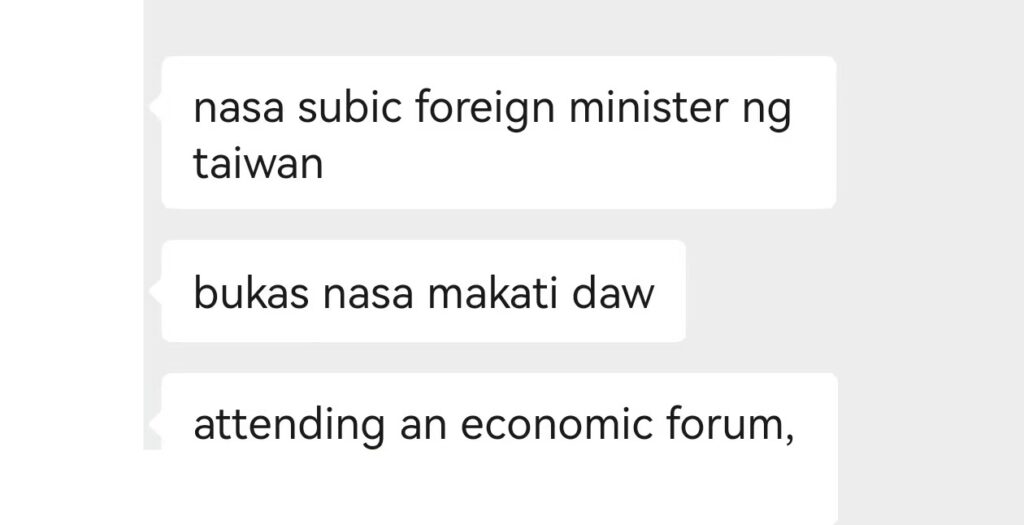
Two reliable friends informed me that, allegedly, the “foreign minister” of Taiwan was in Subic today (August 26, 2025) and is set to be in Makati tomorrow to attend an economic forum. Reportedly, he brought with him a sizable delegation of Taiwanese businessmen to discuss the so-called Luzon Economic Corridor, and I was told that this group, together with the so-called “Foreign Minister of Taiwan,” is scheduled to meet with the Department of Finance. Unless the Marcos Jr. administration, through the relevant agencies and officials of his government, issues a clear and categorical explanation to clarify this matter, the information stands as verified. By the way, I cross-checked it with two independent and trustworthy sources.
Nevertheless, the most important thing is that this development raises troubling and important questions: Is this not a direct or indirect violation of the Philippines’ One China Policy? Why was it the foreign minister of Taiwan, not economic or cultural representatives, who are normally tasked with such exchanges, who came to the Philippines? What signals does this send to Beijing, and what are the possible repercussions for Manila? Could this indicate a quiet but deliberate shift in how the Philippines engages Taiwan under the cover of economic cooperation?
These are not trivial questions. The answers will have far-reaching implications not just for our bilateral relations with China, but also for the Philippines’ delicate position in the evolving geopolitical rivalry of the two superpowers in the Indo-Pacific.
On this note, let me share some thoughts to ponder on….
To note, the Philippines, like around 183 countries, adheres to the One China Policy. The Philippines officially recognizes the PRC (Beijing) as the sole legal government of China, and therefore does not have diplomatic relations with Taiwan. This means Taiwan is represented only through economic and cultural offices (TECO in Manila, MECO in Taipei).
If indeed the Taiwanese “foreign minister” (the head of Taiwan’s Ministry of Foreign Affairs) is in the Philippines in an official capacity, and allegedly had meetings and will be meeting with Philippine government officials during his stay in the country, from whichever department, that is diplomatically problematic.
Under standard/normal protocol, economic or cultural officials (not political or foreign ministry officials) represent Taiwan abroad to avoid violating the One China principle. Thus, if the information I received from reliable sources is accurate, allowing the “foreign minister” of Taiwan to engage with, let us say, the finance department or economic managers/officials of the Philippine government, even under the guise of economic cooperation, can be potentially read as an implicit and unspoken political recognition of the so-called “Taiwan’s government,” a gray-zone move that Beijing could view or perceived as undermining the Philippines’ stated and adherence to the One China Policy commitment, which is the very foundation of the official diplomatic and bilateral ties with the PRC (China).
Typically, visits by Taiwanese delegations are led by TECO representatives or economic officials, keeping the engagements strictly within trade and investment channels. Given that the foreign minister is currently in Manila, Taipei is pushing the envelope by upgrading the political level of engagement with Manila under a Marcos Jr. presidency. This signals Taiwan’s effort to internationalize its presence and secure quasi-diplomatic recognition.
For Manila, agreeing to this meeting, even indirectly, signals either negligence, a calculated risk, or a quiet strategic shift to use Taiwan as an economic partner in the Luzon Economic Corridor (a U.S.-backed initiative under the Indo-Pacific Economic Framework for Prosperity or IPEF). If so, it will also tie Taiwan more closely to the Luzon Economic Corridor, potentially embedding it in U.S.-Philippines supply chain realignment (semiconductors, electronics, logistics) and who knows what more. Take note, all these are situated in Subic.
Implications?
For Philippines-China Relations: Beijing may potentially interpret this as a violation of trust and a breach of the One China Policy. It could trigger diplomatic protests or economic retaliation. China has historically reacted strongly even to symbolic gestures (e.g., U.S. officials visiting Taipei). Also, this might further strain PH-China relations, which are already tense due to South China Sea disputes and the Marcos Jr. government’s U.S.-leaning stance.
For U.S.-Philippines Alignment: The U.S. may quietly support this, as Washington is promoting “friend-shoring” of supply chains with Taiwan included, especially in semiconductors. This raises suspicions that the Philippines is quietly aligning with the U.S.-Taiwan economic-security agenda, which Beijing may potentially perceive as part of containment.
Critical Insight: This episode is more than a “technical violation.” It is a symbolic escalation. The Marcos Jr. administration is playing a risky game:
- Domestically, it might sell this as economic cooperation and investment-seeking (jobs, corridors, infrastructure).
- Geopolitically, however, it positions the Philippines more openly in the U.S.-Taiwan orbit, at the expense of its already strained bilateral relations with China under a Marcos Jr. presidency.
In short, this is not just an economic forum; it is a political signal. The presence of Taiwan’s foreign minister instead of just economic or cultural envoys transforms the event into a quasi-diplomatic act. For Beijing, it may potentially perceive that PH is crossing its RED LINE.
Bottom line: From my vantage point, yes, this edges toward a violation of the One China Policy. The choice of Taiwan’s foreign minister, not just trade officials, politicizes what could have been kept as a technical/economic exchange. The Philippines risks being seen by Beijing as drifting into the U.S.-Taiwan camp, which will have serious diplomatic, political, and economic repercussions for the Philippines.