
IN a bold yet risky pivot, the Philippines is moving toward military cooperation with Taiwan, which could further destabilize the already tense dynamics in the South China Sea (SCS) and Taiwan Strait. RAdm. Roy Vincent Trinidad confirmed ongoing talks with Taipei to regularize warship transits through the Taiwan Strait, marking the first official acknowledgment of potential military-to-military ties with Taiwan. While framed as part of routine defense coordination, discussions reportedly include joint patrols in the strategically vital Luzon Strait.
Though current engagements remain informal, the trajectory toward institutionalized cooperation is clear. Taiwan responded cautiously, reaffirming its commitment to regional peace without confirming joint plans. Beijing, however, reacted swiftly and sternly, summoning Philippine Ambassador Jaime Flor Cruz and denouncing Manila’s moves as violations of diplomatic red lines, warning of serious repercussions.
For Beijing, there is no gray area: any official interaction with Taiwan is tantamount to endorsing Taiwanese independence, and such cooperation would be interpreted as an endorsement of secession and would “definitely anger” the Chinese leadership. The warning is not empty rhetoric; economic retaliation, downgraded diplomatic ties or stepped-up maritime pressure are all on the table.
Note that Taiwan is indeed a red line for China. It is a core of China’s interests, an inalienable part of China as far as the People’s Republic of China (PRC) is concerned, and the Taiwan issue is China’s internal affair and brooks no external interference. Both the Cairo Declaration and the Potsdam Proclamation clearly define Taiwan as belonging to China. The One-China principle is the political foundation of the official diplomatic relations between the Philippines and China. However, the imperative question is, what is the Philippines playing at?
Manila’s game plan?
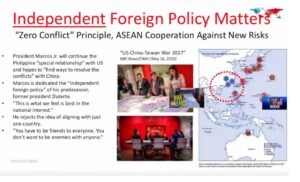
The Marcos administration’s willingness to deepen military engagement with Taiwan cannot be viewed in isolation; it is a calculated extension of Manila’s increasingly assertive alignment with the US-led security architecture in the Indo-Pacific. With American warships routinely transiting the Taiwan Strait and expanded US military access under the Enhanced Defense Cooperation Agreement (EDCA), the Philippines appears to be wagering on a doctrine of strategic ambiguity and deterrence, mirroring Washington’s containment posture against China. However, this gamble carries dangerous consequences. The expanded EDCA sites and intensifying trilateral military drills with the US and Japan point to a clear strategic pivot away from Duterte’s so-called independent and neutral foreign policy, signaling a full embrace of an Indo-Pacific strategy designed to encircle and contain China. By locking itself into this security orbit, the Philippines risks forfeiting its diplomatic leverage and exposing itself as a forward outpost in a brewing superpower showdown, where the cost of miscalculation could be catastrophic.
Manila’s opening to Taiwan could prove to be a diplomatic grenade with the pin already pulled. The Philippine economy remains deeply entangled with China, and Beijing’s capacity for coercive diplomacy, mainly economic and even military, is formidable.
In its pursuit of greater strategic relevance, the Philippines under President Ferdinand Marcos Jr. is recalibrating its defense posture by exploring military cooperation with Taiwan, a bold move that signals a shift away from the cautious neutrality and independent foreign policy of the Duterte era. While Manila frames this initiative as part of broader maritime security objectives and the defense of its claims in the SCS, it introduces a volatile new variable into East Asia’s already fragile security matrix. The move risks deepening tensions with China, intensifying the US-China strategic rivalry, and potentially turning the Philippines into a flash point in the Taiwan Strait crisis. As Manila edges closer to Washington’s containment strategy, the critical question remains: Is the country prepared to bear the consequences of entanglement in one of the region’s most combustible geopolitical flash points and minefields?
Serious consequences
Although the Philippines formally recognizes the PRC and its One-China policy, engaging in military dialogues with Taiwan blurs that commitment and may be viewed by Beijing as an implicit recognition of Taiwan’s autonomous defense posture, which the Chinese leadership could view as a “de facto” challenge to the “One-China policy,” and could be perceived as Manila violating China’s red line. Thus, the Marcos government is treading a tightrope, seeking security cooperation with Taiwan while saying it officially adheres to the One-China policy. This duality invites diplomatic and political backlash from Beijing and economic retaliation.
The most concerning is the potential escalation in the Taiwan Strait and the contested waters of the SCS. Such a move increases the risk of Manila being entangled in a Taiwan contingency. China may perceive any joint exercises or military transits involving the Philippines in the Taiwan Strait as provocations or preparatory steps for regional containment. Rather than just safeguarding the SCS, the Philippines could become a strategic choke point or forward base in a US-China confrontation over Taiwan, exposing the archipelago to preemptive or retaliatory military measures/strikes.
Furthermore, such a move by the current Marcos regime increases the military tensions in the region. China would likely interpret military cooperation with Taiwan as a hostile act, which may lead to a severe deterioration of cross-strait relations and undermine peace and stability in the Taiwan Strait and the Asia-Pacific region. Manila should be guided by the fact that China, many times over, has made it clear that it will take all necessary measures to safeguard national sovereignty and territorial integrity. If any country or force dares to cross the red line on the Taiwan issue, China will surely take resolute countermeasures.
Asean centrality and regional neutrality
Moreover, the Philippines’ potential overt security alignment with Taiwan could fracture Asean’s fragile neutrality consensus regarding Taiwan and SCS disputes. Instead of fostering regional unity, this move isolates the Philippines within Asean, potentially weakening its diplomatic leverage and making it a frontline state in a superpower confrontation.
Undoubtedly, this policy move of the Marcos regime is akin to strategic vulnerability. It lacks a clear national consensus and could drag the Philippines into a potential hot war or military escalation in the Taiwan Strait that is not of its making. It also increases dependence on the US security umbrella without guaranteeing reciprocal protection beyond ambiguous treaty language. Filipinos should note that the Mutual Defense Treaty does not explicitly cover a Taiwan contingency. In the event of a larger war involving China and the US over Taiwan, the Philippines may find itself abandoned or sacrificed.
Conclusion
In retrospect, the Marcos Jr. administration’s willingness to deepen military ties with Taiwan is geopolitically bold but fraught with strategic peril and laced with geopolitical recklessness. While intended to bolster deterrence in the SCS, this move dangerously flirts with the red line of China, placing the Philippines at the intersection of great-power confrontation. Likewise, these expose the country to a diplomatic firestorm with China, punitive economic countermeasures that jeopardize critical trade and investment flows, and the real risk of being caught in a Taiwan Strait conflict. Worse, it positions the Philippines as a potential frontline state in a conflict not of its own making. Rather than safeguarding national interest and security, this gambit may ultimately erode the stability and sovereignty it claims to defend.
Source: The Manila Times
https://www.manilatimes.net/2025/05/03/opinion/columns/manilas-risky-tango-with-taipei-strategic-calculus-or-diplomatic-provocation/2104758