
In his recent statement based on his interview with the Indian news website Firstpost in New Delhi,
“No way PH can stay out of China‑Taiwan Tussle,” Marcos Jr. just declared that the Philippines cannot remain neutral if a war/military conflict breaks out in the Taiwan Strait. He justified it due to proximity and deep ties with Taiwan because many Filipino nationals reside there. He emphasized that Manila would inevitably be drawn into such a conflict, especially to evacuate Filipino citizens from Taiwan.
Taiwan is geographically very close to the northern Philippines, and thousands of Filipinos live and work there. Marcos emphasizes that Manila must prepare for evacuation and security measures if tensions escalate.
Under Marcos Jr.’s presidency, the Philippines has significantly strengthened its military alliance with the U.S. and the Western alliance. The Enhanced Defense Cooperation Agreement (EDCA) was expanded to include additional sites in northern Luzon facing Taiwan. The Marcos Jr. administration has secretly expanded cooperation with Taiwan, including intelligence sharing and coast guard coordination, among others.
Implications
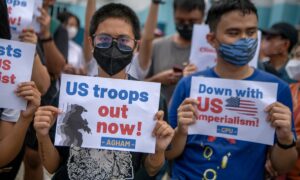
So, there you have it! Marcos Jr. has finally said the quiet part out loud. His recent declaration conveniently strips away any remaining illusion of Philippine neutrality on Taiwan, essentially locking the country into the United States’ Indo-Pacific playbook and strategy. Never mind that we have no diplomatic ties to Taiwan, when we’ve got EDCA sites facing its shoreline and a commander-in-chief acting like the Philippines is the 51st U.S. state. This is what you call foreign policy schizophrenia.
Marcos Jr.’s recent statement crystallizes and manifests his administration’s position and foreign policy, implying that neutrality on Taiwan is no longer viable or an option for his administration. His statement essentially aligns the country fully with the U.S. against China over Taiwan.
Hence, the Philippines is firmly squeezed in the middle of a great-power rivalry showdown it neither started nor can survive. If a war or a military conflict explodes over Taiwan, the Philippines will be dragged in, front-row and center, armed with talking points and borrowed missiles. Indeed, this is a shining example of how the commander-in-chief placed the country in a position to face an existential catastrophe. My goodness!
What’s WRONG with Marcos Jr.’s Logic and Mindset:
The logic and mindset of Marcos Jr. in declaring that there is “no way the Philippines can stay out of the China-Taiwan tussle” reveal several troubling flaws, strategically and diplomatically. While the desire to protect Filipino citizens in Taiwan is legitimate in case a military conflict breaks out in the Taiwan Strait, his framing prematurely commits the Philippines to a potential war/military conflict that is neither of its choosing nor in its interest and benefit.
By asserting that the Philippines cannot stay out of a “China-Taiwan tussle/conflict, Marcos Jr. effectively surrenders agency and neutrality even before any war or military conflict has begun. This is what you call Preemptive Entrapment into a Conflict, – a fatalistic and defeatist logic. This signals to China that the Philippines is a pre-committed party to any eventualities in the Taiwan Strait, regardless of how events unfold. It invites China to treat the Philippines as an enemy combatant from the outset, potentially making EDCA sites or northern Philippine provinces first-strike targets in any event that a military conflict breaks out in the Taiwan Strait.
A more prudent and sovereign stance would be to stay out of the Taiwan issue, as it is an internal affair of China and its RED.. RED LINE.. This approach would involve maintaining neutrality as much as possible while preparing contingency plans for Filipino evacuation, rather than loudly and willingly broadcasting the Philippine entanglement in this very sensitive geopolitical issue.
Marcos argues that geographic closeness to Taiwan makes Philippine involvement inevitable. This is A DANGEROUS OVERSIMPLIFICATION, and it is A FLAWED ASSUMPTION that proximity equals automatic involvement.
Look at Vietnam. It is close to the South China Sea flashpoints as well, and its location is geo-strategically essential too, yet it maintains strategic independence.
Proximity does not equate to participation or involvement, unless a country’s leadership chooses to make itself a staging ground for foreign powers and its country a forward base and a pawn.
The Philippines is NOT Taiwan, nor is it a formal U.S. treaty partner in defending Taiwan. So why is Marcos Jr. volunteering the country as a frontline pawn?
Most important of all, Marcos Jr.’s recent statement clearly shows that his foreign policy is Reactive, Not Strategic, and lacks a Long-Term National Interest Calculation and Long-Term Vision for Philippine Strategic Autonomy and the Preservation of the country’s SOVEREIGNTY.
Has Marcos Jr. considered the economic, energy, and diplomatic blowback if China treats the Philippines as an enemy?
Has there been a proper cost-benefit analysis of what being “involved” in a Taiwan Strait war would mean, economically, socially, and militarily, and if in any case the country will survive?
Marcos Jr.’s recent statement clearly stinks more of performative alignment to appease Washington than a cold, calculated defense of Philippine sovereignty.
Yes, indeed, ensuring the safety of Filipinos in Taiwan is valid, but this should not be the basis for a wholesale shift in geopolitical posture towards the military architecture of the U.S. in the Indo-Pacific region.
Evacuation is a humanitarian and logistical issue, not a justification to position the Philippines as a forward operating base of the United States in its great-power strategic rivalry or a potential/possible war with China. There are quieter, more pragmatic ways to prepare and enhance evacuation protocols and services without telegraphing military intentions.
Moreover, Marcos Jr.’s recent statement just provoked a regional security dilemma. It provided China with more justifications, reasons, and incentives to strengthen its positions in the South China Sea and potentially retaliate against the expanded EDCA.
The security dilemma is that one side’s “defensive preparation” is seen as offensive posturing by the other, leading to spiraling tensions that increase the risk of miscalculation or accidental war.
Conclusion:
Marcos Jr.’s logic amounts to preemptively surrendering the Philippines’ neutrality and sovereignty under the illusion of realism. It’s a strategic surrender disguised as realism. It positions the country as a forward base and pawn in the U.S. Indo-Pacific strategy, rather than as an autonomous and independent country with a carefully calibrated foreign policy.
What’s truly dangerous is that Marcos couches and puts this fatalistic entrapment in the language of inevitability, as if war is a weather pattern one can only brace for. In truth, NEUTRALITY IS A CHOICE, DIPLOMACY IS A TOOL, and SOVEREIGNTY IS NOT DEFINED by PROXIMITY TO CONFLICT BUT BY LEADERSHIP THAT ACTS IN THE NATIONAL INTEREST, NOT someone else’s.