

BY any measure, the International Criminal Court (ICC) rejected the jurisdiction challenge, despite the Philippines’ withdrawal from the ICC in 2018. The court ruled that it still has jurisdiction because crimes occurred while the Philippines was a member, a critical legal precedent. Confirming charges against former Philippine president Rodrigo Duterte is historic. But history, as always, depends on who writes it and for what purpose.
Strip away the moral theater and legal formalism, and a harder, more uncomfortable question emerges: “Is the ICC dispensing justice or staging relevance?”
Because what we are witnessing may not just be the prosecution of a former head of state. It may well be the institutional self-preservation of a court that has long struggled with legitimacy, enforcement and geopolitical irrelevance.
For years, the ICC has faced an existential crisis. Major powers, China, the United States and Russia, either never joined or openly rejected it. African states have accused it of selective justice. Enforcement remains weak, reliant on state cooperation that is often absent when most needed.
Against this backdrop, the Duterte case arrives not merely as a legal proceeding but as a “lifeline.”
A former president. A controversial antidrug campaign. Thousands of alleged deaths. A politically polarized domestic landscape. And, crucially, a state that once recognized the ICC’s jurisdiction.
For the ICC, this is not just a case. It is a domestically politically motivated case trophy. A demonstration that it can still matter. It can still prosecute. It can still project authority beyond Europe and Africa into Southeast Asia. In institutional terms, the incentives are obvious: This is a case too valuable to fail.
Sovereignty undone
by legal elasticity
At the heart of the controversy lies a deeply troubling implication: The ICC’s interpretation of jurisdiction effectively hollows out the sovereign right of withdrawal.
The Philippines formally withdrew from the Rome Statute in 2019. On paper, that should have marked the end of its obligations, at least prospectively. But the ICC’s ruling stretches its jurisdiction backward and forward, creating a legal paradox.
Under this logic, if a prosecutor initiates, or even merely contemplates, a preliminary examination before withdrawal takes effect, the state remains bound indefinitely. Let us be blunt about what this means.
A country that withdraws today could still find itself compelled to cooperate with the ICC in 10 to 20 years from now, so long as a preliminary process had been triggered before or shortly after withdrawal. The timeline becomes elastic. The obligation becomes perpetual. This is not just legal interpretation. This is a jurisdictional expansion by procedural timing. And the implication is stark: Withdrawal is no longer an exit. It is merely a delay.
Such a framework effectively transforms the ICC into a body whose reach extends far beyond formal membership. Sovereignty, in this context, becomes conditional, subject not to the will of states but to the administrative sequencing of a prosecutor’s docket. This is not a trivial institutional design issue. It goes to the core of international law’s legitimacy. When prosecutorial discretion begins to override sovereign decision-making, the system risks drifting from consensual legal order to something more coercive, yet without the democratic or political accountability that normally accompanies coercive authority.
Article 59
Equally significant is what the ICC did “not” rule on. Notably, the defense did not raise the issue of noncompliance with Article 59 of the Rome Statute, provisions governing arrest procedures and the rights of the accused within domestic jurisdictions.
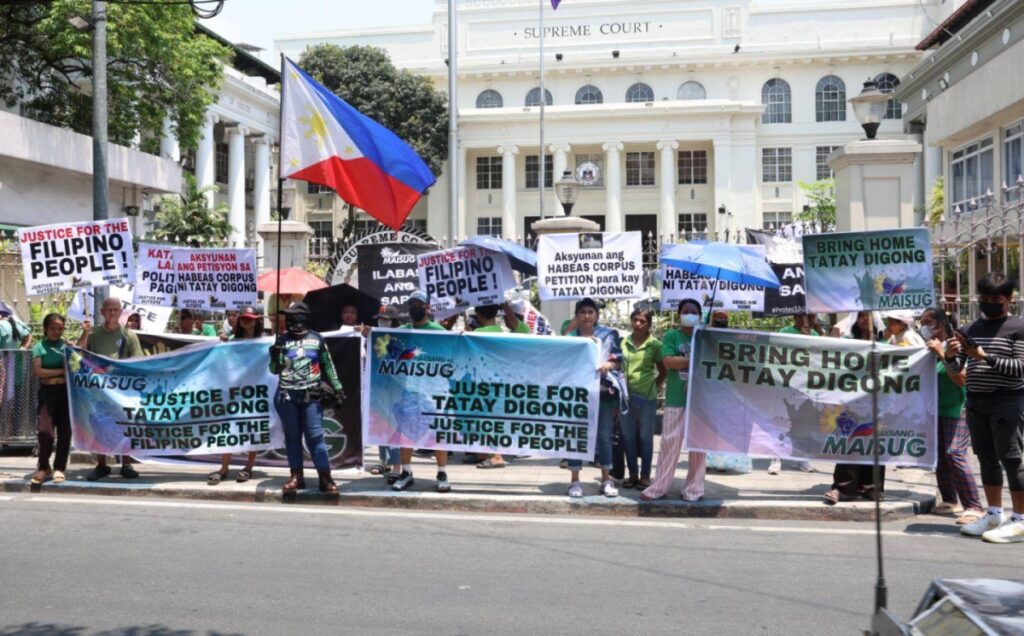
This omission is not a minor technicality. It is a strategic gamble with far-reaching implications. Because the absence of a ruling on Article 59 leaves open a critical legal pathway, one that now shifts from The Hague to Manila, specifically to the Supreme Court of the Philippines.
If the Supreme Court were to determine that Duterte’s transfer constituted extraordinary rendition, that is, an unlawful or irregular surrender outside proper legal channels, it would introduce a new factual and legal basis that could be invoked before the ICC on appeal. In other words, the battlefield is no longer confined to international law. It now straddles domestic constitutional adjudication.
The defense’s gamble is clear: If the Supreme Court rules in their favor, the ICC’s jurisdictional legitimacy is shaken; the appeal gains new ground. If the Supreme Court rules against them, ICC jurisdiction becomes effectively settled; only the merits of the case remain. This is high-stakes lawfare. And it underscores a deeper truth: The ICC’s authority is not self-executing. It is mediated, sometimes contested, through domestic legal systems.
Justice or jurisdictional opportunism?
None of this is to dismiss the gravity of the allegations. The deaths associated with the drug war demand scrutiny, accountability and justice. But justice cannot be detached from the integrity of the process that seeks to deliver it.
The problem arises when the process itself becomes politicized or instrumentalized. The ICC, in pursuing Duterte, may indeed be upholding international criminal law. But it is also, whether intentionally or not, advancing a model of jurisdiction that weakens the finality of state withdrawal, expands prosecutorial discretion beyond reasonable temporal limits and relies on selective enforcement shaped by geopolitical feasibility and domestic politics. This is a dangerous combination. Because when international justice appears selective, elastic and opportunistic, it risks losing the very legitimacy it seeks to assert.
Let us not pretend this case exists in a vacuum. The Philippines sits at the crossroads of great power competition. Its legal, political and security decisions are scrutinized not only in The Hague but in Washington, Beijing and beyond. The ICC’s actions, therefore, carry geopolitical weight. They shape narratives about sovereignty, external intervention and the limits of international law.
For many in the Global South, the Duterte case will not simply be read as a legal proceeding. It will be interpreted as part of a broader pattern: institutions rooted in Western legal traditions asserting authority over states with complex domestic realities, often selectively, often unevenly. This perception, whether fair or not, matters. Because international law does not operate in a vacuum. It operates in a world of power, perception and politics.
The long-term consequences of this ruling extend far beyond Duterte. This is not merely a legal development. It is a structural shift in how international criminal jurisdiction is understood. And it raises a fundamental question: At what point does international justice cease to be consensual and begin to resemble imposed authority or coercion? Between justice and overreach.
Conclusion
The Duterte case may well proceed to trial. Evidence will be presented. Arguments will be tested. A judgment will eventually be rendered. But the real verdict on the ICC itself is already being formed.
Is this a court delivering justice without fear or favor? Or is it an institution, facing declining relevance, seizing upon a high-profile case to reassert its authority, stretching legal principles in the process?
The answer is not yet settled. But one thing is clear: If international justice is to endure, it must be seen not only as “powerful” but as “principled, consistent and restrained.” Without that, even the most high-profile prosecutions risk becoming less about justice and more about institutional survival.
Source: The Manila Times
https://www.manilatimes.net/2026/04/25/opinion/columns/how-the-rodrigo-duterte-case-became-the-iccs-institutional-survival-strategy/2328208