
According to the latest report from the World Bank (WB), the Philippines has been reclassified as an upper-middle-income economy. Really??? Seriously?
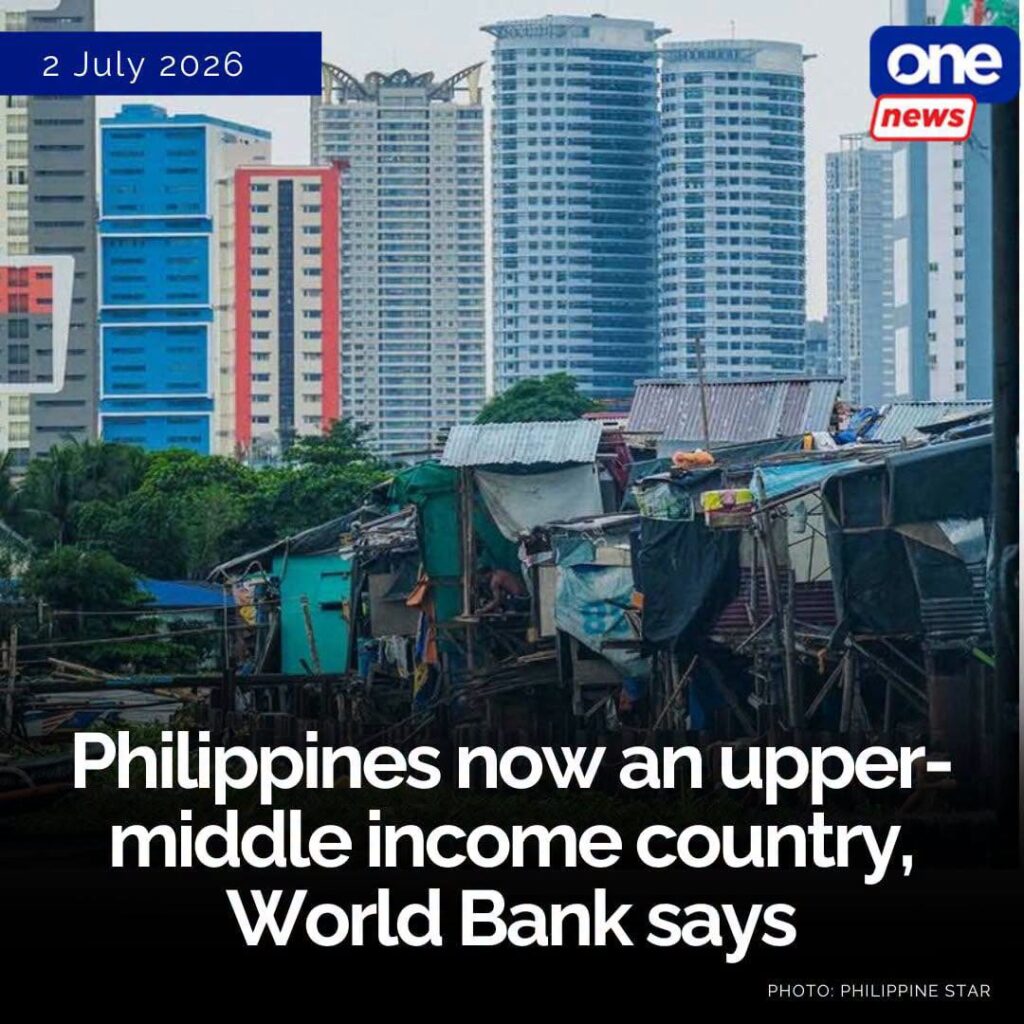
Folks, look at the image below. It shows a lot. The image is very striking because it places the headline against the visual contradiction of urban high-rises beside informal settlements. Let me share my perspective on this, given that, to some extent, I have an economic background: what’s the point of having a Ph.D. in economics if I cannot at least make sense of all these?
The Factual Part: Yes, the classification is real. The World Bank’s current income grouping places the Philippines among upper-middle-income economies, defined for FY2027 as those with GNI per capita between $4,636 and $14,375, calculated using the World Bank Atlas method. The Philippines is listed under that upper-middle-income group.
But here is the essential caveat: this is a statistical classification of the national economy, not a declaration that Filipinos are now living upper-middle-class lives. The World Bank itself cautions that “no single measure can fully capture the complexity of a country’s development.”
Where The Public Can Be Misled: The danger is not the World Bank classification itself. The danger is the political and media packaging around it.
A country can cross an income threshold while millions of its citizens remain poor, underpaid, vulnerable, indebted, food-insecure, or one emergency away from collapse. That is the Philippine contradiction: the macro number has moved up, but the household reality has not moved up at the same pace.
The phrase “upper-middle-income country” sounds grand. But it DOES NOT MEAN:
- Most Filipinos are now middle class.
- Poverty is no longer serious
- Wages are now decent
- The economy is broadly healthy
What this actually means is:
- No. It is based on average national income per person
- No. Millions remain poor or vulnerable
- No. Underemployment and weak job quality remain major problems.
- Not necessarily. Growth, prices, debt, jobs, and inequality must also be examined.
The Real Economic Picture Is More Complicated: The World Bank’s own June 2026 report gives the more sober picture. It says Philippine poverty fell to 15.5% in 2023 from 23.5% in 2015, but also warns that progress is far from secure. Nearly 28% of Filipinos are vulnerable or at risk of falling back into poverty, while the secure middle class is only about a quarter of the population and has barely grown since 2018.
That is the real story: many Filipinos are not deeply poor by official statistics, but they are not economically secure either. They are suspended in a fragile zone, above the poverty line, but below genuine comfort.
The PSA’s official poverty data also shows the gravity of the situation. In 2023, the national poverty threshold for a family of five was only ₱13,873 per month, yet 17.54 million Filipinos were still considered unable to meet basic food and non-food needs. This threshold itself is very low, so being “not poor” by official definition does not automatically mean living decently.
Inflation Exposes the Weakness of the Headline: If the country is supposedly “upper-middle income,” why do ordinary families still feel squeezed? Because prices are punishing households faster than income security improves.
In May 2026, headline inflation was still 6.8%, with food inflation at 5.8%. Rice inflation alone was 15.6%, according to PSA. For the bottom 30% of households by income, the situation was worse: inflation was 8.4%, and food inflation reached 8.9%, driven heavily by rice and cereals.
That means the poorest households are experiencing a very different economy from the one celebrated in the headline. For them, “upper-middle income” may sound less like a national achievement and more like a cruel joke at the grocery store.
Jobs Exist, But Job Quality Remains The Wound: The labor market also complicates the celebration. In April 2026, unemployment was 4.7%, but underemployment was 15.2%, meaning 7.41 million employed Filipinos still wanted more hours, another job, or better work.
That is critical. A person can be counted as employed yet still be struggling economically. The Philippine problem is not only joblessness. It is also low-quality employment, insecure work, low wages, informal labor, and survival-level income.
So yes, the country may have advanced in classification, but many workers remain stuck in a daily arithmetic of rent, rice, transport, electricity, medicine, tuition, and debt.
Growth Is Also Slowing: Another reason to be cautious: the economy is not exactly roaring. PSA reported that Philippine GDP grew only 2.8% in the first quarter of 2026, with agriculture and industry both declining year-on-year. Gross capital formation also declined by 3.3%.
That weakens the triumphalist narrative. A country can receive a better income classification due to past gains and still face a current economic slowdown, inflationary pressures, and weak investment.
The Visual Irony of the Image: The One News graphic is actually powerful because the picture itself almost contradicts the headline. In the background: towers, glass, capital, real estate, urban wealth. In the foreground: shanties, precarity, informal shelter, social exclusion.
That image says what the headline does not: the Philippines has islands of prosperity beside oceans of deprivation.
It is a perfect metaphor for the country’s economic structure: glittering growth above, fragile lives below.
Conclusion: So, is this a misrepresentation?
The World Bank classification is not false. But using it to imply that the Filipino people are now broadly prosperous is misleading.
The Philippines may now be upper-middle-income by classification, but it is not yet an upper-middle-class society in lived reality. The former is a statistical milestone. The latter requires decent wages, affordable food, secure jobs, quality public services, resilient households, lower inequality, and a government capable of turning growth into genuine human development.
The most honest headline should be: Philippines Enters Upper-Middle-Income Rank — But Millions of Filipinos Still Live in Lower-Income Reality
This is not a moment for empty self-congratulation. It is a moment for serious reckoning. A country does not become truly developed when its averages improve. It becomes truly developed when ordinary people can finally breathe.
Now, will BBM use this “upper-middle income” tag as a shiny prop in his upcoming SONA (State of the Nation Address)? Of course!
Expect the usual grandstanding: big words, polished applause lines, and a triumphant declaration that the Philippines has “arrived.” But let’s be clear: a World Bank classification is not a grocery receipt, not a payslip, not a hospital bill, not a tuition payment, and certainly not proof that ordinary Filipinos are living better.
You cannot feed a family with a statistical upgrade. You cannot pay rent with a headline. You cannot cure hunger with a PowerPoint slide.
If Malacañang uses this as a trophy, then it must also explain why millions of Filipinos still struggle with high prices, low wages, insecure jobs, poor services, and a daily cost of living that feels anything but “upper-middle income.”
Upper-middle income on paper. Lower-income reality on the ground.
So yes, expect this to be paraded in the SONA like a political medal. But for many Filipinos, the real State of the Nation is still written in unpaid bills, skipped meals, crowded hospitals, broken classrooms, and wages that die before the month ends. That is the truth behind the headline.
Duh!