
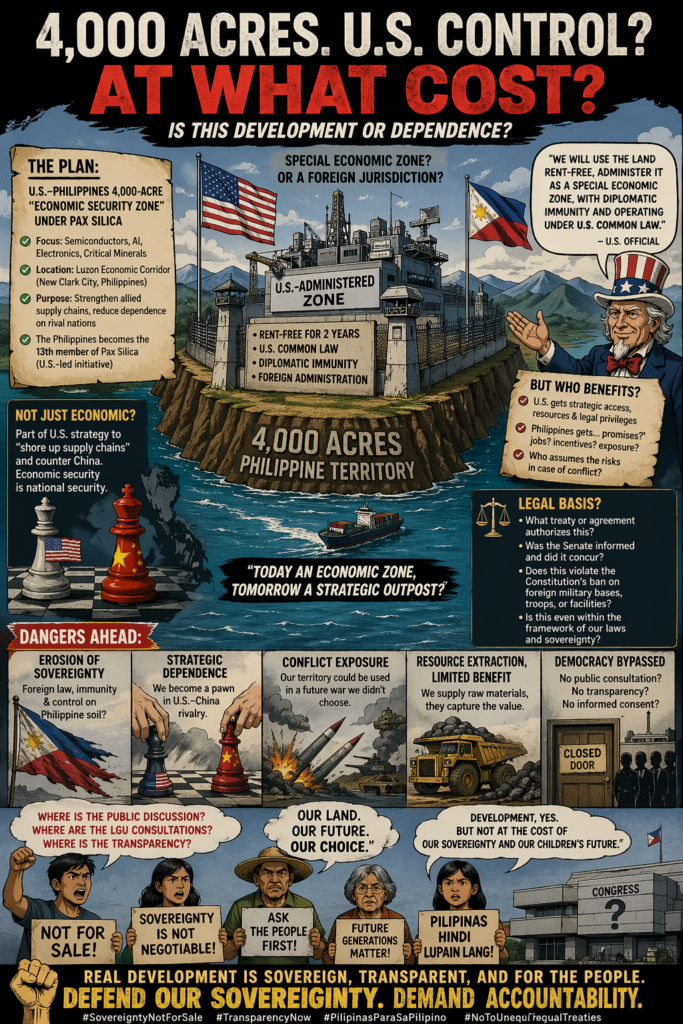
U.S.–Philippines 4,000-acre Economic Security Zone under Pax Silica is being marketed as an economic project, but the available record already shows that it is NOT merely economic. The official U.S. line is that the zone is meant to shore up supply chains for semiconductors, electronics, and critical minerals through Pax Silica. Reuters also reported that the initiative is part of Washington’s strategy to reduce dependence on “rival nations,” while situating the hub in New Clark City, on land that was once part of a U.S. military reservation.
That matters because once a foreign-led project is explicitly tied to economic security, allied manufacturing, and strategic decoupling from China, it stops being an ordinary investment story. It becomes part of the wider architecture of great-power competition. In other words, this is geo-economics-politics wearing the clothes of industrial policy.
The Sovereignty Problem: The biggest issue is not the acreage. It is the juridical logic being described around it. Reports attributed to Jacob Helberg say the United States would occupy the site rent-free for two years, on a renewable basis, administer it as a special economic zone, and that the hub would enjoy diplomatic-immunity-like protections and operate under U.S. common law. Those details do NOT appear in the official U.S. State Department announcement that was publicly circulated, which speaks in broad terms about an “Economic Security Zone” and allied manufacturing but does not publicly spell out the legal instrument authorizing diplomatic immunity or a U.S.-law carveout on Philippine soil. THIS GAP IS ALARMING!
If a foreign power is to exercise a privileged administrative regime over 4,000 acres of Philippine territory, the first question is simple: BY WHAT LEGAL AUTHORITY?
The Philippine Constitution is NOT vague on first principles. It says sovereignty resides in the people, mandates an independent foreign policy, and requires full public disclosure of transactions involving public interest. It also says NO treaty or international agreement is valid and effective without Senate concurrence.
And if the arrangement, in substance, begins to resemble a foreign facility with special immunities and long-term foreign control, Article XVIII, Section 25 becomes even more relevant: foreign military bases, troops, or facilities are not allowed except under a treaty duly concurred in by the Senate and recognized as a treaty by the other contracting state. This is why the whole affair cannot be brushed aside with the LAZY LINE line that it is “just an economic zone.”
EDCA Parallels Are Hard to Ignore: There is a clear EDCA-style pattern here, even if the form differs. With EDCA, the legal defense was that it implemented preexisting treaties. The Supreme Court accepted that logic in a military context because the government argued it flowed from the VFA (Visiting Forces Agreement) and MDT (Mutual Defense Treaty). At the same time, the Court reiterated the constitutional baseline: the general rule is that foreign bases, troops, and facilities are not permitted unless authorized by treaty.
Now look at this new case. It is not being presented as a military facility, but it is being tied to:
Allied Manufacturing, Critical minerals, Semiconductors, AI, Supply-Chain Resilience, and Strategic Decoupling from China.
That means the zone may function as a DUAL-USE STRATEGIC PLATFORM even if it is not formally labeled a base. Modern competition does not always begin with barracks and runways. It begins with logistics, data infrastructure, industrial control, minerals processing, legal enclaves, and secured production nodes. That is exactly why the distinction between “economic” and “strategic” is no longer clean.
So, are these really economic projects, or preparation for a future conflict with China? The prudent answer is: they are economic projects designed within a conflict-contingency framework. There is no public proof that this zone is a war base. But there is already ample evidence that it is part of a U.S. strategic effort to harden allied supply chains against China and to secure key inputs for defense-relevant and high-technology industries. That is NOT neutral commerce. That is strategic preparation by other means.
Why is this Dangerous for Philippine Strategic Autonomy?: The long-term danger is not just legal embarrassment. It is a STRUCTURAL DEPENDENCE. If the Philippines turns over land, legal privileges, and policy space in order to insert itself into a U.S.-designed strategic production chain, then the country risks becoming:
- a forward operating node for allied supply-chain competition,
- a critical-minerals feeder for other countries’ industrial priorities,
- and a target for retaliation in any future U.S.-China crisis.
That is the REAL SOVEREIGNTY COST. Not necessarily the formal loss of title, but the EROSION OF DECISION-MAKING INDEPENDENCE!
A state loses strategic autonomy not only when foreign troops arrive, but when its territory, industry, law, and diplomacy are reorganized around another power’s threat perceptions. Once that happens, domestic policy becomes externally conditioned. The country no longer asks, “What industrial strategy best serves Filipino development?” It asks, “What role has been assigned to us in another state’s geopolitical design?”
THIS IS NOT SOVEREIGNTY! THIS IS MANAGED ALIGNMENT with the U.S.
Is there a legal Basis for U.S. Common Law and Diplomatic Immunity Here?: Based on the public sources now available, no clear public legal basis has been shown. That is the key point. The Philippine Special Economic Zone Act does allow special economic zones, but explicitly “within the framework of the Constitution and the national sovereignty and territorial integrity of the Philippines.” In other words, Philippine ecozones are still Philippine legal space. The available law does not, on its face, suggest that an ecozone can simply be converted into territory administered under foreign common law with diplomatic-style immunity.
So, unless the government produces a treaty, a statute, or some constitutionally defensible instrument explaining the scope of immunity, the applicable law, the land tenure, the regulatory powers, the tax and customs treatment, labor jurisdiction, criminal jurisdiction, environmental oversight, and the role of the Philippine courts, then the arrangement looks legally fragile at best and constitutionally suspect at worst.
Was this a Fair Arrangement?: On the face of it, what has been reported is hard to call fair. A rent-free foreign-administered zone with immunity-style protections on Philippine soil sounds less like a balanced industrial partnership and more like an ASYMMETRICAL CONCESSION. If the Philippines is contributing land, location, labor, mineral access, and strategic exposure, while the United States gets legal insulation and supply-chain leverage, then the distribution of gains and risks is plainly uneven.
The Philippines appears to be assuming the political and geopolitical risk up front, while the precise economic returns remain vague. Reuters noted that even BCDA was still assessing whether contiguous land was available and that details still had to be finalized. That suggests the geopolitical announcement came before the public was given a full domestic legal and developmental accounting.
Why No Public Discussion?: That question is one of the most serious. If this is a transaction involving public land, foreign privileges, strategic infrastructure, and possible legal exemptions, then the Filipino public should have been informed in advance, not after the announcement cycle. The Constitution itself adopts a policy of full public disclosure for transactions involving public interest. It also protects local government autonomy and broader public participation in decision-making. So the silence is not a small procedural flaw. It is a DEMOCRATIC DEFECT!
NO meaningful public debate, NO visible Senate scrutiny, no clearly published legal text, no serious local consultation, and yet the country is suddenly told that 4,000 acres may become a foreign-administered “economic security zone” under an unprecedented arrangement. That is exactly how strategic dependence is normalized: announce first, explain later, consult never.
Why are leaders giving in?: Because the ruling logic today is that alignment with Washington is being sold as a source of security. The promise is familiar: investments, technology, jobs, strategic relevance, and proximity to the world’s leading power. For elites, this is seductive. It offers diplomatic favor, security signaling, and the appearance of industrial upgrading. But the hidden cost is that the Philippines may end up trading away policy space, legal clarity, and geopolitical flexibility for a project whose developmental gains remain uncertain and whose strategic liabilities are obvious. In plain language, our leaders may be mistaking being used for being upgraded.
Conclusion:
This is NOT development! This is a STRATEGIC SUBMISSION dressed up as an investment.
A so-called “economic zone” that places Philippine land under foreign control, shields it with immunity, and aligns it with another country’s geopolitical agenda is NOT progress; it is a QUIET EROSION OF SOVEREIGNTY!
What is being built is not just an industrial hub, but a forward node in a great-power rivalry, where Filipinos bear the risks while others define the rules.
If left unchecked, this sets a dangerous precedent:
👉 Philippine territory can be carved out,
👉 Philippine laws can be bypassed,
👉 and Philippine interests can be subordinated—
all without transparency, public consent, or constitutional clarity.
This project should not be treated as a routine investment story. It is a SOVEREIGNTY QUESTION, a CONSTITUTIONAL QUESTION, and a STRATEGIC AUTONOMY. If the reported terms are accurate, then the danger is profound:
- Philippine territory could be placed under an unprecedented regime of foreign privilege.
- The country could be woven deeper into U.S. conflict-contingency planning against China.
- Legal and political accountability could be weakened by immunity and opaque governance.
- The Philippines could absorb the exposure, while the strategic logic is authored elsewhere.
Sovereignty is NOT negotiable!
The Filipino people must demand answers. NOW!