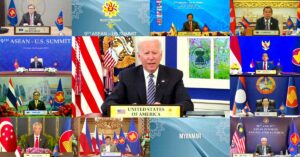

The signing of the China–ASEAN Free Trade Area (CAFTA) 3.0 Protocol during the 2025 Kuala Lumpur ASEAN Summit marks a historic step in the region’s economic evolution. What began in 2002 as a modest effort to lower tariffs has now matured into one of the world’s most dynamic trade architectures, shaping the next phase of growth, digital transformation, and geopolitical balance in the Indo-Pacific.
Since its full implementation in 2010, CAFTA has transformed ASEAN–China economic relations. Bilateral trade has skyrocketed from a modest USD 54 billion in 2002 to USD 982.3 billion in 2024, a seventeen-fold increase. China has been ASEAN’s largest trading partner for sixteen consecutive years, while ASEAN has been China’s top trading partner for the past five. CAFTA 3.0, therefore, is not just an update; it is a strategic redefinition of how the region will compete, cooperate, and coexist amid global trade turbulence.
At its core, the upgraded agreement expands far beyond tariff reduction. It integrates digital economy, green transition, and supply-chain resilience—the three pillars that will define 21st-century competitiveness. By harmonizing digital trade rules, promoting e-commerce, and supporting cross-border payment systems, CAFTA 3.0 paves the way for millions of ASEAN micro, small, and medium enterprises (MSMEs) to participate in regional trade. At the same time, its emphasis on low-carbon logistics, renewable energy, and sustainable agriculture aligns with global climate imperatives and China’s own green-tech transformation.
Amid vulnerabilities in global production networks, CAFTA 3.0 responds by embedding supply-chain security mechanisms to ensure that goods, raw materials, and technologies continue to flow, even amid geopolitical uncertainty. It also strengthens the service and investment chapters, enabling greater professional mobility, innovation, collaboration, and intellectual property protection, crucial for advancing ASEAN economies up the value chain from resource suppliers to innovation partners.
For the Philippines, this is an opportunity for preferential access to China’s vast market while attracting green and digital investments that can accelerate industrial upgrading. Sectors such as electronics, agri-tech, and renewable energy stand to benefit from new financing and technology transfers. At a time when Manila’s relations with Beijing remain strained over maritime disputes, CAFTA 3.0 offers a dual-track strategy that leverages economic engagement while maintaining diplomatic flexibility. Moreover, Philippine MSMEs could find new opportunities in e-commerce, digital logistics networks, and access to ASEAN and China’s 1.4-billion-strong market under CAFTA 3.0.
Conclusion
In a world tilting toward protectionism and economic fragmentation, CAFTA 3.0 sends a different message: integration is still the region’s best defense. It reinforces ASEAN’s centrality, reaffirms economic pragmatism as the region’s unifying principle, and positions Southeast Asia as a stabilizing anchor in a volatile global economy.
For ASEAN, this is a bet on the future. For China, it consolidates its economic leadership. And for the Philippines, it is both an opportunity and a challenge to harness the promise of regional interdependence while ensuring that growth translates into genuine national competitiveness.
Source: The Lobbyist
https://www.thelobbyist.biz/perspectives/article-details/prime%20insight/cafta-30-aseans-strategic-leap-in-an-era-of-trade-turbulence