

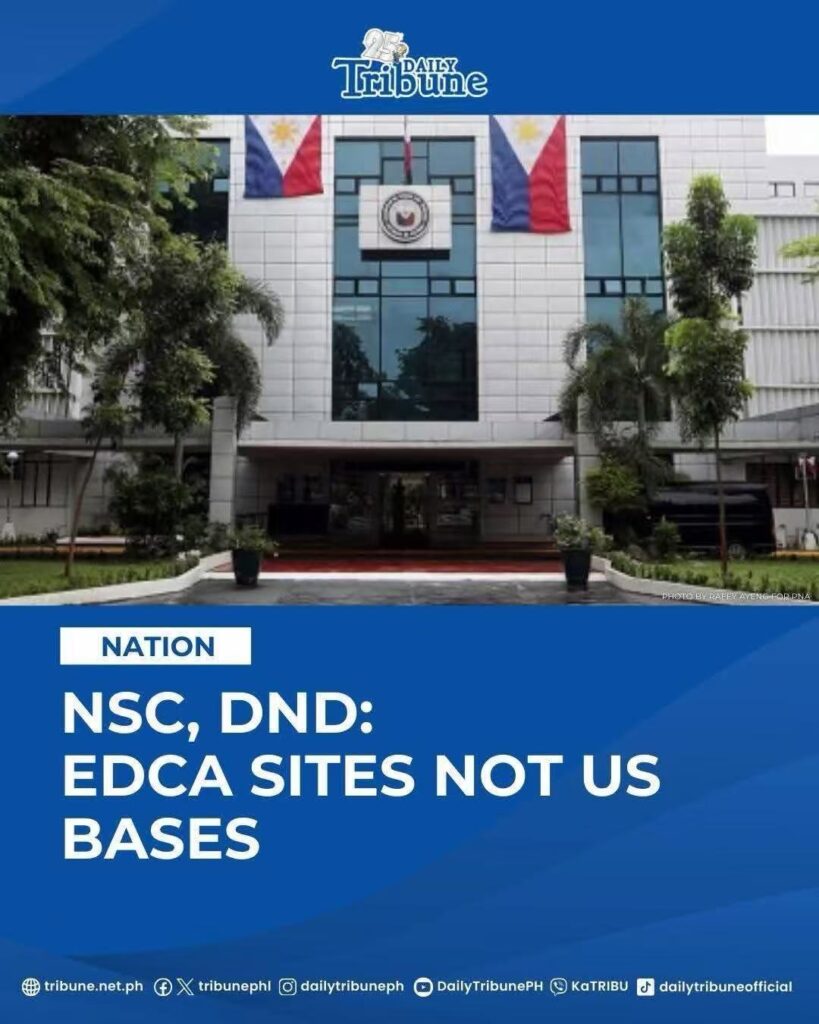
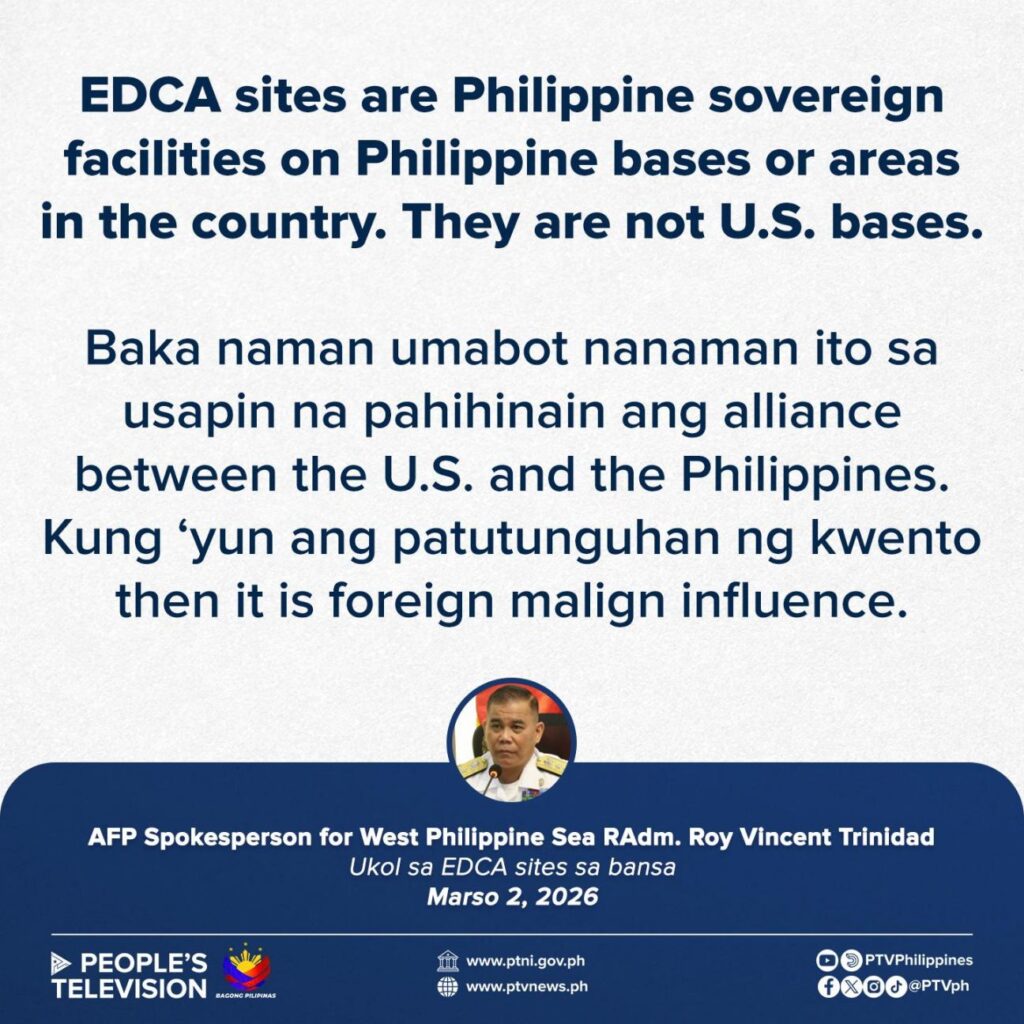
What? Seriously?? Is this a joke?? Because it’s NOT funny at all!
“Not U.S. bases” is a semantic escape hatch, NOT a security reality. Saying EDCA sites are “not U.S. bases” is technically lawyerable, but STRATEGICALLY MISLEADING! It’s the same trick as saying: “It’s not a gun—it’s a firearm platform.” The label doesn’t change what they do and what they truly are – U.S. MILITARY BASES!
First, if these EDCA sites walk like military bases, then they function like military bases. Under EDCA, the U.S. gets dedicated access to “agreed locations,” including the ability to:
- Rotate U.S. troops in and out
- Preposition U.S. military equipment, assets, and supplies
- Build/upgrade facilities
- Use the site for military logistics and operations
You can call it a “shared facilities” all day, but OPERATIONALLY, in any eventuality, they become and are forward staging nodes for the U.S. That’s base-like behavior, base-like utility, and base-like consequences.
Second, the real issue is twofold: who controls the EDCA sites and, most importantly, their use. The public is being invited to fixate on a legal technicality:
- “The Philippines owns it.”
- “The Philippine flag flies there.”
- “It’s inside AFP camps.”
Fine, but in a crisis, the question is NOT whose title is on the property. The question is: Who can use it, for what, and in whose war does it become relevant?
If a facility is usable for:
- refueling,
- storage,
- surveillance,
- rapid deployment,
- and interoperability for a foreign power…
…then it’s a military asset in the war calculus, whether or not you stamp “U.S. base” on the gate. So, not U.S. bases,” they say, but fully usable by U.S. forces? Seriously?? Who are you kidding???
Third, what the DOD (Defense Department) and the NSC (National Security Council) are saying is NOT reassurance, IT’S DAMAGE CONTROL!
This statement pops up precisely because people see the obvious risk:
- EDCA sites can be interpreted by U.S. adversaries or perceived enemies as U.S.-enabling infrastructure
- which means the Philippines is a credible U.S. “platform or forward base” in a broader, escalated, and expanded conflict scenario
So this line—“not U.S. bases”—functions as public-relations anesthesia or deodorant, and it’s like saying: Don’t worry, we changed the vocabulary, so the danger disappeared.
This is a spin! This is evasion! Not reassurance for the Filipino people.
The DND and NSC should take note that the Filipino public isn’t asking for word games. We are asking for accountability and transparency. The Marcos Jr. government should answer the following hard questions:
- What exact missions are these sites designed to support?
- What U.S. assets can be prepositioned (and where), and what have been prepositioned already for transparency’s sake?
- Why are there deployments of missile systems on Philippine soil, such as the Typhoon missile system? What are these for? Philippine defense to what? For whom? For whose purposes?
- What are the red lines on offensive use?
- In the event of war or military conflict, who controls these EDCA sites (U.S. military bases), and what are the assurances that they will not be used as a launching pad, or be an operational base of the Americans, putting the country on a dangerous path and compromising its situation?
- What enforcement mechanism exists when the alliance dynamic pressures Manila to comply?
- If a regional war erupts, what contingency plan is in place for civilians near these sites?
Folks, EDCA sites may not be “U.S. bases” by label, but they are U.S.-usable basing infrastructure by function. And in geopolitics, function beats branding every time.
Call it what you want, in a war map, function matters more than the label.
Folks, in geopolitics, self-deception is costly!