
ACCORDING to a Bloomberg report, US President Donald Trump is privately weighing a significant shift in policy regarding the South China Sea (SCS). Washington is reportedly considering a proposal to scale back the presence of US military forces near China’s coastline in exchange for a reduction in Chinese coast guard patrols in the contested waters. This potential deal marks a departure from previous US administrations’ strategies, which focused on military, and defense and freedom of navigation operations in the region, particularly in the South China Sea.
The initiative to de-escalate tensions is largely driven by John Andrew Byers, a history professor who now serves as deputy assistant secretary of defense for South and Southeast Asia in the Trump 2.0 administration. Byers has long been an outlier in Washington, advocating for a more diplomatic approach to US-China relations rather than the confrontational stance embraced by the Biden administration and many Republican hawks. His proposal reflects a broader debate within US foreign policy circles over whether sustained military presence in the SCS serves US strategic interests or merely exacerbates tensions with Beijing.
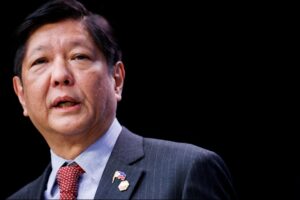
With this potential shift in the US foreign policy approach to Asia-Pacific, one that appears to diverge from years of preparation for a possible hot war with China, it is crucial to assess the broader implications for the region. A key question arises: How would such a strategic recalibration by the US under Trump impact the Philippines under Ferdinand Marcos Jr.’s presidency?
Note that the Philippines has been a frontline state in the US Indo-Pacific Strategy, with military agreements and the presence of nine declared EDCA/US military bases, reinforcing its role as a critical partner in counterbalancing and containing China using the SCS dispute. A potential US pullback from the region, even as part of a diplomatic trade-off with Beijing, could leave Marcos Jr. in a precarious and vulnerable position.
Implications
Moreover, Byers’ proposal has significant geopolitical implications. It could represent a shift in how the US and China engage in the SCS dispute. It signals a potential move toward de-escalation, where both sides agree to reduce their military footprints in the area.
For the US, this kind of concession could be seen as a way to reduce military expenditures and avoid direct confrontation with China. For China, this might be a tactical move to gain international legitimacy or reduce external pressures, particularly from the US and its allies. China could portray this potential concession with the US as a win on the global stage, showing its ability to negotiate concessions while maintaining its core interests. But at the same time, I would presume Beijing will ensure that its territorial claims in the SCS are not compromised, particularly in the face of competing claims from countries like the Philippines, Malaysia and Vietnam. Also, the possibility of reducing the number of these Chinese coast guard vessels as part of a deal could be seen as a significant concession from China, although it would likely be framed as a gesture of goodwill or diplomatic pragmatism rather than a major shift in policy from both sides, China and the US.
If in any case, the potential withdrawal and easing of US military forces near the coast of China, especially in the SCS, would mark a dramatic shift in US foreign policy. For countries like the Philippines, which heavily rely on US military support for territorial disputes, again, such a withdrawal will leave President Marcos vulnerable and in a precarious position with limited options to navigate.
A US military withdrawal would compel Marcos to undertake a complex strategic recalibration, navigating a web of geopolitical risks and limited choices. He would have to weigh several uncertain paths, each fraught with challenges.
Would he attempt a pragmatic yet controversial pivot toward China, seeking economic benefits and diplomatic accommodation? But would President Xi Jinping be willing to overlook the betrayals of Marcos? Alternatively, could Marcos turn to Asean partners, banking on regional solidarity to hedge against a diminished US presence? Yet, Asean has long struggled to present a unified front on the SCS issue, with member states maintaining varied, and at times, contradictory, interests. Would Asean counterparts be willing, or be even capable, to offer security support, and will Asean countries be able to accommodate a belligerent and confrontational stand of the Marcos administration against China over the SCS dispute?
Another option would be to strengthen partnerships with US allies like Japan, New Zealand and Australia to fill the security vacuum. But would these allies, despite their vested interests, act independently of Washington’s broader foreign policy calculus? Would they be willing to invest significantly in bolstering Philippine defense, especially if the US signals a strategic and calibrated military withdrawal from the region, especially in the SCS?
Lastly, Marcos could push for a substantial enhancement of the Philippines’ own military capabilities, fostering self-reliance. However, this path requires enormous financial investment, long-term planning and institutional reforms. Does his administration have the fiscal capacity, the strategic foresight, and most critically, the time to execute such an ambitious defense buildup before external pressures become insurmountable?
Each of these choices presents a high-stakes gamble with no easy answers. The looming question remains: Can Marcos maneuver through this geopolitical dilemma without compromising national interest and sovereignty or strategic stability?
Indeed, Marcos would be confronted with one of the most formidable geopolitical challenges of his presidency should the US scale back its military presence in the SCS. With diminishing security guarantees from Washington, he would have to navigate a precarious balancing act, managing relations with China while preserving credibility with domestic stakeholders and regional allies.
The manner in which he responds to this evolving power dynamic will determine whether the Philippines asserts itself as a regional player or remains merely a dispensable/disposable pawn in the grand chessboard of US strategic interests vis-à-vis China. In this high-stakes scenario, Marcos will inevitably face a defining test of leadership, diplomatic agility, and strategic foresight and maneuvering. But the more pressing question remains: Does he possess the acumen, strategic mind, ability, resilience and political will to withstand and maneuver through this impending geopolitical storm?
Conclusion
As far as regional peace and stability are concerned, Byers’ proposal, if pursued, could lead to greater regional peace, security and stability. A genuine de-escalation could pave the way for more cooperative efforts in addressing other maritime issues, such as fishing rights, environmental protection and the safety of navigation.
Likewise, the proposal to withdraw US forces in exchange for a reduction in Chinese coast guard vessels could reduce immediate tensions, especially in the contested waters of the SCS. The success or failure of such an approach will depend on careful diplomacy, mutual trust and the broader strategic calculations of both the US and China, as well as the reactions of other countries in the region. Indeed, this kind of diplomatic bargaining highlights the strategic importance of the SCS, which is central to both regional security and global economic interests.
Source: The Manila Times
https://www.manilatimes.net/2025/02/15/opinion/columns/why-a-cold-peace-between-china-and-the-us-would-be-bad-for-marcos/2056025