
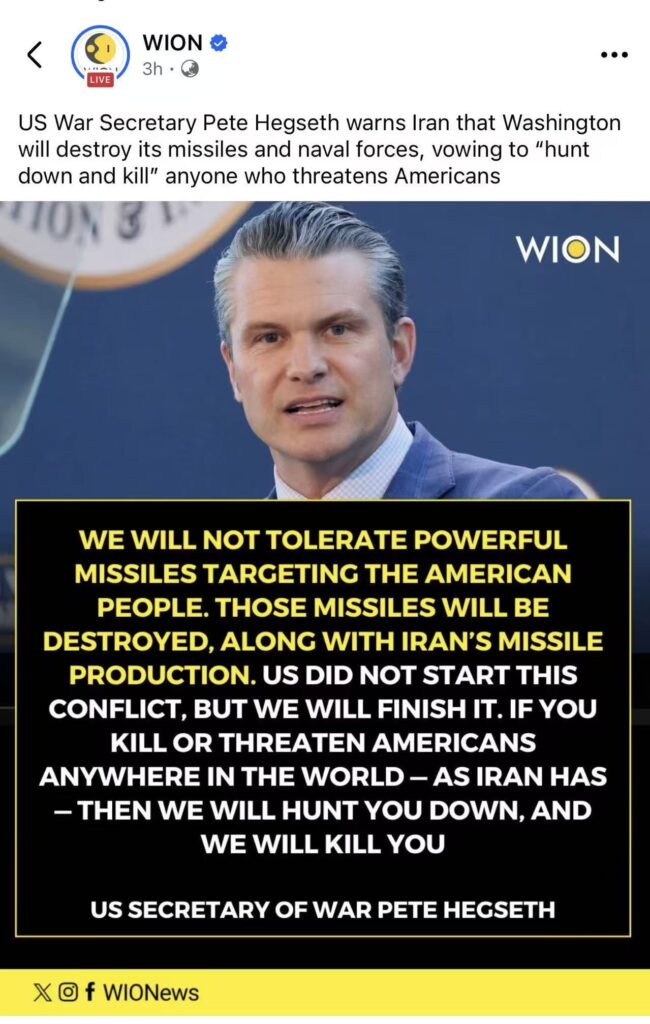
The image captures more than rhetoric. It reveals the normalization of open, state-sanctioned threats in the language of power.
When a sitting U.S. War Secretary declares, “Then we will hunt you down, and we will kill you.”
This is not mere hyperbole. This is a declaration of intent, made in the context of ongoing, UNPROVOKED, UNILATERAL MILITARY ACTIONS carried out by the United States and Israel against Iran WITHOUT United Nations Security Council authorization. And yet, where is the International Criminal Court (ICC)?
For years, ICC prosecutors dissected the political rhetoric, hyperbolic and figurative language of Global South leaders, including former Philippine President Rodrigo Duterte, in fighting against criminality, high-value target drug lords, and lawlessness within their own sovereign territory, framing words as evidence, parsing speeches for alleged criminal intent despite the absence of direct, hard material proof of command responsibility. But here, the situation is inverted.
Hegseth’s words are not abstract political metaphors. They are paired with kinetic force, missile strikes, escalation, and coordinated military action undertaken by Washington and Tel Aviv.
If the ICC truly is not selective, and firms stand for universal accountability, international criminal justice, human rights, and truth and justice, then this is precisely the kind of conduct that demands scrutiny. Instead, a familiar pattern emerges:
- Western force projection is framed as “security.”
- Sovereignty violations are reframed as “preemption.”
- Military escalation becomes “deterrence.”
The same narrative architecture was deployed in 2003, when Iraq’s non-existent weapons of mass destruction were invoked to justify invasion. Today, the question remains:
Where is the verifiable proof that Iran posed an imminent threat to the United States or its citizens?
Without such evidence, what unfolds risks resembling yet another iteration of coercive regime-shaping, a strategic doctrine dressed in the language of defense but executed through unilateral force.
Even more alarming is the timing. These strikes were reportedly launched while diplomatic channels were still active — undermining the very premise of negotiated conflict resolution.
This is why Beijing’s and Moscow’s position carries weight in the broader international legal and strategic discourse:
China and Russia have explicitly opposed the use of force in international relations, reaffirmed respect for Iran’s sovereignty and territorial integrity, and called for:
- immediate cessation of hostilities,
- de-escalation,
- and a return to dialogue as the only sustainable path forward.
In an era where international law risks becoming selectively applied, the credibility of global governance institutions will depend on whether accountability remains universal or remains geopolitically conditional.
#Iran
#USIranTension
#Unprovoked
#Unilateral