
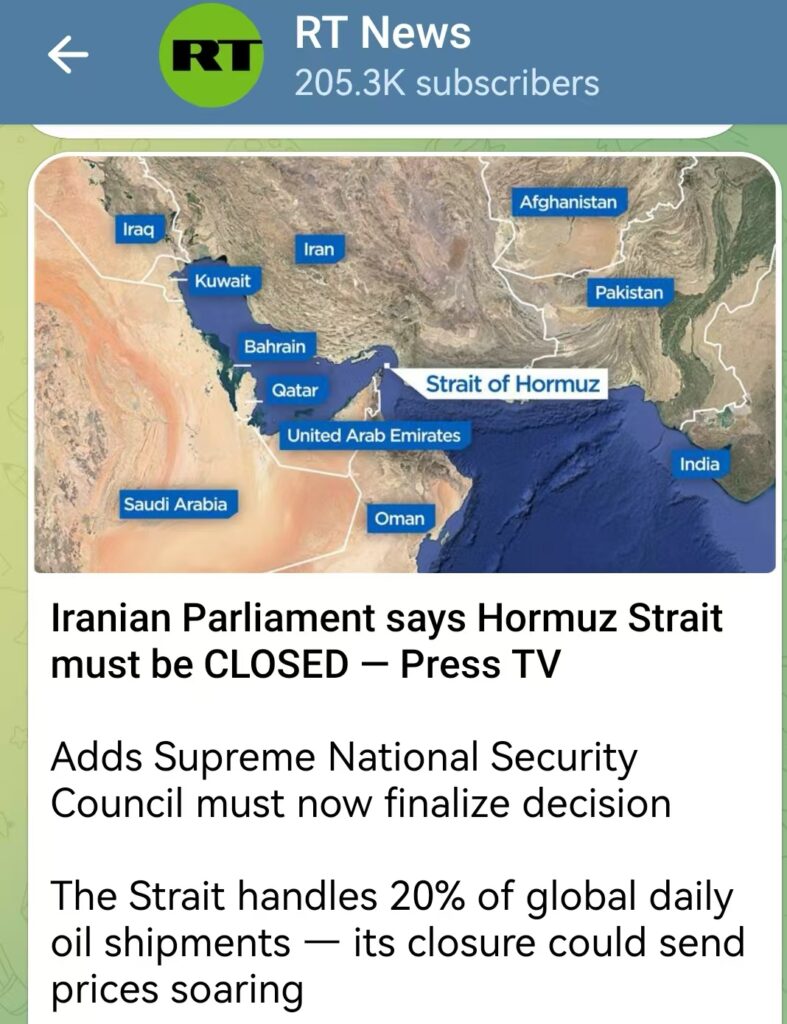
The potential closure of the Strait of Hormuz amid an escalating war between Israel and Iran, especially following a U.S. bombing of Iran, would trigger seismic geopolitical, economic, and security repercussions globally.
If the Strait of Hormuz is closed, we’re no longer talking about a regional war; we’re talking about a global rupture. Oil-dependent economies, fragile supply chains, and an already volatile geopolitical landscape could spiral into chaos. It would be the most dangerous escalation since the Cuban Missile Crisis, with economic pain felt not just in Washington and Tehran but also in Manila, New Delhi, Nairobi, and Jakarta. The question now is not whether the world is ready, but whether it can survive another man-made catastrophe born of arrogance, oil, and outdated empire fantasies.
How does this impact the Philippines?:
The Philippines is an energy-import-dependent, trade-vulnerable, and geopolitically entangled archipelago that will face serious and multidimensional consequences, and these include;
- Severe Energy Shock: High Fuel Prices and Supply Disruptions: The Philippines is overly dependent on oil imports. Over 90% of its crude oil originates from or passes through the Middle East, especially Saudi Arabia and the UAE. A Hormuz closure could cripple supply chains, forcing the country to seek more expensive alternatives. In effect, there will be an inflation spike. Expect an immediate surge in fuel prices (diesel, gasoline, LPG), triggering a domino effect on transportation costs, electricity rates (especially in diesel-powered islands), and basic commodities, further burdening the already inflation-hit Filipino population. Another potential impact is transport sector paralysis. Public transport fares will soar. Jeepney and delivery operators may stage protests, paralyzing urban mobility and supply chains.
- Economic Fallout: Inflation, Recession Risks, and Widening Deficit: A sudden oil price spike increases dollar demand, pressuring the Philippine peso to weaken, further driving up the cost of imports and ballooning foreign debt repayments. As oil becomes more expensive and export growth slows due to global volatility, the Philippines’ current account deficit will worsen, deepening fiscal imbalances. The twin threats of surging inflation and supply disruptions could derail economic recovery, slowing down GDP growth and possibly tipping the economy into stagflation, a rare and dangerous combo of high inflation and stagnant growth.
- OFWs in the Gulf at Risk: Humanitarian and Economic Crisis: Over 2 million Filipino workers reside in the Middle East (Saudi Arabia, UAE, Qatar, Bahrain, Kuwait), and many of these countries would be directly affected by a regional war. If Iran retaliates against the U.S. or allied Gulf states, which is more likely, Filipino OFWs could be caught in the crossfire, prompting mass evacuations. The Philippine government’s capacity under Marcos Jr.’s presidency for swift repatriation and reintegration of OFWs is questionable, especially with ongoing domestic economic constraints. Also, the Middle East remittances comprise over 25% of total annual remittance inflows. Any disruption in these flows will impact household consumption, a key driver of the Philippine economy.
- Foreign Policy Tightrope: Trapped in the U.S. Orbit: Under Marcos Jr., the Philippines has tightened its alignment with the U.S. through the EDCA expansion (9 EDCA-US bases) and military exercises, joint patrols in the South China Sea, deployment of missile systems, rotational US boots on PH soil, and prepositioning of US high level military assets. With a U.S. strike on Iran (bombed Iran on June 21, 2025), with a potential retaliation from Iran, and the escalation of conflict into a regional war or even world war, forces the Philippines into a moral and strategic dilemma: (a) Support U.S. interventionism, which risks regional backlash and endangers OFWs? Or (b) Call for neutrality and diplomacy, which may offend Washington and compromise defense aid?
Nevertheless, expect heightened pressure on the Philippines to open its ports or airspace to U.S. operations or surveillance over the Indo-Pacific. Such a move would effectively militarize the Philippines further, making it a potential target in a broader proxy war. - Geostrategic Risk: Philippines as a Collateral Pawn: If the U.S. launches operations in the Middle East from Indo-Pacific assets (including those in the Philippines), Iran or its proxies could expand retaliation. The Philippines, though geographically distant, becomes part of the global web of U.S. military logistics, and thus a potential target in cyber warfare, economic disruption, or symbolic attacks by non-state actors. Also, diplomatic fallout with energy partners in the Middle East could occur, especially if Manila is perceived as overly aligned with U.S. aggression.
What’s the Imperatives?
Now, the imperative question is whether the Marcos Jr. administration is proactively crafting a robust, multi-sectoral contingency plan in anticipation of a potential Strait of Hormuz closure amid a rapidly escalating Middle East crisis, with the US already dragged and directly involved. Because if it isn’t, the consequences could be devastating.
This is not a theoretical exercise in geopolitical forecasting but a matter of national survival. The Philippines’ chronic dependency on Middle Eastern oil, fragile logistics infrastructure, and exposure to global economic shocks make it extremely vulnerable. A Strait of Hormuz shutdown would choke off vital energy supplies, spike inflation, deepen the trade deficit, and possibly trigger a wave of socioeconomic unrest at home.
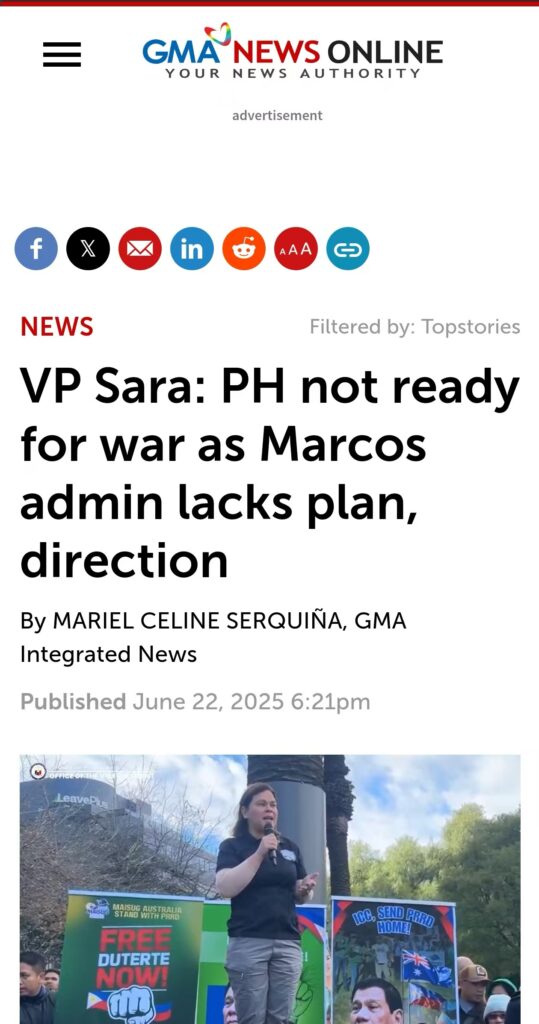
But beyond the economic fallout lies an even more troubling issue: the Marcos Jr. government’s apparent strategic inertia and absence of transparent national security foresight. While other nations are rapidly recalibrating energy sourcing strategies, refining diplomatic postures, and preparing civilian response protocols, the Marcos Jr.’s government and its political allies seems more preoccupied with the impending impeachment trial of VP Sara Duterte, politically crucifying the Dutertes, geopolitical grandstanding more particularly on its South China Sea dispute with China, and focused on foreign alignment theater, particularly its tightening embrace of U.S. military prerogatives, than safeguarding actual domestic national interests and the welfare of the Filipino people. .
Filipinos should ask and demand, has Malacañang convened a crisis task force on energy resilience and OFW repatriation planning? Has the Department of Foreign Affairs coordinated with Middle Eastern embassies for real-time evacuation logistics? Has the Department of Energy issued a comprehensive stress test on national reserves and energy grid contingencies? Has Congress demanded accountability or emergency budgetary flexibility? Etc… etc…etc…
If not, the Marcos Jr. administration is sleepwalking the nation into a perfect storm, an externally triggered crisis compounded by internal incompetence and policy paralysis.
In a world on the brink, governance cannot afford to be reactive. It must be anticipatory, grounded in national interest, and shielded from the gravitational pull of superpower wars that have nothing to do with Filipino prosperity or security.
Conclusion
The Philippines stands to lose more than it gains from a Strait of Hormuz shutdown and a U.S.-Iran-Israel war. Economically fragile, energy-dependent, and strategically exposed, the country is in no position to absorb the blowback of superpower military adventurism. A neutral, peace-oriented, and ASEAN-aligned foreign policy is not just wise, it may be the only path to survival.