

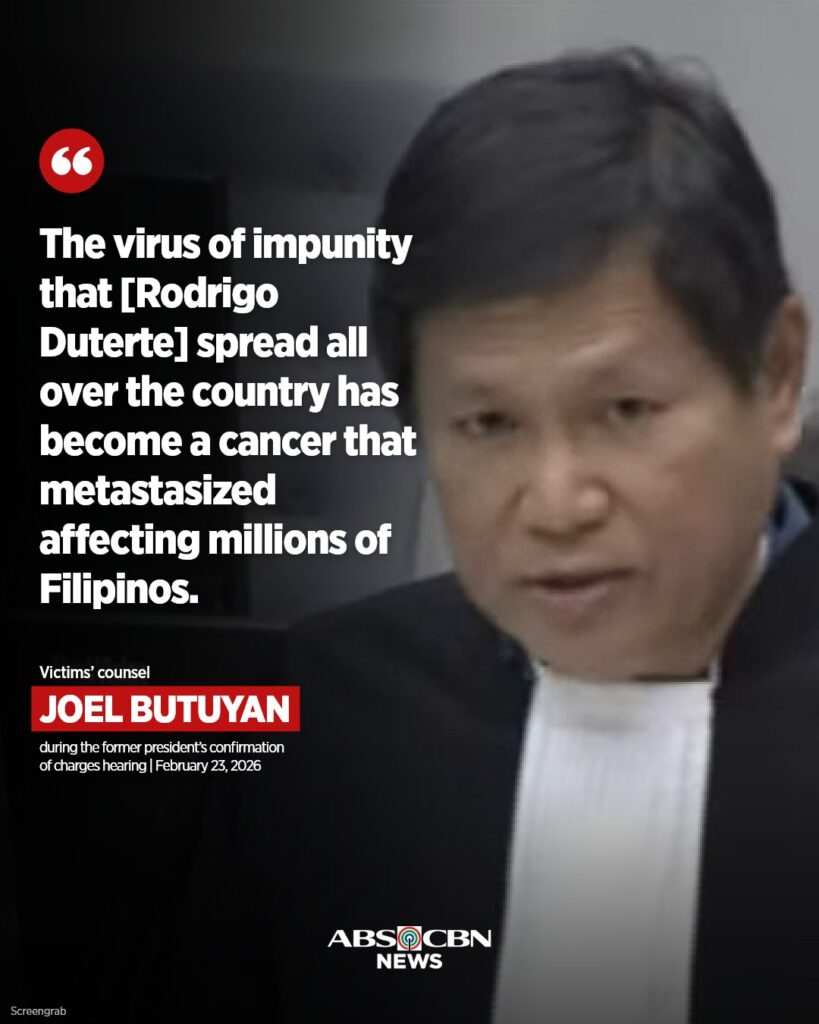
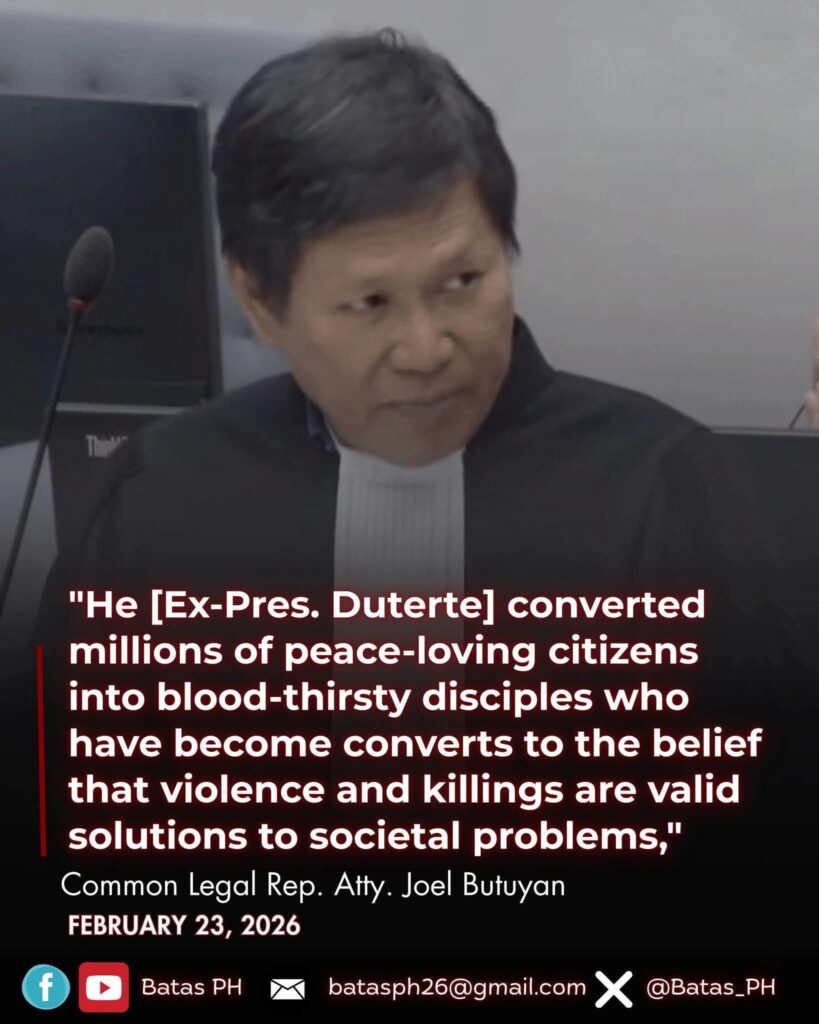
What a shame for Butuyan to portray the Philippines as if it were a failed state. To suggest, in an international courtroom no less, that the country is so irredeemably broken that only foreign intervention can rescue it, that its courts are hopeless, its institutions hollow, its officials infected, its people misled, is not merely legal advocacy. It is narrative escalation.
The Philippines is not a failed state. It has a functioning judiciary. It has active courts. It has prosecutors, ombudsmen, legislators, media, civil society, and adversarial politics. It has elections that remove and replace leaders.
To frame the nation as structurally incapable of justice, as though it were a collapsed regime in need of external salvation, is an overreach.
Critique the system. Yes!
Demand reform. Absolutely!
Challenge impunity where proven. By all means!
But painting the entire republic as a moral wasteland infected by “clones,” “viruses,” and cultural decay crosses from legal argument into national denigration.
The ICC was designed as a court of last resort, NOT as a referendum on a country’s civic worth, nor as a platform to portray its electorate as ideologically diseased.
You can argue for international jurisdiction without diminishing the Philippines’ sovereignty or its institutional complexity. You can seek justice without implying national collapse. And if the case is strong, it does not require dramatizing the country as broken beyond repair.
The Philippines is NOT a failed state. It is a contested democracy, – loud, flawed, polarized, but functioning. And that distinction matters.
Folks, let’s debunk the most glaring issue presented by Butyan yesterday during the 1st day of the confirmation hearing at the ICC.
- When legal argument starts sounding like epidemiology and moral crusade, “virus of impunity,” “vaccinate with truth,” “clones,” “apostles of impunity,” we have officially left the terrain of law and entered metaphorical theater. Take note, this is the ICC. NOT a campaign rally. NOT a sociology symposium.
NOT a moral revival meeting.
- The “Mini-Duterte” Theory: Butuyan claims that victims remain silent because of “mini-Dutertes” who threaten them and perpetuate a culture of fear. This is a sweeping generalization without structural proof.
Who are these “clones”?
Named individuals?
Organized networks?
Documented threats?
Prosecutable conduct?
Or is this a rhetorical umbrella meant to frame political supporters as extensions of criminality?
Supporting a former president is NOT evidence of participation in crimes against humanity. If political alignment becomes a proxy for criminal culture, then democracy itself becomes suspect. The ICC prosecutes individuals, not ideological ecosystems.
- “Culture of Impunity” = Legal Element? Seriously??
“Culture of impunity” is a political phrase. It is NOT a legal element under Article 7. The Rome Statute requires:
- A policy,
- A widespread or systematic attack,
- Knowledge,
- Contribution.
It does NOT recognize “cultural vibes” as admissible evidence. You cannot criminally convict someone for allegedly creating a “climate.”
You must prove:
- Orders,
- Coordination,
- Institutional design,
- Direct linkage.
Anything else is sociological commentary, NOT prosecutorial proof.
- Fear Narrative Without Forensic Anchoring: If victims are allegedly being threatened, that is a serious matter. But the ICC is not a forum for abstract fear. Where are:
- Police reports?
- Sworn affidavits of ongoing intimidation?
- Named perpetrators?
- Pattern documentation?
Without evidentiary anchoring, “fear” becomes rhetorical reinforcement, NOT legal substance. Fear must be proven, not presumed.
- Slamming ICC for Allowing Absence?: Rodrigo Duterte waived his right to attend the confirmation hearing. That is a procedural right recognized in ICC rules. Turning a lawful procedural waiver into moral outrage is political framing. The ICC permitted it. It is within the legal framework. You cannot selectively respect international law only when it benefits your argument.
- The “Virus of Impunity” and “Vaccination Through Trial” Argument: This is perhaps the most revealing. Butuyan argues that confirming charges and holding a trial will “vaccinate” supporters and prevent the election of “another apostle of impunity.” That is NO longer legal reasoning. That is political engineering.
The ICC is NOT an electoral corrective mechanism. It is NOT designed to influence voters.
It is NOT a moral disinfectant for political culture. If the purpose of the trial is to prevent voters from electing certain types of leaders, then the Court is being framed as a political instrument. That is precisely the perception that fuels accusations of politicization.
- “Worse Than 2011–2019” — Apocalyptic Forecasting: Predicting that failing to confirm charges will produce “an even more serious condition of impunity” is speculative fear projection. International criminal law does not operate on hypothetical dystopia. It operates on evidence. Future political outcomes are NOT elements of crimes against humanity.
- Remulla’s Statement on Domestic Hurdles: Citing prosecutorial difficulty in domestic courts does not automatically establish unwillingness or inability under complementarity. Legal hurdles exist in every jurisdiction. The ICC threshold is:
- Systemic unwillingness,
- Structural inability,
- Shielding of perpetrators.
NOT MERE difficulty.
- Emotional Appeal vs. Legal Burden: The most striking pattern in Butuyan’s narrative is emotional amplification: Clones, Virus, Vaccination, Apostles, Culture, and Brutality awaken hearts. This is compelling rhetoric. But ICC confirmation is NOT about awakening hearts. It is about:
- Substantial grounds,
- Evidentiary sufficiency,
- Legal elements.
If the case is strong, it does NOT need metaphors. It needs documentation. Hence, maybe the case against Rodrigo Duterte is NOT strong merit, and there’s NO Merits which is why Butuyan has resorted to moral outrage and rhetoric.
- What’s the Core Weakness in Butuyan’s Narrative? The sweeping leap is this:
From: Political support → Cultural complicity → Structural impunity → Criminal liability.
That chain is NOT legally automatic. Political influence does NOT equal criminal conspiracy.
Supporters are not extensions of the accused. Rhetoric is NOT mens rea (not guilty mind). Atmosphere is NOT policy.
Real Talk….
International criminal law collapses if:
- Political culture becomes evidence,
- Voter behavior becomes a legal risk,
- Metaphor becomes mens rea (guilty mind),
- Popularity becomes proof of systemic crime.
If the prosecution’s strongest framing relies on moral allegory rather than institutional documentation, then the defense only needs to ask one question: Where is the hard evidence?
Not:
- Emotional resonance,
- Not a sociological diagnosis,
- Not political forecasting.
EVIDENCE is all that matters!
Because the ICC does NOT convict cultures. It convicts individuals based on PROOF/EVIDENCE! If that proof exists, it will stand without metaphors. If it does NOT, NO amount of rhetorical vaccination will substitute for it.