
THE PHILIPPINE Senate today looks less like the “august chamber” of constitutional and democratic deliberation and more like the main stage of a national political circus. At the center are impeachment, Senate leadership coups, walkouts, remote-voting controversies, International Criminal Court (ICC)-related drama and endless partisan maneuvering. The Senate, supposedly the chamber of sober judgment, has become a battlefield of political factional survival.
To be clear, impeachment is a constitutional process. Accountability is necessary in any democracy. If serious allegations are raised against Vice President Sara Duterte, they must be heard, tested and decided in accordance with law, evidence and due process. The Senate has the constitutional duty to sit as an impeachment court, not as a cheering squad, not as a demolition team, and certainly not as a refuge for any political factions.
Political bickering
But what is deeply troubling is how this entire process has been swallowed by political bickering. Sara Duterte was impeached by the House. She denies wrongdoing, and her supporters call the impeachment politically motivated, political persecution and a crucifixion. If convicted by the Senate, she could be barred from public office, derailing her 2028 presidential ambitions. That alone should demand seriousness. Instead, what Filipinos are witnessing is a brutal display of procedural warfare. The Senate formally convened as an impeachment court on May 18, 2026, but had not yet set a date for the actual hearings, amid a turbulent political backdrop, including a Senate leadership change and controversy involving Sen. Ronald “Bato” dela Rosa, who has a standing warrant of arrest issued by the ICC over alleged crimes against humanity related to the fight against illegal drugs during president Rodrigo Duterte’s administration.
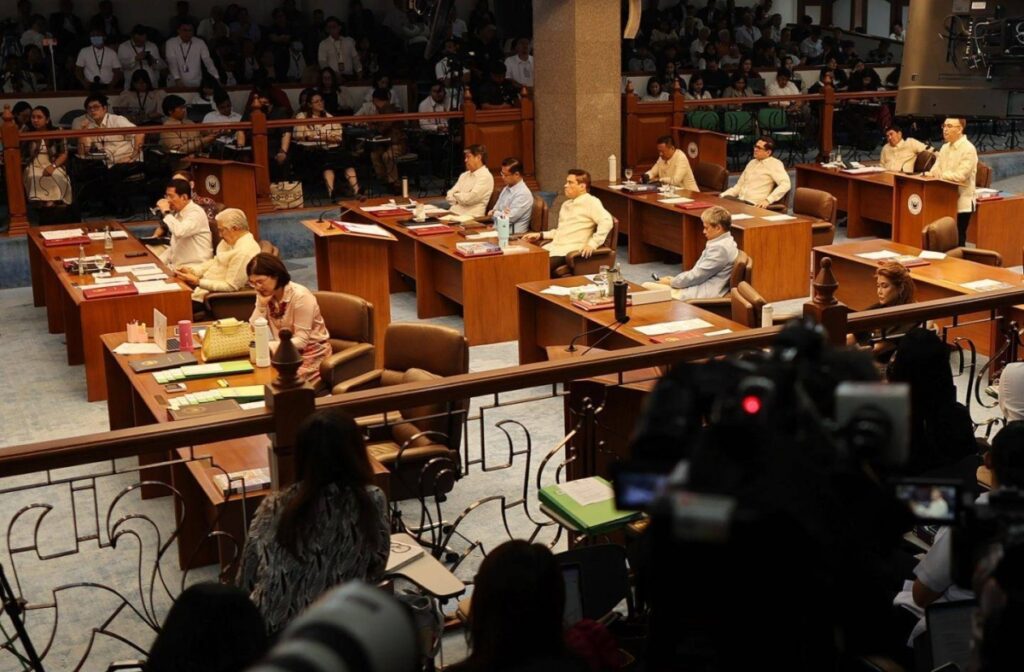
This is where the problem begins. The issue is no longer just whether Sara Duterte is guilty or innocent. The issue is whether the Senate itself still has the institutional discipline to act as a fair impeachment court. Can senators rise above political camps? Can they judge based on evidence? Or will the trial become another episode in the Marcos-Duterte family political feud, with the public reduced to spectators?
Senate squabbles
The abrupt replacement of Senate president Vicente Sotto III by Alan Peter Cayetano on May 11 sharpened these suspicions. Cayetano was elected with 13 votes, replacing Sotto, just ahead of the transmittal of the articles of impeachment against the vice president. Cayetano denied that the leadership change had anything to do with impeachment, but in politics, timing often speaks louder than denials.
Then came the Bato dela Rosa spectacle. Reports of a senator “wanted” by the ICC taking refuge in the Senate, the Senate placed under tension, security confrontations, confusion and later his disappearance from the heavily guarded building after being placed under protective custody by the Senate president added another layer of controversy.
The bickering over remote voting is another symptom of the same disease. At one level, remote participation may sound modern and practical. In principle, legislative institutions can adopt digital tools. But in the current political climate, the proposal is viewed not as reform but as maneuver. Critics fear it may allow absent, detained, fugitive or politically compromised senators to still influence Senate proceedings, including matters related to impeachment. The Senate majority’s remote voting push triggered opposition from the Senate minority block.
Again, all these are not merely procedural. In impeachment, procedure is power. Who is counted present? Who can vote? Who can participate? Who controls the rules? These questions determine political outcomes. And when rules are adjusted in the middle of a high-stakes battle, the public and critics naturally suspect that the procedure is being bent to serve factional ends.
Backward politics
Meanwhile, what happens to the Filipino people? The ordinary Filipino is already burdened by inflation, food insecurity, transport costs, energy insecurity concerns, weak wages, job insecurity, massive corruption scandals, water vulnerability and the everyday cost of simply surviving. The public needs a Senate that legislates with urgency, investigates massive corruption with seriousness and protects institutions from collapse. Instead, it sees senators fighting over numbers, loyalties, rules and political survival.
This is the tragedy of the moment: while politicians calculate votes, ordinary citizens calculate meals. While the Senate argues over who gets counted, Filipinos count pesos. While political factions fight over 2028, millions worry about tomorrow. The Philippines does not lack laws. It lacks a political culture that respects the public enough to govern seriously. Too often, politics becomes a contest of personalities rather than policies; dynasties rather than institutions; drama rather than service; vengeance rather than governance.
What is happening in the Senate says much about the kind of politics the Philippines has at the moment. It is the politics of a permanent campaign. A politics of revenge cycles. A politics where public institutions are pulled into private rivalries among powerful political clans. A politics where constitutional processes are valid in form but often degraded in practice by suspicion, political opportunism and factional calculation.
The Senate should be a stabilizing institution. It should be the chamber that slows down the political passions of the moment, not amplifies them. It should protect constitutional order, not turn procedure into a weapon. It should hear evidence, not noise. It should project statesmanship, not spectacle.
Yet the present Senate crisis suggests the opposite: institutions are being stretched by the weight of political ambition. The impeachment trial is not just a legal proceeding. It is a preview of 2028. The ICC issue is about Philippines sovereignty, independence and the country’s agency. The remote voting debate is not just about modernizing Senate procedures, it is about control. The leadership change is not just internal housekeeping. It is about who gets to shape the battlefield.
And the Filipino public? Once again, they are told to watch, react, take sides and absorb the cost. This madness must stop. The Senate must remember that it is not a private arena for political clans. It is not a sanctuary for allies. It is not a stage for factional theater. It is a constitutional institution funded by taxpayers, entrusted with national responsibility and bound by public duty.
If the vice president must be tried, then try her fairly. If the ICC issue must be addressed, address it according to law. If Senate rules must be amended, amend them transparently, not conveniently. If senators want to argue, let them argue within the bounds of propriety and with substance.
Conclusion
The Filipino people deserve better than a Senate consumed by its own drama. They deserve a Senate that understands that every hour spent on political theatrics is an hour stolen from public service. Every procedural trick deepens cynicism. Every spectacle weakens faith in democracy. Every act of elite self-preservation reminds the people that, in the Philippines, justice and accountability often depend not on what one did, but on whom one knows.
At this point, the Senate is not only trying Sara Duterte. It is also trying itself. And before the Filipino people, the question is simple: Will the Senate rise as a court of accountability, or sink further as a theater of political survival?
Source: The Manila Times
https://www.manilatimes.net/2026/05/30/opinion/columns/the-senate-circus-when-political-theater-becomes-a-public-burdenthe-senate-circus-when-political-theater-becomes-a-public-burden/2354688