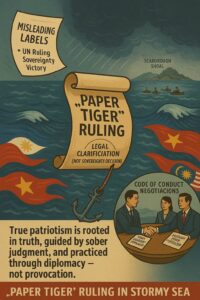

One of the most persistent and damaging errors in public discussion about the Kalayaan Group of Islands (KIG) is the belief that the Philippine claim rests on Exclusive Economic Zone (EEZ) entitlement. It does not. It never has. The Philippines’ claim to the KIG is a territorial claim grounded in classical doctrines of international law governing sovereignty over land territory, doctrines that predate UNCLOS by centuries and remain fully operative today.
At the core of the Philippine position/claim is effective occupation (effectivités). Since the 1970s, the Philippines has undertaken actual, public, and continuous acts of state authority over specific KIG features, most notably Pag-asa (Thitu) Island. These acts include physical occupation, construction of an airstrip, civilian settlement, provision of public services, and creation of a local government unit, the Municipality of Kalayaan. International jurisprudence consistently treats such conduct as legally significant, particularly where sovereignty is contested, and historical titles are ambiguous.
Closely related is the doctrine of historical consolidation of title. The Philippine claim argues that, at the time of occupation, the relevant features were effectively “terra nullius,” not under the effective control of any other state, and that subsequent Philippine acts consolidated sovereignty. This approach is well supported in international case law. In decisions such as Qatar v. Bahrain and Indonesia v. Malaysia (Ligitan/Sipadan), international courts have emphasized that vague historical narratives, unsupported by concrete administrative acts, carry little weight when measured against actual, effective governance on the ground.
A third, more nuanced argument concerns acquiescence or delayed protest. In international law, prolonged silence in the face of open and public exercise of authority may, in certain contexts, strengthen a claim of title. While heavily contested in the Spratlys and not dispositive, this principle remains part of legal argumentation and is not displaced by EEZ considerations.
What the 2016 Annex VII arbitration did—and did not—do is critical here. The tribunal explicitly declined to rule on sovereignty over any Spratly feature, including those in the KIG. It confined itself strictly to maritime entitlements under UNCLOS. At no point did it suggest that islands outside a state’s EEZ cannot be claimed as territory. Such a proposition would contradict centuries of international practice.
This distinction matters. EEZs are consequences of sovereignty, not prerequisites for it. Islands do not belong to whoever draws the largest maritime zone. They belong to whoever can establish title under general international law. Conflating maritime entitlements with territorial sovereignty does not strengthen the Philippine position; it weakens it by discarding the very doctrines on which the KIG claim actually rests.
But acknowledging the correct legal foundation leads to a harder, more honest question: how strong is the Philippine claim when measured against competing claims using the proper legal yardstick? That assessment requires confronting uncomfortable facts, and Part 2 of this article turns to that comparison.
Part 2 – Title vs. Footprints: How the Philippine KIG Claim Stacks Up Against Vietnam and China
Source: The Lobbyist
https://www.thelobbyist.biz/perspectives/article-details/prime%20insight/sovereignty-is-not-geometry-the-real-legal-basis-of-the-philippines-claim-to-the-kalayaan-group-of-islands