
The Tribunal did not rule on territorial sovereignty over any island, rock, or reef in the South China Sea (SCS). It never did. It never could. And it said so explicitly.
What the Tribunal invalidated was China’s claim to so-called “historic rights” over maritime areas enclosed by the nine-dash line, not sovereignty over land features. As stated unambiguously in the Award (para. 272), questions of territorial ownership fall outside the Tribunal’s jurisdiction and even of UNCLOS. This was not accidental. The case proceeded precisely because the Philippines carefully framed its submissions to cover only maritime entitlements and the body of water, not sovereignty over land features such as those in the Spratly Islands or Scarborough Shoal (paras. 153–154, 272). This distinction matters. Plus, take note: China did not participate in the entire arbitral proceedings and rejected the Award outright.
What PH Actually Won and What It Did Not
Because sovereignty over the maritime features in the SCS has never been adjudicated, they remain legally disputed. Such disputes can only be resolved through diplomatic negotiations or, in the worst case, armed confrontation, but certainly not through megaphone diplomacy.
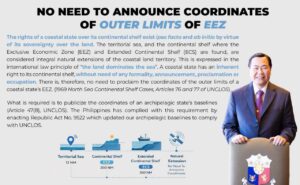
The Philippines did not win ownership of any island or rock. What it obtained was recognition of certain maritime entitlements, not sovereignty. Even the oft-repeated claim of a “won EEZ (exclusive economic zone)” must be properly understood. The Award recognized EEZ rights in principle, but these rights are not absolute because the waters involved are subject to overlapping claims by China, Vietnam, Malaysia, and Taiwan. Under international law, overlapping EEZs must be resolved through delimitation agreements, not unilateral enforcement, and UNCLOS itself requires that such disputes be settled by agreement in accordance with international law (UNCLOS Articles 74 and 83).
Moreover, EEZ rights are sovereign rights, not sovereignty itself. They are limited to resource-related functions such as: (1) exploration and exploitation of natural resources, (2) conservation and management of living resources, and (3) regulation of artificial islands and environmental protection (UNCLOS Arts. 56, 61, 62).
By contrast, sovereignty over land territory, if established, prevails over maritime entitlements. Because the Tribunal did not invalidate China’s sovereignty claims over the features it occupies, those features may legally generate either a 200-nautical-mile EEZ (if classified as islands under Article 121[2]) or a 12-nautical-mile territorial sea (if classified as rocks under Article 121[3]). Overlap is inevitable. Negotiation, not confrontation, is therefore the only lawful path forward.
Given these realities, it is important for relevant government agencies to revisit the 2016 Arbitral Award not superficially but objectively and clearly, then clearly explain what the Philippines won and what it did not. This is crucial so the Award will not be used or distorted by politicians who have a propensity for megaphone diplomacy and political grandstanding, driven not by law and facts, but by noise, to the country’s peril.
Source: The Lobbyist
https://www.thelobbyist.biz/perspectives/article-details/prime%20insight/the-risk-when-law-and-facts-are-replaced-by-megaphones-misreading-the-2016-arbitral-award