

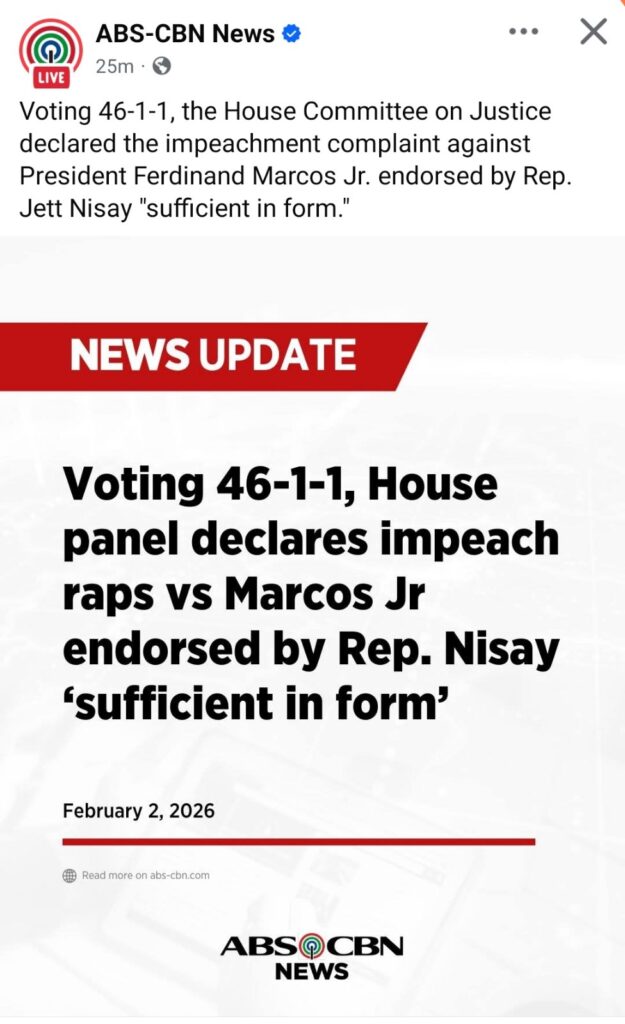
Let’s not kid ourselves. When the House Committee on Justice voted 46–1–1 to declare the impeachment complaint against Ferdinand Marcos Jr. “sufficient in form,” this was not some sudden outbreak of congressional courage. This was realpolitik, Philippine-style, procedural, calibrated, and dripping with plausible deniability.
On paper, it looks dramatic. Headlines scream “impeachment.” Social media lights up. Commentators rush to declare cracks in the armor. But in reality? This smells less like accountability and more like INSURANCE!
Let’s unpack what “sufficient in form” actually means. It doesn’t mean the allegations are strong. It doesn’t mean wrongdoing is credible. It doesn’t even mean Congress is serious about removing the President. It simply means the paperwork was properly notarized, verified, and endorsed. In other words, the envelope was addressed correctly. Nothing more!
And yet, this seemingly innocuous procedural step is where the real game begins. Recall our earlier discussion: the one-year impeachment ban is triggered upon initiation, that is, referral to the Committee on Justice. Once that happens, the Constitution bars any other impeachment attempt against the same official for one full year, regardless of whether the case is later dismissed, stalled, or buried under “further study.”
Now ask the obvious question: who benefits from triggering the one-year bar early? Certainly not the complainants. Certainly not the public. And certainly not accountability. But it benefits a President who enjoys decisive command of Congress, a supermajority coalition, and a Senate that, let’s be honest, has shown little appetite for crossing Malacañang.
This is where the suspicion becomes unavoidable. By allowing a controlled, low-risk impeachment complaint to move just far enough, sufficient in form, but NOT substance, the House effectively activates the constitutional shield. The guillotine is acknowledged, raised, admired… and then politely returned to storage. For a year. That’s not impeachment as accountability. That’s impeachment as inoculation.
Make no mistake: if the House truly wanted to hold Marcos Jr. to account, it would have moved aggressively on sufficiency in substance, fast-tracked hearings, and forced members to go on record. But none of that is happening. Instead, what we’re seeing is classic calendar management masquerading as due process.
And the Senate? Let’s not pretend it’s an independent variable here. With Marcos’s allies firmly entrenched and opposition numbers insufficient to convict, the upper chamber has little incentive to escalate. Why risk instability when a procedure can quietly do the job?
So is this “real”? Yes, in the narrow, technical sense. A complaint exists. A vote was taken. A box was checked.
But is it real accountability? Hardly!
This looks far more like a Malacañang-compatible choreography: allow the optics of scrutiny, trigger the one-year ban, and neutralize any serious impeachment push before it can gain momentum. Everyone gets what they want, the administration gets protection, Congress gets cover, and the public gets theater.
In Philippine politics, survival is rarely about innocence. It’s about timing, numbers, and procedural judo. And right now, Marcos Jr. isn’t fighting impeachment; he’s using it. So before anyone pops champagne over “sufficient in form,” remember this: in a system where delay equals immunity, form can be more powerful than truth.
And that, more than any allegation, tells you exactly what game is being played.