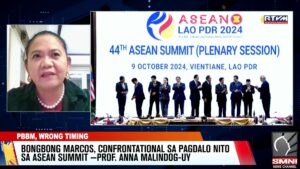

Whenever Philippine officials boast that the country is “meeting ASEAN standards,” it sounds reassuring until one asks a fundamental question: whose standards, exactly? If “ASEAN standards” mean the organization’s own declared aspirations—a people-centered, inclusive, high-human-development community—then the uncomfortable truth is this: the Philippines is not living up to them.
Insofar as the ASEAN Socio-Cultural Community (ASCC) Blueprint 2025 is concerned, it advocates equitable access to health, education, and social protection, alongside reduced inequality and narrowed development gaps – the question is not whether the Philippines has improved, but whether it has conformed and is catching up faster—or slower—than its ASEAN neighbors.
On human development, the Philippines’ position is revealing. Its Human Development Index (HDI) relative to its ASEAN neighbors is not on par. With an HDI score of 0.720 and a global rank of 117, the Philippines sits below the ASEAN average and firmly in the lower half of the bloc, behind Singapore, Brunei, Malaysia, Indonesia, Thailand, and Vietnam. This is nowhere near the pace-setters, and others are moving faster.
Poverty tells the same story. Accordingly, the national poverty rate declined to around 15.5% in 2023. That is progress. But this fragile progress was easily reversed by inflation, climate disasters, massive corruption, declining economic growth, and global shocks, and was far too slow for a country that aspires to upper-middle-income status. In ASEAN terms, the Philippines again sits awkwardly in the middle: worse than Vietnam, Malaysia, or Thailand, but a bit better than lower-ranked ASEAN members like Myanmar.
Also, health outcomes expose the most serious gaps. Universal Health Coverage (UHC) remains incomplete, with the Philippines still described, politely, as “working toward” UHC rather than having achieved it. Improvements in infant mortality have been slow, with recent data showing worrying stagnation or even backsliding. On nutrition, the picture is stark: over a quarter of Filipino children under five are stunted, with some regions approaching crisis levels. Adolescent pregnancy rates are among the highest in ASEAN, and HIV-AIDS cases are rising. These are not the indicators of a country living up to a “people-centered” development vision.
Why all these? Income level alone does not explain it; several neighbors with comparable resources have done better. The deeper problem is structural. Governance and implementation deficits turn well-written laws into weak outcomes. Fiscal priorities are distorted by leakages, massive corruption, and political patronage that blunt the impact of social spending. Regional inequality remains severe, allowing national averages to mask pockets of deprivation closer to ASEAN’s poorest states than its leaders.
So, under a Marcos regime, is the Philippines living up to ASEAN standards? If “standards” mean the regional median, then yes, it muddles through. But if ASEAN’s own rhetoric is taken seriously—about narrowing gaps, equity, and leaving no one behind—the answer is no. It conforms to the region’s mediocrity, not its aspirations, and no amount of diplomatic visibility can hide this.
Source: The Lobbyist
https://www.thelobbyist.biz/perspectives/article-details/prime%20insight/is-ph-living-up-to-aseans-standards-under-a-marcos-jr-regime