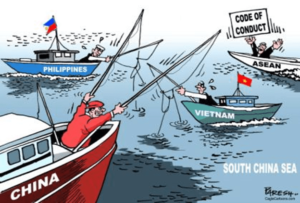

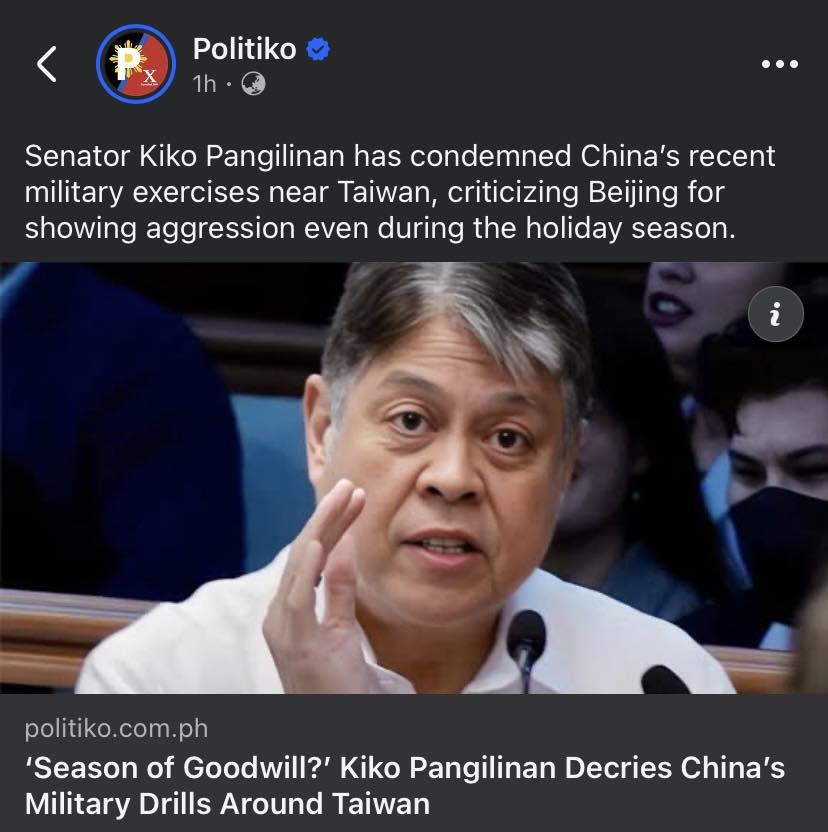
There is a difference between sounding tough and being strategically sound. Senator Kiko Pangilinan’s recent outbursts against China, particularly his responses to the Chinese Embassy, manage to miss that distinction entirely. What we get instead is a performance: legally sloppy, strategically confused and noisy, and internally inconsistent. Worse, it weakens the Philippines’ strongest positions by muddling and botching issues that should never have been mixed in the first place.
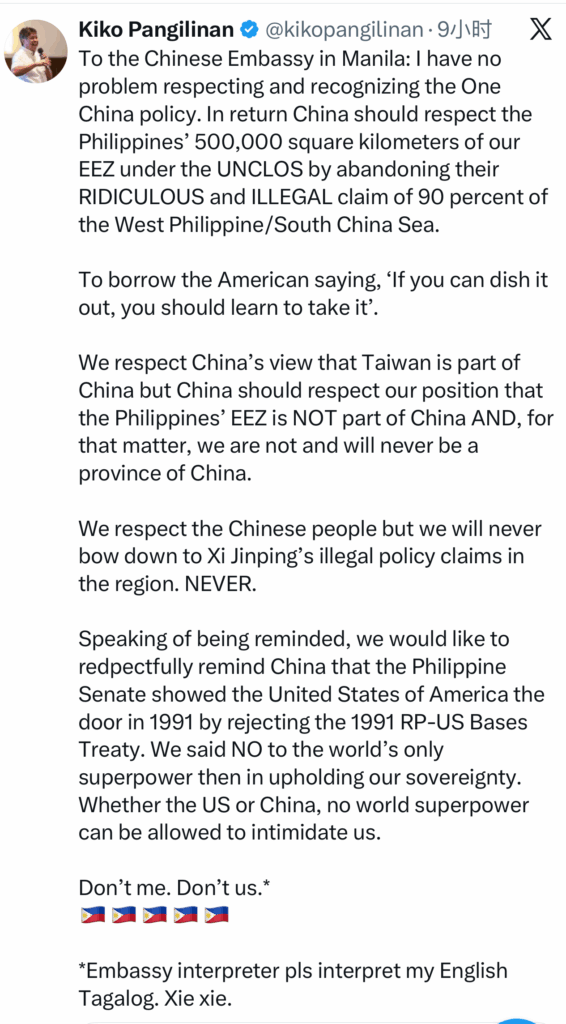
The BIG conflation: “One China” ≠ “China’s South China Sea claims.” At the heart of Kiko Pangilinan’s argument is a fundamental conflation: the Taiwan question and the South China Sea (SCS) dispute are not the same issue, not governed by the same law, and not resolved in the same forums. Treating them as interchangeable may earn applause on social media, but it collapses under the most basic legal scrutiny.
Taiwan is a sovereignty-recognition issue. Whereas the SCS Dispute is a maritime entitlements issue. That distinction is not academic hair-splitting—it is the backbone of international law.
The Philippines’ claims in the SCS are primarily not claims of territorial sovereignty, but of sovereign rights and jurisdiction over an Exclusive Economic Zone (EEZ) under the United Nations Convention on the Law of the Sea (UNCLOS). Taiwan, by contrast, is a question of statehood, recognition, and civil war legacies, governed by political agreements and diplomatic practice—not UNCLOS.
Yet Pangilinan casually barters them as if they were chips on the same table: I respect the One China policy; therefore, China should respect our EEZ. That’s not how the law works. It’s not how diplomacy works either. It’s rhetorical wishful thinking masquerading as principle.
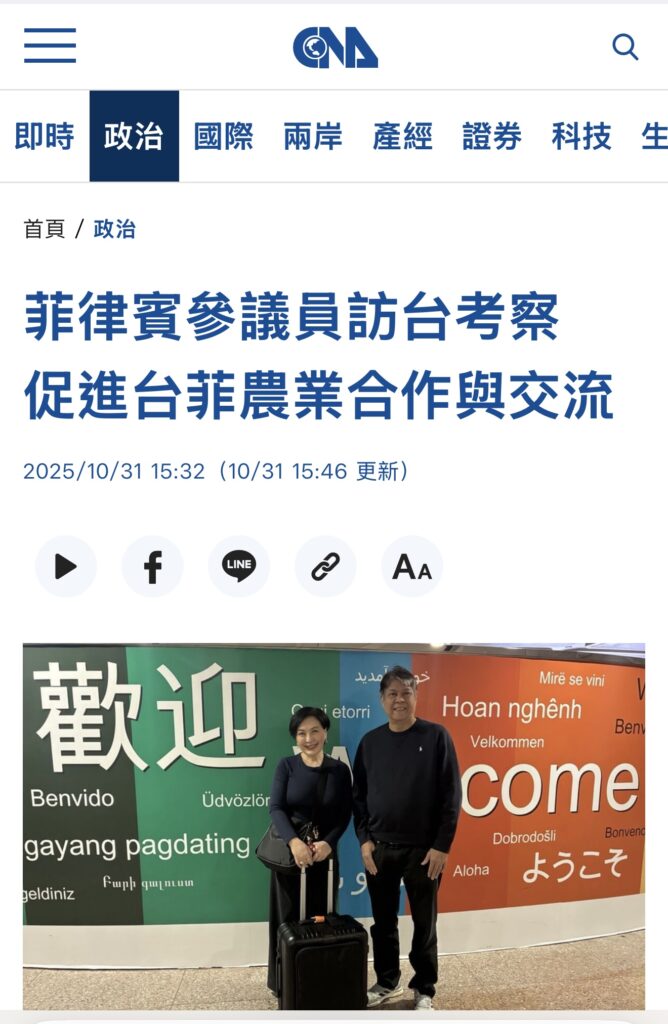
Moreover, Kiko’s “I respect the One China Policy” while doing photo ops with Taipei makes the hypocrisy problem glaring. Pangilinan insists he respects the One China Policy while having repeatedly visited Taiwan and held public meetings, as framed by Taiwanese authorities, which they described as official political engagement. One does not need to be a Beijing hardliner to see the contradiction.
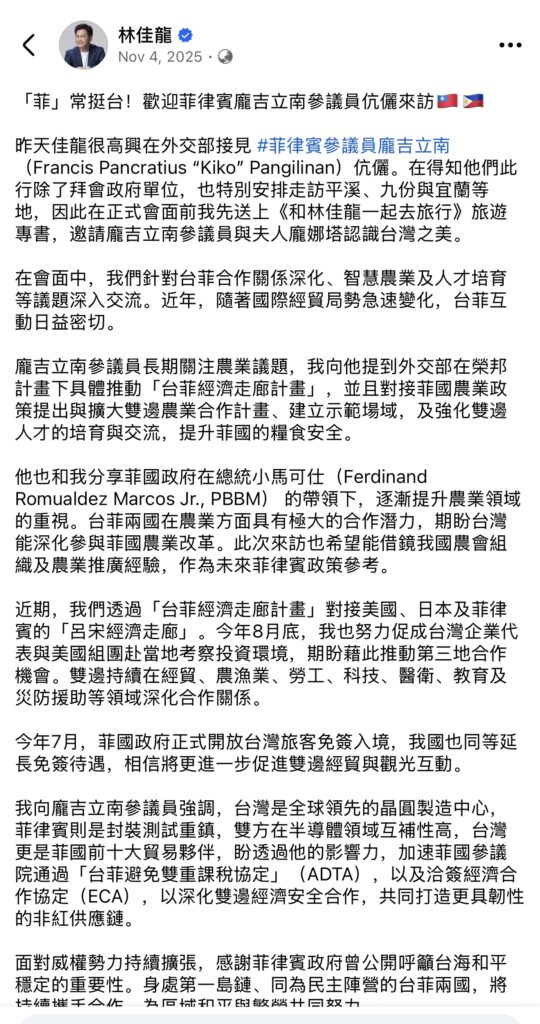
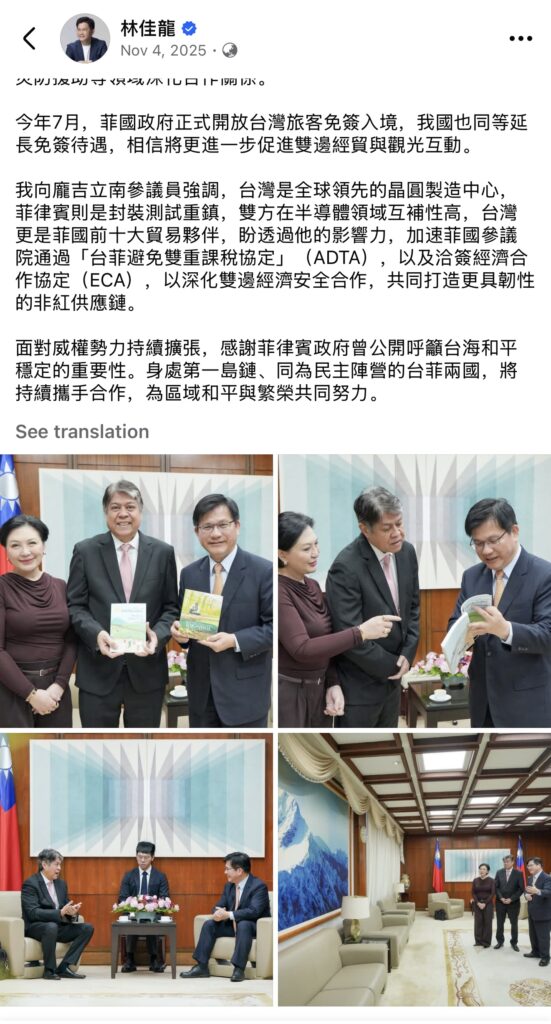
Taiwan’s news agency CNA reported that Pangilinan visited Taiwan (October 30–November 4, 2025) in his capacity as Chair of a Philippine Senate committee, and that he would meet “government officials and legislators” to discuss strengthening ties. CNA also reported that Taiwan’s vice president received Pangilinan and his wife at the Presidential Office, explicitly describing deepening the Taiwan–Philippines partnership. And CNA further reported that Taiwan’s foreign minister met with him and used the occasion to push for agreements and cooperation, framing Taiwan and the Philippines as “democratic partners” in the “first island chain.”
Thus, Kiko can’t simultaneously insist he “respects One China Policy,” and behave in ways Taiwan publicly markets as quasi-official political engagement. That’s blatant hypocrisy and dishonesty.
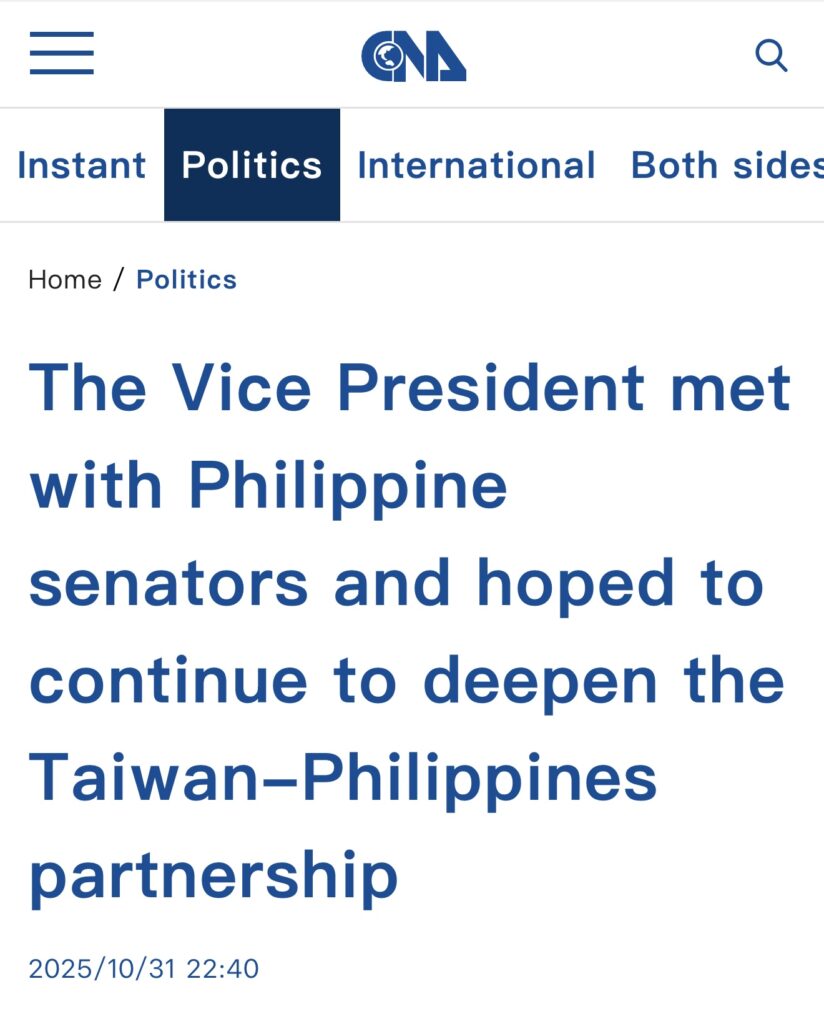
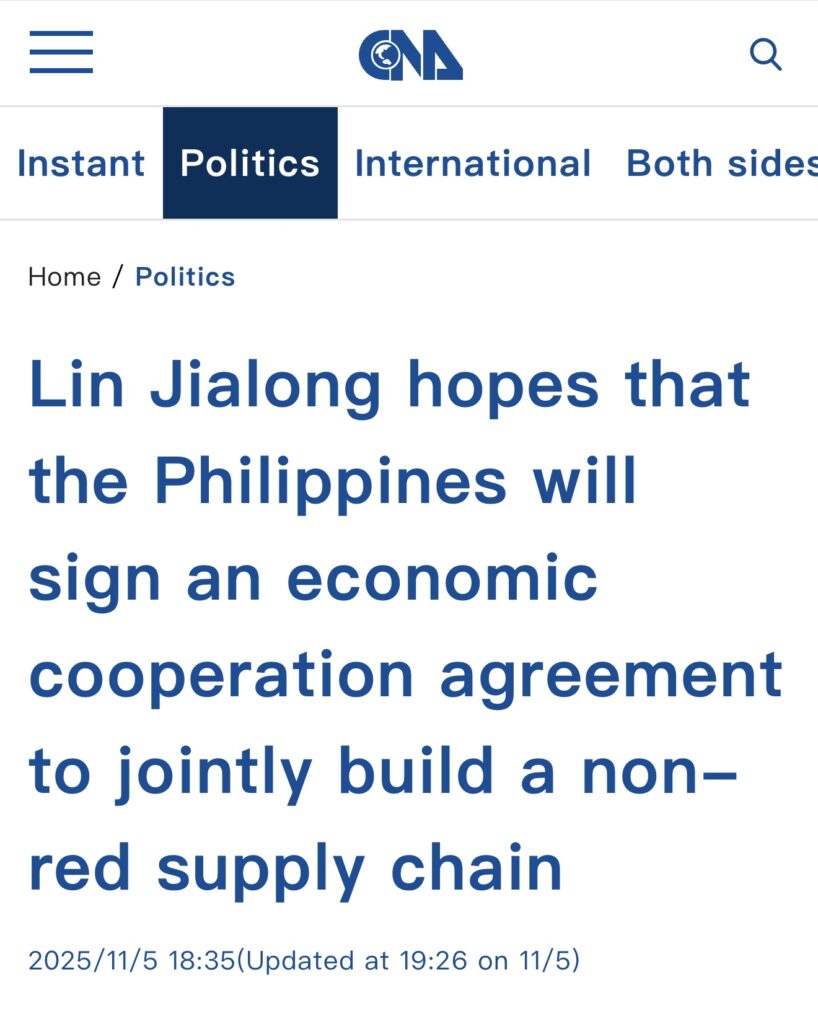
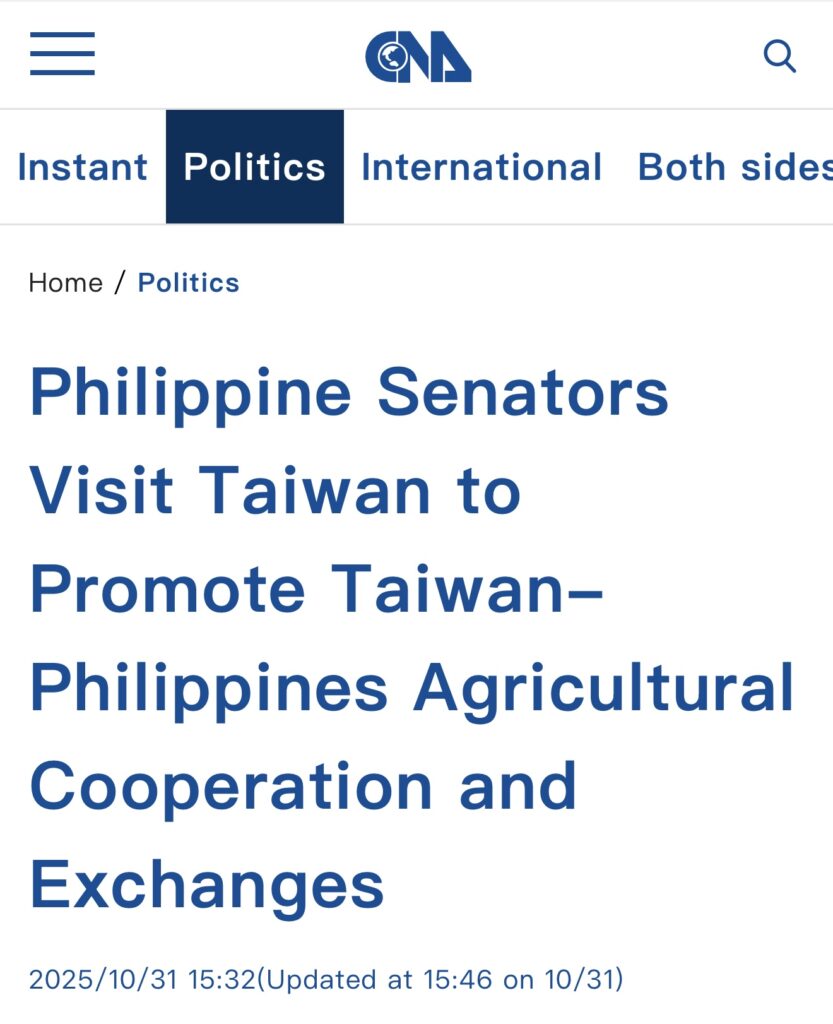
Kiko may call it “agriculture cooperation” or “economic exchange,” but in signaling terms, it’s still: “I’m engaging Taipei as a political interlocutor.” Beijing will obviously read it that way, because Taipei itself is broadcasting it that way.
So the loophole in Kiko’s own posture is simple: He’s using “One China Policy” as a disclaimer, while practicing “Taiwan engagement” as a performance. That’s not statesmanship. That’s have-your-cake diplomacy.
Thus, Kiko cannot claim fidelity to the One China Policy while acting in ways that Taipei itself advertises as quasi-official recognition. Beijing does not need propaganda to challenge this inconsistency; Pangilinan supplies the evidence himself. The disclaimer (“I respect One China”) is neutralized by the behavior that follows it.
This is not a question of whether Philippine legislators should visit Taiwan—they can, and many do. It is about CREDIBILITY. Kiko cannot invoke the One China Policy as a shield while simultaneously undermining it through signaling. That is not diplomacy; it is strategic duplicity in diplomacy.
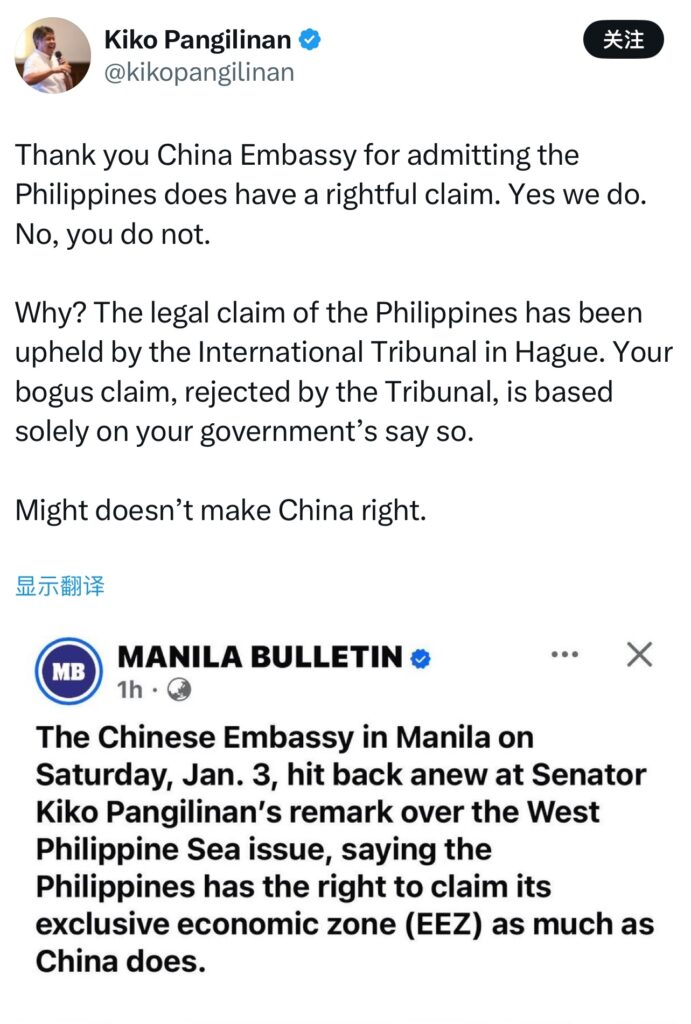
Moreover, Pangilinan’s invocation of the 2016 arbitral award is another case of overreach. The ruling, yes, is being attributed as a major legal victory for the Philippines, but not in the way his statements suggest. The tribunal explicitly did not decide, did not rule on territorial sovereignty over land territory, and did not delimit maritime boundaries. It did not decide who owns which islands. What it did do—critically and decisively—was clarify maritime entitlements under UNCLOS, invalidate claims to “historic rights” incompatible with the Convention, and rule on the legality of certain actions at sea.
Overselling the award as a sweeping judgment of sovereignty is not just inaccurate—it weakens the Philippines’ position by making it easier for critics to dismiss the ruling as politicized. Precision is power. Pangilinan trades that precision for slogans. Ironically, this undercuts the Philippines’ strongest legal ground: EEZ-based sovereign rights, not nationalist chest-thumping,
more so, not blanket “sovereignty over everything.” Kiko’s framing blurs that distinction—and that blur is precisely what makes his argument easier to caricature. Note that sovereign rights and sovereignty are NOT the same and are not synonymous.
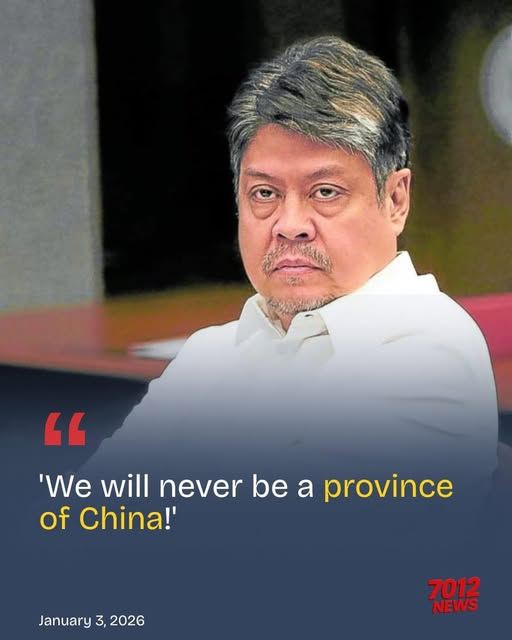
Likewise, Kiko’s “We will never be a province of China” is a hollow argument that paints Kiko as a strawman and signals alliance in neon lights. This is the most theatrical line in Pangilinan’s messaging and is also the most analytically empty. China is not in any way interested nor has the illusion of making the Philippines become a Chinese province. NOT AT ALL. Plus, that is not the dispute on the table.
What this line actually does is signal alignment. It shifts the debate from maritime law into identity politics, echoing a familiar U.S.-centric narrative of civilizational struggle. Once you choose that frame, you abandon the legal battlefield—where the Philippines has leverage—and move onto ideological terrain, where small states rarely win. Thus, Kiko’s “We will never be a province of China” line is the rhetorical equivalent of yelling, “I will never become a unicorn.”
China’s SCS posture may be aggressive, but it is not literally a formal claim that the Philippines will be annexed as a Chinese province. The SCS dispute is framed around maritime claims/entitlements and, in some cases, sovereignty over features—not an announced plan to absorb the Philippine state.
So Kiko’s “we will never be a province” works mainly as fearmongering, a strawman argument against something not actually claimed, and alliance signaling, broadcasting a “we’re in the anti-China camp” posture. The alliance “signaling” becomes even less subtle when he spices it up with: “To borrow the American saying…” That’s not an argument; that’s branding. It is alignment—performed with a straight face.
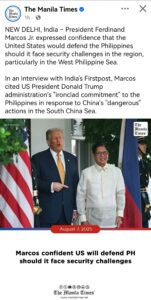
On the other hand, Kiko cites the 1991 Senate rejection of the bases treaty as proof that the Philippines won’t bow to any superpower. But in today’s strategic reality, under Marcos Jr.’s regime, the Philippines already bowed to the U.S. as a superpower. Note that the Philippines has expanded U.S. access under EDCA to nine agreed locations accompanied by rotational access, prepositioning of military assets, including the Typhon missile system, and facilities on Philippine bases.
Hence, the jingoist punchline becomes: “We kicked out the bases… anyway, here are nine access sites.” Yes, Kiko can very well argue that EDCA is not the same as permanent bases, and that’s true in formal legal framing. However, it is still a deepened U.S. military presence and operational access on Philippine territory. That makes Kiko’s “no superpower can intimidate us” line sound less like policy coherence and more like political cosplay: perform independence, then quietly rely on alliance infrastructure.
Indeed, if Pangilinan’s principle is opposed to intimidation by great powers, then consistency demands that it be applied universally.
Pangilinan rails against imagined scenarios of China’s annexation while remaining conspicuously quiet about the very real expansion of U.S. military access on Philippine soil under EDCA.
Let’s be clear: EDCA sites are inside Philippine sovereign territory. The SCS dispute, by contrast, largely concerns sovereign rights, not sovereignty. If Kiko is genuinely alarmed about sovereignty erosion, logic dictates focusing first on where foreign (U.S.) military presence is physically embedded—not on theatrical hypotheticals.
Bottom line, Kiko argues like a meme, not like a lawyer nor a senator of the Republic. He is a lawyer who forgot legal discipline. He treats UNCLOS as if it’s an emotional “ownership certificate,” and treats the One‑China Policy/Principle as if it’s a diplomatic coupon he can redeem for compliance in the SCS.
Bottom line, Kiko Pangilinan’s arguments rely on conflation, exaggeration, and selective framing—exactly the habits lawyers are trained to avoid.Obviously, Kiko opted for volume over rigor, narrative over law, and signaling over substance. The result is not strength. It is NOISE. And in geopolitics, noise is NOT power.