
WITHOUT A WISE RULER, A STATE WILL BE DOOMED!
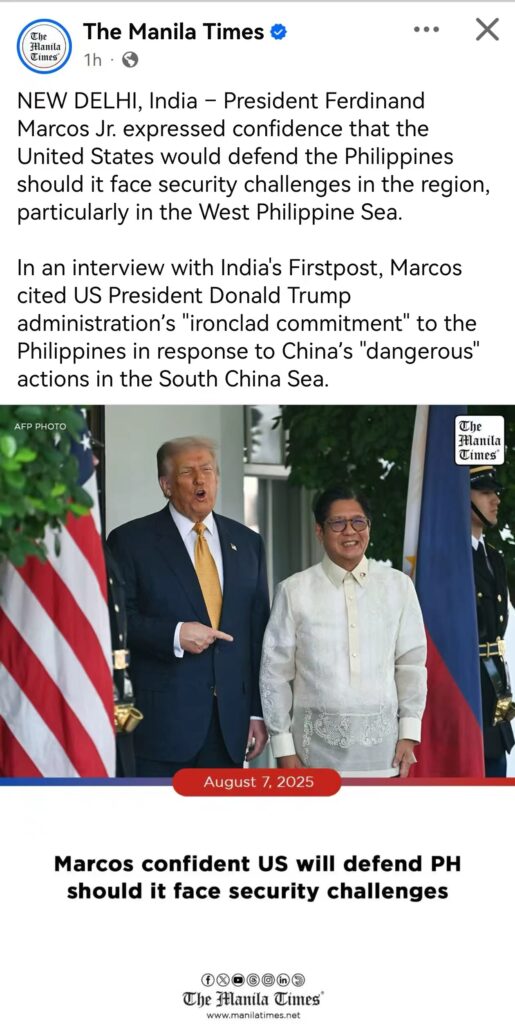
Marcos Jr.’s statement in his interview with the Indian news website Firstpost in New Delhi is not only naïve, but it borders on strategic foolishness and idiocy. His confidence that the United States will defend the Philippines “should it face security challenges” dangerously outsources the country’s sovereignty and survival to a superpower with a long, documented history of abandoning allies when their utility expires, or the geopolitical cost becomes too high.
What’s Wrong with Marcos Jr.’s Thinking? Here’s What’s Wrong:
First, Outsourcing National Defense = (equals) Surrendering Sovereignty. To rely on another state’s military in this regard, the U.S., for our country’s defense, is to abdicate sovereign responsibility. It transforms the Philippines from a nation-state into a forward outpost/base, which it already is, a proxy, not a partner. Marcos Jr. seems to have confused “strategic alignment” with strategic dependence. A sovereign nation must defend its people, protect its survival, and its independence, not wait for a phone call from the Pentagon.
Second, Historical Examples: When the U.S. Used Countries and Allies and Abandoned Them:
🟠 Vietnam (1975): Despite promises, the U.S. abandoned South Vietnam after the Paris Peace Accords. When North Vietnam launched its final offensive in 1975, U.S. military aid evaporated. The result? Saigon fell, and thousands of American allies were left behind to face imprisonment, death, or forced re-education. “Ironclad” alliance? More like “paper-thin” loyalty when public opinion turned at home.
🔴 Kurdish Allies in Syria (2019): Betrayal on the Battlefield:
The U.S. backed the Kurdish forces, YPG (People’s Protection Units (Yekîneyên Parastina Gel)/ SDF (Syrian Democratic Forces) in fighting ISIS. But when Turkey, a NATO ally, opposed them, Trump withdrew U.S. troops overnight, leaving Kurdish fighters, who had sacrificed thousands of lives, to face a Turkish onslaught alone. What happened here, obviously, the Kurdish Allies in Syria were used as cannon fodder by the U.S., then discarded them. Isn’t it obvious?
The fight against ISIS created temporary alliances (e.g., U.S.-YPG) that were quickly discarded when the geopolitical cost rose, illustrating how “strategic partnerships” built on convenience often end in betrayal. For the Philippines, any deal banking on U.S. protection, as with Marcos Jr.’s confidence in Washington’s “ironclad” vow, must take this history into account.
🟡 Afghanistan (2021): The Great Abandonment: Over twenty years, billions of dollars, and countless promises of democracy later, the U.S. withdrew abruptly, triggering the collapse of the Afghan government and the return of the Taliban. The world watched in horror as Afghan civilians clung to U.S. evacuation planes, falling to their deaths. Women judges, MPs, activists, and journalists went into hiding. U.S. allies were left behind, interpreters, informants, and civil society leaders were now hunted. This was NOT a peaceful exit. It was a strategic abandonment – a BETRAYAL, which will haunt U.S. credibility and integrity for decades.
Look at Afghanistan now? What happened to it? Do we want the same fate as a country? So much for nation-building and security guarantees, promises of the U.S.
Lessons for the Philippines? The story of Afghanistan post-2021 is the final nail in the coffin of any romantic notion that the U.S. stands by its long-term allies when the going gets tough. It is a case study in imperial fatigue, false promises, and the catastrophic costs of outsourcing national destiny to a foreign superpower.
Note that Afghanistan trusted the U.S. for 20 years. It was abandoned in 20 days. The Philippines must never confuse a superpower’s interests with its loyalty. As Filipinos, we should NOT and never again should our sovereignty be subcontracted to foreign hands, as lessons from our history as a country.
🔵 Iraq (1991–2003): Broken Promises, Fabricated Justifications and the WMD Lie That Destroyed a Nation:
President George H.W. Bush publicly urged the Iraqi people to rise up and overthrow Saddam Hussein. After encouraging a Shiite uprising against Saddam Hussein in 1991, emboldened by this rhetorical green light from the U.S., Shiite Muslims in the South and Kurds in the North launched uprisings against Saddam’s regime. But when the moment came, the U.S. stood down and allowed Saddam’s Republican Guard to crush the rebellion with tanks, helicopters, and mass executions, while American forces watched from across the border. The result: tens of thousands were slaughtered, and the surviving population was subjected to repression, mass graves, and decades of trauma because they trusted America’s rhetorical support.
Lessons? The betrayal of the Iraqi Shiite uprising in 1991, followed by the catastrophic 2003 U.S. invasion of Iraq under false pretenses, stands as one of the most egregious, appalling, atrocious, and horrendous examples of how American strategic interests, NOT morality, democracy, or human rights, determine U.S. foreign policy.
Note that the George W. Bush administration, with strong support from the UK’s Tony Blair, launched the 2003 invasion of Iraq based on one central claim: “Iraq has weapons of mass destruction (WMD).” But the truth? The UN weapons inspectors found no credible evidence of active WMD programs. The “proof” presented by U.S. Secretary of State Colin Powell to the UN, vials of powder, satellite images, and intercepted conversations, was either cherry-picked, exaggerated, or outright false. A 2004 U.S. report (the Iraq Survey Group) later confirmed Iraq had no active WMD programs at the time of the invasion. The invasion went forward anyway, not to protect Americans, but to pursue neoconservative fantasies of regime change, resource control (Iraqi oil), and U.S. regional dominance and hegemony in the Middle East.
Now What Has Become of Iraq? Estimates of Iraqi deaths range from 200,000 to over a million.
Civilian infrastructure (hospitals, water, electricity, education) was destroyed or degraded.
Then here comes the Rise of Extremism in Iraq. The power vacuum and sectarian chaos created by the U.S. invasion and botched occupation directly led to the rise of ISIS. Iraq became a battleground for proxy wars: U.S. vs. Iran, Sunni vs. Shia, Kurds vs. Baghdad, and facilitated the emergence of failed state institutions. Corruption soared, elections were held, but institutions were hollowed out. Iraq’s democracy is now fragile, fragmented, and deeply dependent on foreign actors (U.S., Iran, Turkey).
Most significant is Oil Plunder. Western oil companies gained access to Iraq’s reserves, long kept off-limits. But ordinary Iraqis saw little benefit as their economy collapsed under mismanagement, sanctions, and cronyism.
What the Iraq Story Shows Us? The U.S. does not fight for democracy or human rights. It fights for strategic control, energy resources, and geopolitical positioning. Alliances with the U.S. are temporary and transactional. The Shiites who rose in 1991 and the Kurds in the North learned this with blood. Military intervention based on lies destroys nations. Iraq, once a relatively secular and educated society, is now fractured and vulnerable.
🇵🇭 What This Means for the Philippines? President Marcos Jr.’s belief in the “ironclad” U.S. defense commitment should be judged against the record of betrayal in Iraq and elsewhere.
Take note, Iraq trusted American promises. American lies destroyed Iraq. Will the Philippines learn, or repeat the same mistake??
These are just a few examples among others. Note that I did not even include the case of Ukraine here. But what’s happening in Ukraine is another glaring example from which we as a country should draw lessons in our dealings with Uncle Sam.
🧠 Sobering Thoughts:
When will Filipinos and the entire country open their eyes to the fact, as evidenced by the historical events of modern times, that the U.S. has strategic interests, not permanent friends?
Marcos Jr. seems to believe that the Philippines is special, that the U.S. will risk a war with China to defend Philippine shoals and seas. But here’s the reality:
The Mutual Defense Treaty (MDT) does not guarantee automatic U.S. military action. It requires “constitutional processes” and does not cover artificial islands or gray-zone operations. The U.S. acts only when its core strategic interests, such as homeland security or credibility with other allies, are at stake. Public opinion in the U.S. will ultimately determine whether American soldiers die for Scarborough Shoal or Ayungin Shoal or the contested waters of the South China Sea. Will they? Really?
🤔 If Taiwan is already a gray-zone puzzle for U.S. defense planners, why would they jump into a war with China over the disputed South China Sea? Think about this, folks!
Conclusion:
Undoubtedly, Marcos Jr.’s Gambit is DANGEROUS and SHORT-SIGHTED! It invites escalation.
It reduces leverage. By making the Philippines fully dependent, Marcos Jr. gives up strategic bargaining power. It gambles Filipino lives in a potential war between the U.S. and China that is not of their choosing, on a battlefield not of their making.
We should all be aware that China knows that EDCA sites (U.S. bases) turn the Philippines into a launchpad and a forward base for the U.S. in the Asia-Pacific region. Therefore, the Chinese understand that under Marcos Jr.’s presidency, the Philippines is NOT a neutral actor. This removes all ambiguity as far as China is concerned.
What are the ultimate lessons the Philippines can draw from the examples provided here? The case studies presented here serve as a warning for nations like the Philippines that depend too heavily on Washington’s security-military umbrella. Just like Afghanistan, the Philippines hosts U.S. troops. It is told its sovereignty will be “protected.” It is asked to align militarily in return for security and promises. But when the costs mount for Washington, when the body bags pile up or polls dip, will the U.S. stay? Or will it cut and run, as it did in Vietnam (1975), Iraq (1991, again in 2011), Syria (2019), and Afghanistan (2021)? And just like these countries as examples, the Philippines will be left behind, holding the empty shell of promises once branded “ironclad.”
To place the Philippines’ fate in the hands of Washington, especially under a transactional figure like Trump, is to forget that great powers do not have friends. They have interests. And when those interests shift, so too do their commitments. Hence, Marcos Jr. and his ex-Maltese defense secretary should stop romanticizing the so-called “Ironclad Promises” of Uncle Sam.
🇵🇭 The Philippines must not be a pawn/proxy and a forward base of a declining superpower’s great power game and rivalry against a rising superpower in the East. Its leaders, primarily Marcos Jr., must stop acting like salesmen of sovereignty and start behaving like guardians of the nation’s survival, independence, autonomy, and sovereignty!