
By: Bruno Falci
Edited by: Nathallia Fonseca
This article has been translated from Portuguese. We apologize for any unintended translation errors.
International experts denounce illegal sanctions, military threats and Washington’s interference in Caracas
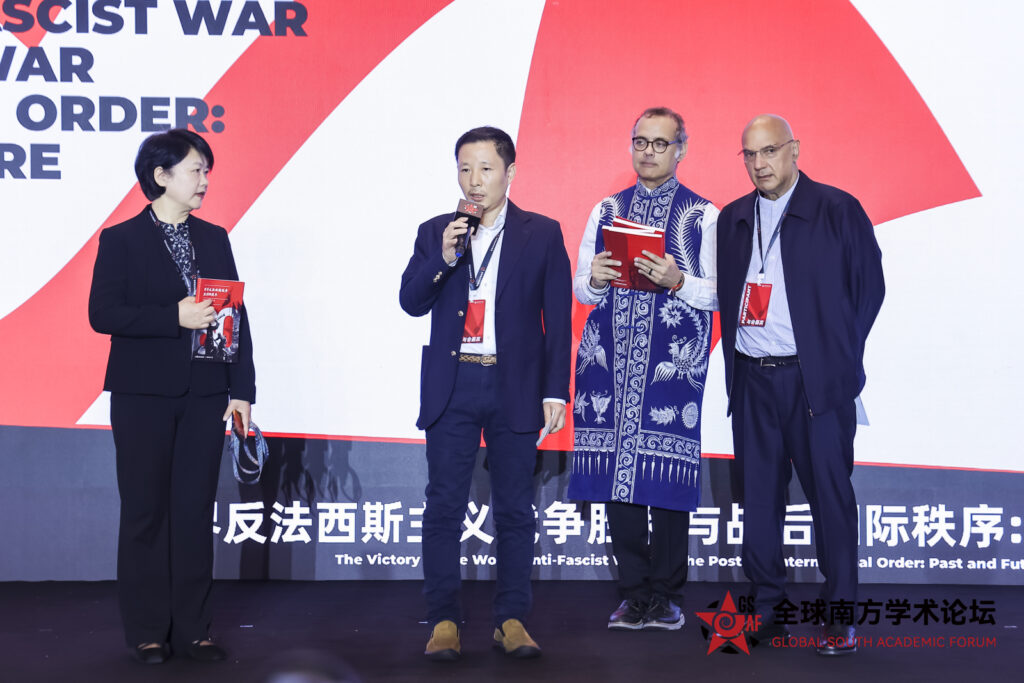
| Credit: GSAF
“We hope to unite the Global South, especially Latin America, because the region has the deepest history and practice of anti-colonial struggle and has won great victories. We want to work together with Latin America to promote a new order of information dissemination in the 21st century, breaking the hegemony of Western discourse, knowledge and historical narrative.”
With these words, Lu Xinyu, dean of the Institute of International Communication at East China Normal University and president of the Global South Academic Forum, summarized the path advocated by international academics to strengthen Venezuela in the dispute of narratives in the face of the political and media offensive of the United States.
The speech of solidarity with Venezuela and strengthening scientific and cultural cooperation between countries of the Global South was the tone of the third edition of the Forum, in Shanghai, with the participation of more than 250 experts from 21 countries.
Venezuela faces growing military and economic pressure, with intense threats from the United States, including the deployment of troops and warships in the Caribbean, sea and air blockade, assassinations and attacks on Venezuelan fishing vessels, as well as the imposition of nearly a thousand sanctions considered illegal under international law. At the same time, Venezuelan opposition leaders, such as María Corina Machado, have publicly advocated external military interventions in their country.
To Brasil de Fato, the president of the Forum highlighted experiences of social resistance in Latin America, such as the MST in Brazil:
“This year I visited Brazil and got to know the MST and the Florestan Fernandes National School. I was deeply touched by the courage, resistance and political strength of the peasant movement,” she said. According to Lu, these initiatives demonstrate that the Global South can develop its own alternatives in the face of disinformation and international pressure on countries like Venezuela.
Indian historian Vijay Prashad, director of Tricontinental: Institute, also harshly criticized the United States’ accusations against Venezuela, stating that the “narco-state” narrative is used as a pretext to justify a military intervention:
“A trivial lie is to say that Venezuela is a narco-state, because the U.S. Drug Enforcement Administration (DEA) clearly reports that 80 percent of drugs come through the Pacific coast and have nothing to do with Venezuela. But deeper than that is the lie about democracy and freedom. The idea that, somehow, the United States is the beacon of democracy and all other countries are inferior to them, like Cuba, Venezuela.”
A war of lying narratives that led, according to Prashad, to other military interventions in search of, in fact, oil, such as that of Iraq. The historian also criticized opposition figures who advocate foreign intervention, comparing them to governments that violated international norms.
“The fact that María Corina Machado received the Nobel Peace Prize puts her in the same camp as Barack Obama, who won the Nobel Prize and then carried out extrajudicial killings with drones in other countries. It is impossible to take them seriously,” he said.
The position was also shared by the vice president and director of the Asian Strategic Studies Institute of the Philippines, Anna Rosario Malindog-Uy, who pointed out that the United States’ action against Venezuela represents a plan to change the government to control the country’s natural resources.
“They want Maduro to leave because they can’t control him. Venezuela is one of the main suppliers of oil and has many natural resources that interest the United States; they want to control them. But Maduro is not a puppet of the United States.”
“Trump justifies this as a drug trafficking issue, but no one believes in it here in the Global South. We all know that when the U.S. is interested in a country’s natural resources, it finds ways to intervene, including planning changes in government. This has happened many times in different parts of the world, in the Philippines, in the Middle East,” the researcher stressed.
She called on the Venezuelan people to defend their sovereignty. “All solidarity with my Venezuelan compatriots and my comrades. Do not allow your country to fall under the control of an imperial power like the United States. You must fight for your country,” he concluded.
Source: Brasil de Fato
https://www.brasildefato.com.br/2025/12/22/forum-de-academicos-do-sul-global-defende-soberania-da-venezuela-querem-saida-de-maduro-pois-nao-conseguem-controla-lo/