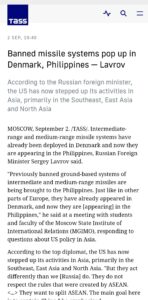

ASEAN today finds itself in an uncomfortable but unavoidable position: seated squarely at the fault line of U.S.–China rivalry. The question often asked — Is ASEAN being forced to choose sides?
The pressure is real, yes, but no one is twisting arms in back rooms. Instead, the pressure emerges from the region’s own structural dependence on two superpowers that dominate different pillars of its survival.
On one side is China — ASEAN’s top trading partner, supplying over USD 730 billion in two-way trade in 2023 and anchoring the region’s manufacturing lifelines under RCEP and ACFTA 3.0. Decoupling is not merely unrealistic; it is economically suicidal.
On the other side is the United States, the region’s so-called security provider through alliances, defense agreements, and military exercises. Countries like the Philippines, Singapore, Thailand, and even Vietnam, to some degree, continue to cooperate with Washington at varying levels to balance and deter, especially in the South China Sea.
Thus, ASEAN is tugged not by explicit coercion, but by contradictory dependencies: economic gravity pulling toward Beijing and security magnetism pulling toward Washington—the real pressure surfaces whenever these vectors collide in maritime disputes.
ASEAN Centrality
ASEAN’s doctrine of “centrality” was meant to guard against precisely this potential polarization. To remain relevant, ASEAN must reclaim its voice — setting rules rather than reacting to them. That means championing inclusive dialogue, leading on digital and climate governance, and advancing long-delayed maritime norms, such as the Code of Conduct in the SCS.
For the Philippines, the dilemma is particularly acute. Manila hosts U.S. EDCA sites and joins patrols, which Washington frames as deterrence but Beijing sees as provocation/containment. Yet the Philippine economy remains deeply tied to Chinese trade, tourists, investments, and supply chains. Washington, for all its rhetoric about “friend-shoring,” offers little in the form of market access or infrastructure capital.
The smarter path is neither capitulation nor confrontation, but strategic autonomy: deterrence without becoming a pawn, engagement without dependence, diversification without naïveté. This requires talking not only to Washington and Beijing, but also to Tokyo, Seoul, Delhi, Brussels, Canberra, Moscow, and the wider Global South.
Conclusion
The Philippines’ 2026 ASEAN chairmanship is the perfect stage to shift from reactive diplomacy to agenda-setting leadership. Manila can reframe ASEAN’s future around supply-chain resilience, a sustainable blue economy, digital governance, and maritime confidence-building measures. By championing an “ASEAN 2045” vision, Manila can help transform the region from a theater of great-power competition into an architect of regional stability.
In the end, ASEAN’s real choice is not between Washington and Beijing — but between cohesion or fragmentation, passive drift or strategic leadership.
The strongest states are not those that take sides, but those that set the rules, hold the center, and ensure that engagement with all powers ultimately serves their own people. If ASEAN can do that, it will not merely survive great-power rivalry — it will shape the regional order that emerges from it.
Source: The Lobbyist
https://www.thelobbyist.biz/perspectives/article-details/prime%20insight/caught-in-the-crossfire-why-aseans-real-battle-isnt-choosing-sides-%E2%80%94-but-choosing-its-future