

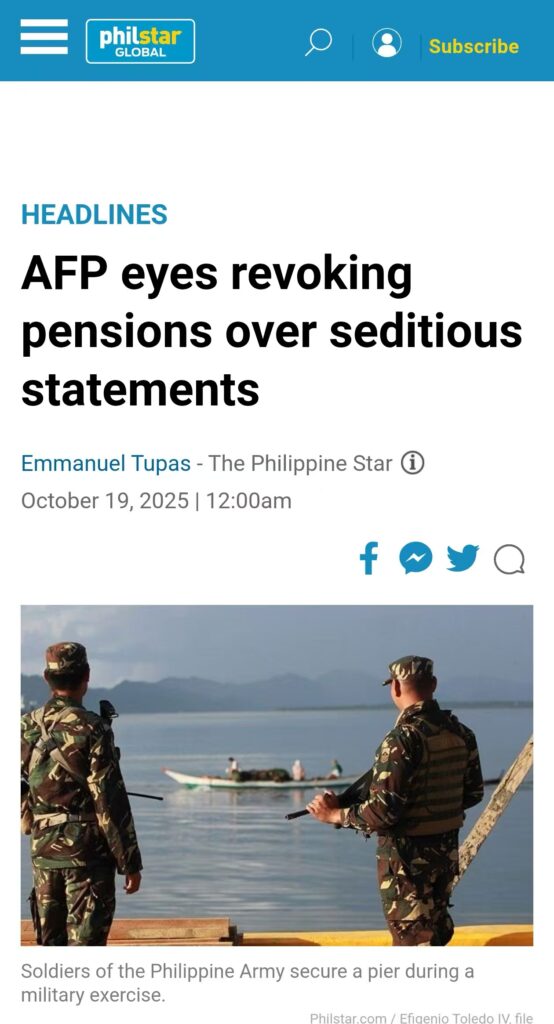
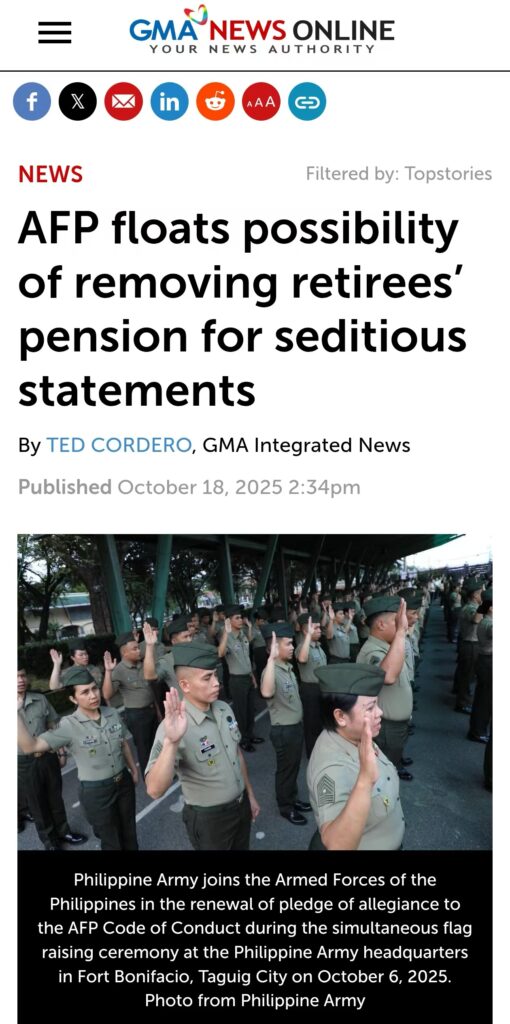
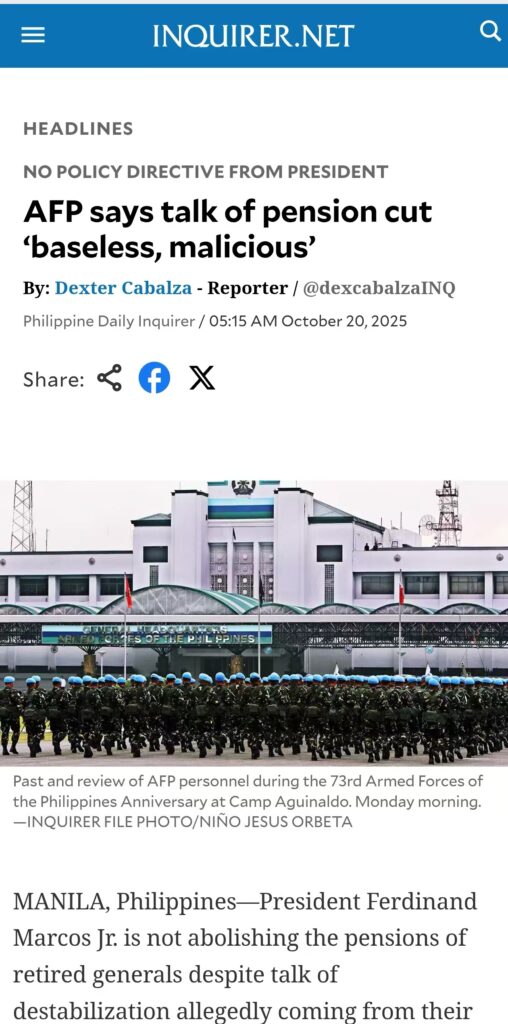

It has been two weeks since I last wrote a short commentary on Philippine affairs directly posted on my social media platforms, mainly because I am currently immersed in completing my Ph.D. dissertation, which rightfully demands most of my time and focus. Still, in my brief and occasional scans of national news, one particular issue caught my attention: reports that the Armed Forces of the Philippines (AFP) is allegedly considering cutting or revoking the pensions of retired officers who have allegedly expressed dissent or called for a change in leadership amid mounting public outrage over massive corruption in BBM’s government.
According to several media reports, the AFP is “studying” the possibility of suspending or reducing the pensions of retired officers accused of “spreading fake news” or “inciting sedition” (GMA Network+2Philstar.com+2). AFP spokesperson Col. Francel Margareth Padilla confirmed that such measures are under review and that the institution is assessing their legal and institutional implications (GMA Network+1). Meanwhile, a separate report by the Philippine Daily Inquirer described talk of pension cuts as “baseless” and “malicious,” citing AFP sources who insisted that no official order or policy has been issued (Inquirer.net).
The AFP’s internal discussions reportedly stem from the alleged involvement of some retired officers who have publicly urged the military to withdraw support from President Marcos Jr.’s administration, following rising discontent over governance issues such as alleged flood-control fund irregularities and widespread corruption in government (GMA Network+2ABS-CBN+2).
Here’s my commentary on this issue….
The AFP allegedly floated the idea of reviewing or revoking the pensions of retired officers accused of “seditious” remarks, amid mounting public and internal discontent over governance issues such as massive corruption in government, from flood-control corruption scandals to perceived weak crisis management under the Marcos Jr. administration.
Retired generals and officers have reportedly voiced criticism and called for leadership accountability, or allegedly even hinted subtly at a need for “change of leadership.” The alleged AFP’s response — contemplating pension cuts — represents not merely an administrative action but a politically charged reaction that risks eroding the constitutional principle of civilian supremacy and freedom of expression. Thus far, there is no confirmed law, regulation, or executive directive authorizing pension cuts on the grounds of political expression or dissent. Nonetheless, the mere contemplation of such a move is deeply troubling. It carries political undertones that could be construed as punitive toward military retirees critical of the administration. This is an alarming precedent in a democracy that values freedom of thought and the principle of non-partisan professionalism in the armed forces. Let’s unpack this issue at hand.
A. The Legal and Institutional Problem
1. Retirees Are Civilians, Not Soldiers: Once retired, officers are no longer subject to military command or discipline under the Articles of War. They become private citizens with full civil rights, including the right to free expression under Article III, Section 4 of the 1987 Constitution. Any attempt by the AFP to punish retirees for speech acts, absent due process or judicial conviction for sedition, constitutes unlawful command over civilians. Pensions are earned entitlements, not privileges contingent on loyalty to an administration.
2. No Legal Basis Under Current Law: Republic Act No. 11709 (2022) and related AFP pension laws outline service-based benefits, not political conduct-based conditions. Revoking pensions for “speech” would require legislative amendment — not an internal AFP decision. Without a clear legal basis, such revocation would violate due process and property rights, as pensions are vested benefits under jurisprudence (see Pineda v. Court of Appeals, G.R. No. 118145).
3. Weaponization of Sedition: The term “seditious statement” is legally vague. Under the Revised Penal Code (Articles 139–142), “sedition” requires public and tumultuous acts aiming to incite resistance against lawful authority. Mere criticism or calls for reform do not meet that threshold. Using “sedition” to silence political expression or criticism against the current administration blurs the line between legitimate dissent and criminal rebellion, which is constitutionally perilous.
B. The Democratic and Ethical Problem
1. Chilling Effect on Military Professionalism: The alleged proposal signals to active officers that criticism is equated with disloyalty, thereby undermining the military’s ability to maintain internal debate and integrity. True professionalism demands political neutrality, not blind obedience. If retired officers, who have the moral authority of experience, are punished for speaking, current officers will self-censor, weakening institutional feedback loops.
2. Erosion of Civil-Military Trust: Retired officers play vital roles in civil society, advising policymakers, engaging in think tanks, and mentoring younger officers. Silencing them fractures the institutional wisdom continuum across generations of service members.
3. Authoritarian Undertones: Most importantly, the mere floatation of pension revocation as a disciplinary tool reflects an authoritarian impulse, reminiscent of Marcos Sr.-era tactics where economic sanctions and administrative penalties were used to suppress dissent. It recasts the AFP from a constitutional protector into a political instrument. Such a move undermines the very democracy that soldiers swear to defend.
C. The Political and Strategic Implications
1. Signals of Insecurity in the Civilian Leadership: Resorting to punitive measures against retirees betrays a lack of political confidence. Instead of addressing legitimate grievances, massive corruption, inefficiency, flood-control scandals, budget mismanagement, and other problems, the Marcos Jr. government seems to be opting for coercion over dialogue and concrete action in responding to governance-related issues. This suggests that the administration fears dissent within the military establishment, one of the most potent political constituencies in Philippine politics.
2. Risk of Backfiring: Far from consolidating loyalty, such threats may alienate a wide segment of retired officers and even unsettle active-duty personnel who view this as political overreach. Historically, the alienation of retired officers (e.g., during the pre-1986 EDSA period) has preceded institutional fractures. The proposal could reignite civil-military tensions rather than suppress them.
3. Undermines the Rule of Law and the Social Contract: Let us not forget that pensions are part of the social contract between the state and its defenders, compensation for decades of service and risk. Politicizing that contract delegitimizes the state’s moral authority to command future soldiers’ loyalty.
What’s Fundamentally Wrong with the Alleged Proposal:
1. Legal Dimension – No statutory or constitutional basis to revoke pensions over political speech. Therefore, such a proposal potentially violates due process and property rights.
2. Civil-Military Dimension – Treats retirees as political subordinates, which erodes military professionalism.
3. Democratic Dimension – Criminalizes dissenting opinion, which could be construed as suppression of freedom of expression.
4. Strategic Dimension – Weaponizes benefits as political control, which may breed resentment and reduce cohesion.
5. Ethical Dimension – Undermines the reciprocity owed to service members, betraying the trust between the state and the soldier.
Conclusion: Caveats
In many ways, the alleged proposal must be viewed within the broader drift of governance under Marcos Jr.—the securitization of dissent, the politicization of institutions, and the narrowing of civic space.
The AFP’s strength has always lain in its constitutional loyalty, NOT TO A PERSON, BUT TO THE REPUBLIC! By entertaining a policy that equates dissent with sedition, the institution (AFP) risks crossing the boundary from protector of democracy to instrument of suppression.
The wiser course for the AFP and its leadership is to reaffirm professional restraint, protect institutional independence, and uphold the rights of its retired members to speak freely, even when their words are inconvenient to those in power.