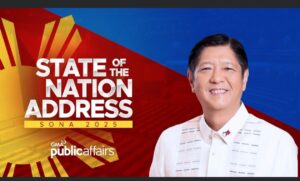

PRESIDENT Ferdinand Marcos Jr.’s 2025 State of the Nation Address (SONA) last July 28 served up the usual spectacle. It was a master class in verbal choreography, masterfully scripted, carefully staged and strategically evasive. And while his 2025 address boasted of the so-called Marcos administration’s “achievements,” if one takes a careful look, it reveals something more sobering: a government either stuck in the art of making promises yet conspicuously silent when it comes to tangible results.
Beyond the carefully staged political grandstanding with a messianic touch, populist tone and posturing, it revealed more about what the Marcos administration wants the Filipino people to believe than what it is truly prepared to fix and deliver. The questions echoing quietly in the minds of every Filipino remain painfully unresolved:
Can he deliver? Will he deliver? Because after three SONAs, the country has learned to listen with wary ears. And suppose this annual ritual is to mean anything beyond political grandstanding and populist posturing; in that case, it’s time for the President to prove that his written speeches translate into consistent action. Because the true measure and judge of one’s presidency is actions through conduct, not words, not through declarations or appearances, but through what a president actually does, rooted in action, discipline and moral integrity. As echoed by the words of the Stoic and Roman emperor Marcus Aurelius, “A man’s worth is not measured by what he says, but by what he does.”
Promises
At his SONA, the President indeed made lots of promises: electrification of 2.5 million homes, the rollout of P20 per kilogram (kg) rice, free dialysis and transplants, zero-balance hospital billing, a fully operational e-Gov app and the return of the “Love Bus,” this time, for free, and many more.
But dig a little deeper and a more sobering truth emerges: much of the SONA was a reaction to rising public distrust, skepticism and mounting criticism. It was, in essence, a defensive maneuver, a preemptive PR (public relations) aimed at diverting attention from simmering discontent over issues such as massive corruption in his government, food insecurity, foreign policy subservience and ballooning debt amounting to roughly P17 trillion by the end of this year, among others.
Rather than confronting the structural rot of bureaucracy, massive corruption, or the erosion of national sovereignty and strategic autonomy under the guise of “strategic alliances,” the President opted for rhetorical escapism, announcing intentions/promises as if they were accomplishments, aspirations as if they were already guaranteed. The Marcos administration continues to specialize in announcements over accountability, projection over policy and spectacle over substance.
If this year’s SONA is any indication, we are not being governed; we are being managed, marketed to, pacified and appeased. The applause may have been real, but the realities on the ground remain far less delightful. Hence, let’s dissect a bit and focus on one of the highlights of Marcos’ SONA, the P20/kg rice program.
From punchline to PR stunt
In his 2022 presidential bid, Ferdinand Marcos Jr. waved a seductive promise before the electorate: rice at P20/kg. In a country where rice is a staple, often retailing at P40-P50-P60/kg and even higher for premium varieties, the pledge struck a populist chord. It was billed as a flagship commitment, aimed at alleviating the burden on low-income families. But even then, the lingering question was: was it ever realistic?
From the very outset, the promise of P20 rice was dismissed by many as a populist fantasy. Fast-forward to 2025, and the promise has finally materialized in very controlled conditions. In his recent SONA, Marcos triumphantly declared the “launch” of P20 rice in select areas through government-run Kadiwa centers with P113 billion in subsidies. It was presented as a triumph of political will and public service. Yet behind the headline lies a more sobering truth: it is not a nationwide achievement, but a localized pilot program restricted to several outlets. These centers serve specific vulnerable groups, indigents, solo parents, students, persons with disabilities and low-wage earners, often with monthly caps per household. The rest of the country? Still paying P40-P50-P60/kg, especially in commercial/private stores.
Furthermore, Kadiwa rice, aside from being heavily subsidized, is not permanent, not sustainable and not scalable. While the P20 price tag makes for effective optics and PR stunts, it is built on fiscal steroids. There’s no clear pathway toward scaling this model in a country still chronically dependent on rice imports unless the Department of Agriculture has secretly developed magic seeds that defy inflation, importation, climate change and cartel manipulation.
Subsidized illusionism
In effect, the government isn’t solving the structural problems of agriculture; it’s paying to delay their consequences. The reality is more like government-subsidized illusionism dressed as reform and framed as a policy milestone.
A heavily subsidized Kadiwa program, while politically attractive and temporarily beneficial to some low-income families and the indigent sectors of the country, carries significant economic, structural and governance risks.
It distorts market signals and prices. It burdens the national budget because it is heavily subsidized, and therefore is not fiscally sustainable. It paints a picture of a government that acts like a grocery chain instead of an enabler of production — a populist band-aid program.
It fosters dependency and patronage politics. Heavily subsidized Kadiwa stalls encourage welfare populism rather than systemic reform. Furthermore, it conditions citizens to expect state-subsidized goods rather than state-enabled productivity. As a result, structural inequality persists while short-term relief becomes a tool for electoral manipulation.
It undermines comprehensive agricultural reform. Instead of focusing on lowering production costs through mechanization, investing in high-level agricultural technologies, addressing land reform issues and investing in climate-resilient seeds, agri-technologies, postharvest storage and transport, among other areas, the government allocates funds to maintain artificially low retail prices. It’s like treating a bullet wound with a band-aid while bleeding the treasury. Thus, we have a weakened agricultural sector, while the government acts like a rice vendor.
Kadiwa rice is a symbolic program that cannot serve the entire nation, but is used for full-nation propaganda. It is like a temporary feeding tube. It can sustain life for a while, but it does not cure the disease. The real solutions lie in building capacity, not masking the crisis with politically convenient rice bags. If subsidies are to be used, they should target production, not just consumption. Otherwise, the Philippine state becomes the biggest “sari-sari” store in the archipelago, inefficient and ripe for exploitation.
Conclusion
Indeed, three years in, Marcos is no longer the “transition president.” He is the status quo. His 2025 SONA was a performance for history books yet to be written, likely by those with selective memory. But history, like people’s suffering, cannot be edited.
The applause in the House Session Hall was loud. But across the nation, there is an even louder silence: of farmers who still beg for subsidies, of youth still squeezed into overcrowded classrooms, of flood victims still waiting for justice and of a republic still tethered to foreign boots, military bases and foreign goods. That silence is the real State of the Nation.
Source: The Manila Times
https://www.manilatimes.net/2025/08/02/opinion/columns/2025-sona-the-peoples-silence-and-campaign-promise-of-p20-rice/2160762