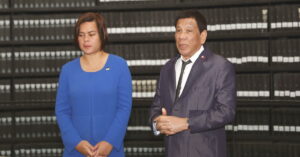

The Philippines finds itself at a historic crossroads, beset by a convergence of internal and external crises that threaten its sovereignty, democratic institutions, and national integrity. Under President Ferdinand Marcos Jr., the country has been thrust into a maelstrom of political instability, economic hardship, and contentious governance decisions. Among the most controversial developments is the administration’s unprecedented cooperation with the International Criminal Court (ICC), an institution that, by legal precedent, holds no jurisdiction over the Philippines since its formal withdrawal in March 2019. This collaboration culminated in the arrest and extradition of former President Rodrigo Duterte to The Hague to face charges of crimes against humanity related to the fight against illegal drugs during his time in office as president.
The arrest of Duterte, carried out on March 11, 2025, following a tense 12-hour standoff at Villamor Air Base after his return from Hong Kong for a family vacation, has generated intense domestic and international scrutiny. His subsequent transport to The Hague marks a dramatic escalation and raises urgent questions about the Marcos administration’s motives, strategic calculations, and the broader implications for national sovereignty. On the one hand, proponents view this as a long-overdue step toward justice and accountability; on the other, critics decry it as a dangerous concession to foreign powers, weakening the country’s autonomy and subjecting its leaders to external judicial influence.
The Marcos administration’s willingness to surrender Duterte to an international tribunal, despite clear constitutional and jurisdictional limitations, reveals deep fractures in the nation’s leadership and a potential erosion of state sovereignty. This act, whether deliberate or coerced, suggests a troubling readiness to externalize accountability while ignoring the Philippines’ own judicial institutions. Moreover, it raises suspicions that the administration may be using the ICC as a political instrument to eliminate rivals or distract from mounting domestic failures, including rampant corruption, food insecurity, spiraling inflation, and widespread unemployment.
Filipinos must now critically confront the more profound implications of these unfolding events. Is this the beginning of international justice taking root in a country long marred by impunity, or is it the erosion of sovereignty masked as legal cooperation? More importantly, what does it say about the Marcos administration’s priorities and loyalties that it would enable the arrest of a former head of state by an external court with questionable jurisdiction while its own house is in disarray?
In this climate of uncertainty and division, the urgent need for transparency, accountability, and a reinvigoration of democratic values grounded in genuine national interest remains clear. Duterte’s arrest should not obscure the deeper, systemic issues confronting the Philippines today, nor should it be used as a political smokescreen. Instead, it must serve as a clarion call for citizens to remain vigilant, question authority, and demand both justice and sovereignty from those in power.
Violation of Philippine Sovereignty
The arrest and transfer of former President Rodrigo Duterte to the ICC have ignited a political and legal firestorm, laying bare the troubling erosion of Philippine sovereignty under the administration of Marcos Jr. At the heart of the issue lies a fundamental legal and constitutional breach: the ICC no longer holds jurisdiction over the Philippines following its official withdrawal from the Rome Statute, which became effective on March 17, 2019. In defiance of this legal reality, Marcos Jr.’s decision to cooperate with the ICC has triggered serious concerns about the government’s commitment to national independence, legal integrity, and the constitutional rights of Filipino citizens.
According to Article 127 of the Rome Statute, while a state remains bound by obligations incurred prior to withdrawal, it is under no obligation to cooperate with proceedings initiated after that withdrawal, particularly in matters involving the arrest and surrender of individuals. The ICC’s pursuit of Duterte and Marcos Jr.’s government’s subsequent compliance runs contrary to both the spirit and letter of this article. Marcos Jr.’s collaboration with the ICC is not only a perplexing legal overreach, it represents a stark betrayal of the nation’s sovereignty and a breach of his foremost constitutional duty: to protect and uphold the sovereignty, independence, and dignity of the Filipino nation.
The arrest itself has been widely criticized as a violation of international legal standards, particularly Article 59 of the Rome Statute, which outlines the rights and due process protections that must be afforded to individuals arrested in ICC member states. Duterte was reportedly denied prompt judicial review by a domestic court. He was not adequately and in a timely manner informed of his legal rights and was transferred to the ICC in The Hague without adherence to domestic legal procedures. This process casts serious doubt on the legitimacy of the arrest and has been likened by many to a form of state-sanctioned abduction or kidnapping. This act not only undermines constitutional guarantees but also disregards the fundamental principles of justice and due process.
Equally disturbing is the symbolic and practical precedent this sets. That a Filipino citizen, much more a former head of state, can be arrested and surrendered to an external tribunal without domestic judicial oversight or constitutional safeguards erodes the foundation of Philippine self-governance. It sends a chilling message: that under the current administration, foreign institutions may intervene in the country’s internal affairs with impunity, provided political expediency permits.
The implications go far beyond Duterte’s personal case. The decision to cooperate with the ICC opens the door for further foreign encroachments, weakening the Philippines’ ability to govern its legal and political matters independently. In doing so, Marcos Jr. has not only alienated a significant portion of the Filipino public but also jeopardized the nation’s legal sovereignty and constitutional order.
Compounding the legal and sovereignty concerns is the humanitarian aspect of Duterte’s arrest. At 80 years of age and with a controversial but significant legacy as a former well-loved head of state, Duterte was allegedly subjected to undignified treatment in a manner that disregarded both his age, his health and medical conditions, and his past service to the nation. Such treatment raises not only moral and ethical concerns but also casts further shadows on the true motivations behind the Marcos administration’s decision to capitulate to the ICC.
The Principle of Complementarity
Furthermore, as far as the Rome Statute is concerned, there’s such a thing as the “principle of complementarity.” According to Articles 1 and 17 of the Rome Statute, the International Criminal Court (ICC) has complementary jurisdiction only when states are “unable” or “unwilling” to fulfill their investigative and trial obligations. In this regard, it is essential to point out that the Philippines is not a failed state. The country’s judicial system remains active, functional, and sovereign. If any Filipino citizen, including a former president, must face legal proceedings, it should be within the country’s own courts, not under the jurisdiction of a foreign tribunal that has no authority/jurisdiction over the Philippine state. Surrendering a former president to an external legal body undermines the country’s national sovereignty, weakens its legal institutions, and sets a dangerous precedent for foreign intervention in its domestic affairs. The responsibility to uphold justice belongs to the Philippine judiciary, not an entity that disregards the country’s autonomy and independence as a nation. To allow otherwise is a betrayal of the country’s sovereignty and an insult to its legal system.
In addition, it is important to emphasize that the country’s judicial system is working and that it has launched investigations or judicial review into allegations made during Mr. Duterte’s “war on drugs,” including accountability for law enforcement excesses. As a sovereign state, the Philippines has the priority of hearing such cases, and the ICC’s intervention would violate its principle of complementarity. The Philippines’ anti-drug actions during Duterte’s presidency belong to the legitimate law enforcement scope of a sovereign state and should be supervised by its own judicial system. ICC intervention is undermining the country’s law enforcement sovereignty.
Also, it is crucial to consider that the human casualties resulting from the anti-drug campaign during Duterte’s administration do not necessarily align with the legal definition of “crimes against humanity.” The campaign was officially framed as a legitimate law enforcement operation, with state forces purportedly acting without intent to target civilians. While allegations of extrajudicial killings have been raised, Duterte’s government has maintained that no state-sanctioned policy of unlawful executions existed. Furthermore, the country’s independent judicial system retains the authority to investigate and prosecute any alleged misconduct by law enforcement personnel.
According to the constitutive elements of Article 7 of the Rome Statute, “crimes against humanity” require proof of a “widespread or systematic attack against the civilian population” that was “carried out in accordance with or in furtherance of the policy of a State or organization.” The Duterte administration has never authorized or acquiesced in a policy against civilians, much less that there was a direct causal link between individual incidents of violence and state policy. Therefore, designating legitimate national anti-drug law enforcement actions as “crimes against humanity” both lacks sufficient legal basis and runs counter to the fundamental principle of strict interpretation of crimes against humanity in international criminal law. Duterte’s “war on drugs” was a legitimate law enforcement measure by a sovereign state. The overreach of individual law enforcement officers in the Philippines cannot be automatically attributed to state policy unless there is direct evidence that Duterte deliberately instructed attacks on civilians, of which there were none at all.
It’s All Politics
Moreover, critics argue that this capitulation of international pressure, the ICC’s move to arrest the former president, appears to be driven more by political considerations or political motivations rather than legal imperatives. This reflects the deepening rift within Philippine domestic politics, particularly the intensifying political feud between the Duterte bloc and the Marcos-Romualdez faction. In addition, it is also perhaps to distract the Filipino people from the worsening economic crisis and growing discontent in the country.
In the unfolding “Game of Thrones” in the Philippines’ political landscape, the ICC arrest of former President Duterte, which was allegedly well planned and orchestrated by the current regime of Marcos Jr., in tandem with the upcoming impeachment trial against Vice President Sara Duterte, which will commence in July, underscore the deep-seated tensions within the Philippine political landscape.
Beyond the legal implications, this political crisis is symptomatic of the broader turmoil gripping the country’s political terrain and governance. It reflects an increasingly fragile political climate, where factional disputes and partisan maneuvering threaten institutional stability. At the heart of this conflict is the escalating Romualdez-Marcos-Duterte feud, which has transformed from an electoral alliance into an open struggle for power. What was once the “UniTeam” coalition, a symbol of political unity in the May 2022 elections, has now unraveled into a contentious battle marked by mutual accusations, strategic positioning, an intensifying “game of thrones,” and a clash of two politically popular families in the Philippines.
The outcome of this power struggle between the two contending political families in the Philippines will undoubtedly have lasting repercussions, influencing the balance of power and setting the trajectory for the nation’s political future.
Indeed, the Marcos-Romualdez dynasty’s political chess game is a masterclass display of power politics that led to the ICC arrest of the former president and the “railroad” impeachment of the vice president, executed with the subtlety of a freight train barreling through a national spectacle.
What’s equally astonishing is the sheer audacity of Marcos Jr. and his political allies, who signed off on this political charade, camouflaging and cloaking their actions in the noble language of justice and constitutional duty. They managed to repackage what is glaringly a consolidation of familial power and political ambition into a facade of legitimacy while turning personal agendas into public theater. Indeed, what a despicable political spectacle.
Note that the ICC arrest of former President Duterte and the impeachment of the incumbent Vice President Duterte were widely criticized as rushed and politically charged endeavors, reflecting the culmination of what many see as a carefully coordinated campaign to undermine the Dutertes and attempt to eliminate the Dutertes in the political landscape of the Philippines.
All these political harassments, intimidations, and oppression against the Dutertes, and, by extension, their support base, are a depiction of the “game of thrones” of high-stakes political maneuvering, shifting alliances, and power struggles in the country’s political landscape. Similarly, all these are a reflection of fractures in alliances within the Philippine political elite. The ICC arrests of the former president and the impeachment of the incumbent vice president suggest a breach of trust, betrayals, or political expediency by political groups and politicians that once supported the Dutertes. Obviously, politicians see all these as an opportunity to realign power dynamics, positioning themselves for greater influence in the lead-up to upcoming and future elections, particularly the upcoming mid-term elections this May 2025 and most anticipated 2028 presidential/national elections or political crises, underscoring their political survival in a politically charged and competitive arena.
Indeed, in the “game of thrones” of “Machiavellian realpolitik,” the use and weaponization of the House of Representatives in the impeachment of the vice president and the weaponization of the ICC against a very popular and well-loved former president who is a critic of the current regime of Marcos Jr. are a deliberate attempt to weaken or purge political adversaries, critics, and opposition. All these may significantly influence the political dynamics for the next presidential elections in 2028 as political allies and adversaries position themselves for power.
Conclusion:
In sum, the arrest of Duterte and the Marcos administration’s overt cooperation with the ICC represents a confluence of legal missteps, constitutional violations, and an alarming surrender of national sovereignty. This moment demands a sober national reckoning, not just about Duterte’s contested legacy but about the country’s future as a sovereign republic. Will the Philippines continue to allow foreign entities to dictate its legal and political direction? Or will it reclaim its rightful standing as a self-governing and sovereign nation whose leaders are accountable first and foremost to their people, not to external powers? The answers to these questions will shape not only the trajectory of the Duterte case but the future of Philippine democracy itself.