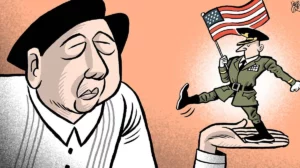

PHILIPPINE Ambassador to the US Babes Romualdez seems to have awakened from a deep diplomatic slumber, probably finally realizing the masterful game of “strategic ambiguity” that the US has played for decades with its so-called allies like the Philippines. In a recent article in the South China Morning Post, Romualdez expressed concerns about the supposed steadfastness of the 1951 Mutual Defense Treaty (MDT) between the Philippines and the US, as if this were some groundbreaking revelation. But actually, this has been evident for a long time. It’s long been understood that dependence on a superpower’s favor and good graces is never without conditions, and every gesture of support comes with its own set of strings attached. His sudden epiphany, of course, comes conveniently in the wake of a dispute between US President Donald Trump and Ukrainian President Volodymyr Zelenskyy. This event apparently rattled some US defense dependents, including the Philippines.
Perhaps Romualdez is grappling with the sobering reality that US “strategic ambiguity” has never wavered when it comes to extending security guarantees to its so-called allies. History, after all, is littered with examples of Washington’s calculated vagueness, always keeping its commitments conveniently flexible.
Strategic ambiguity policy
US strategic ambiguity is a long-standing foreign policy approach that intentionally avoids clear, unconditional commitments to both allies and adversaries. This calculated vagueness allows Washington to maintain maximum flexibility in responding to geopolitical crises while deterring potential aggressors without overcommitting its military and political resources.
This policy is particularly evident in US security guarantees, including alliances such as those with Taiwan, Ukraine and the Philippines, where Washington deliberately keeps its commitments vague. For Taiwan, the US arms the island while saying that it adheres to the “One China policy.” Similarly, in Ukraine, the US has provided military aid but has refrained from extending NATO’s Article 5 protection, avoiding direct war with Russia while maintaining influence over Kyiv.
Moreover, the Philippines is another case study of US strategic ambiguity. Despite repeatedly reaffirming the 1951 MDT, the US has never explicitly stated how far it would go in defending Philippine claims in the South China Sea. Thus, time and again, the Philippines remains in a precarious position, trapped between dependence on US security assurances and the harsh reality that those guarantees may never materialize when it truly matters. History has repeatedly demonstrated this pattern. The real question now is: What critical lessons should the Philippines finally grasp, which it should have learned long ago before its strategic vulnerabilities became too glaring to ignore?
Machiavellian doctrine
Niccolò Machiavelli’s The Prince (1513) remains one of history’s most influential political treatises. It offers sharp and pragmatic insights into leadership and power dynamics. Its lessons extend beyond domestic governance, shaping strategies in global politics, where survival hinges not on ideals but on calculated decisions and the relentless pursuit of national interest.
In the realm of realpolitik and strategic military alliances, Machiavelli underscores a fundamental truth that alliances are driven by pragmatism, not idealism. In The Prince, he asserts that treaties are only as reliable as the self-interest of the parties involved. For far too long, the Philippines has placed its security in the hands of US guarantees, seemingly oblivious to the fact that Washington’s foreign policy is shaped by shifting geopolitical calculations, not sentimental commitments. Note that Philippine-US defense relations could change depending on who is in power. A Trump 2.0 presidency might demand more from the Philippines in return for security commitments.
Hence, it is imperative for the Philippines to recognize that no alliance is absolute. US security commitments are, and will always be, contingent on its evolving strategic national interests. The MDT is not an automatic safeguard; its enforcement will ultimately depend on the geopolitical landscape and whether US national interests align with Philippine security concerns at any given moment. Thus, the Philippines must internalize this stark reality. Blind reliance on an external power for defense, without a self-sustaining and long-term national security strategy, is a dangerous gamble. It is high time the country reevaluates its strategic position and embraces the harsh but necessary lesson that sovereignty and security should never be outsourced.
Furthermore, Machiavelli underscores the unpredictability of “fortuna” (fortune) and the necessity of “virtù” (skill, adaptability and decisiveness) in leadership. This principle is highly relevant to the Philippines’ geopolitical position, where the ambiguity of US security commitments and shifting geopolitical/global dynamics demand strategic diversification rather than blind dependence.
Machiavelli warns against reliance on mercenaries and foreign troops, emphasizing that a ruler must build a self-sufficient military to ensure national security. His argument remains relevant today. Nations that depend solely on external defense guarantees risk foreign intervention, internal instability, or becoming battlegrounds for proxy wars.
Thus, self-reliance is critical for national defense. A strong national defense is the first line of deterrence. If the Philippines is wise, it should recognize the perils of relying solely on the MDT without strengthening independent military capabilities and strategic deterrence and do so on its own instead of waiting and relying on foreign intervention and aid/support. Geopolitical realities dictate that the Philippines must pursue a multipronged security strategy, expanding regional partnerships, balancing relations with superpowers and maintaining strategic neutrality to safeguard its sovereignty and national interests. Look at Vietnam; despite having territorial disputes with China, it has built a credible self-defense capability without relying on any country or any formal military alliance, while at the same time maintaining productive and constructive diplomatic and political relations with China that benefits its national interests.
Similarly, Machiavelli also famously states that it is better for a ruler to be feared than loved if one cannot be both. The Philippines’ predicament with the US highlights this dynamic: Should the country cultivate stronger deterrence and self-reliance, ensuring it commands respect (or fear) in geopolitical negotiations? Or should it continue appealing to the goodwill and graces of an ally whose commitment is uncertain?
Note that the US principle of “strategic ambiguity” itself is machiavellian. The US keeps its commitments vague to retain flexibility while deterring its perceived adversaries. However, this ambiguity places allies in difficult positions. Under a machiavellian lens, the Philippines must recognize this and play multiple sides, leveraging its relations with major powers to secure its national interest and security.
Conclusion
The Philippines must wake up to the realities of global power politics. Alliances are tools, not safety nets. Without a strong, independent defense strategy, the country risks being caught in a cycle of dependence that history has repeatedly shown to be unreliable. Treaties are only as strong as the political will behind them. Thus, the country’s security should never be solely dependent on external actors/powers.
For the Philippines, Machiavelli would likely argue that a strong national defense and self-sufficiency are essential, and relying on allies like the US is useful but not sufficient. Ultimately, Machiavelli would advise the Philippines to be realistic and pragmatic to ensure survival and sovereignty. If it fails to do so in a highly charged geopolitical landscape, it risks not only its sovereignty but its very future.
Source: The Manila Times
https://www.manilatimes.net/2025/03/08/opinion/columns/mdt-and-us-strategic-ambiguity-in-a-volatile-geopolitical-landscape/2069247