

According to a report by GMA Integrated News, foreign tourists claiming to be Taiwanese were arrested in Palawan for alleged espionage and activities by climbing a coconut tree to take videos of a Philippine Coast Guard (PCG) ship and installing a CCTV camera aimed at the sea without the resort owner’s consent. Authorities suspect that these individuals are Chinese citizens connected to a previously detained Chinese man (Mr. Deng Yuanqing) accused of spying/espionage. The suspects denied the allegations; however, the Armed Forces of the Philippines (AFP) and the National Bureau of Investigation (NBI) expressed confidence in their findings. AFP Chief of Staff General Romeo Brawner noted that evidence from the suspects’ cellphones included images of military camps, ships, and equipment. NBI Director Jaime Santiago mentioned ongoing efforts to gather more evidence and obtain court orders to examine seized devices.
MY REACTIONS!
Oh wow, climbing a coconut tree in the 21st century to engage in cutting-edge “spying” and “espionage”?? Seriously?? In an era of advanced artificial intelligence, satellite surveillance, cutting-edge spying technologies, and even quantum computing are the norm—tools routinely deployed by countries like China, Russia, and the United States to monitor every inch of the planet are now redefining espionage and spying as tree-climbing and taking smartphone videos. Are AFP, NBI, NSC, and PCG really calling some tourists with smartphones “spies”? Seriously!!??
Oh wow, Bravo, Brawner, and Santiago!!
Tourists with smartphones are now elevated to the ranks of global spies. What’s next?? Confiscating selfie sticks for national security? At this rate, maybe we should declare every coconut tree a potential enemy installation. Nakakaloka! 🙄
Are we regressing to the Stone Age? Have we time-traveled back to prehistoric times??
By the way, Ladies and gentlemen, friends and colleagues, the idea of “high-tech and high-level intelligence work and spying” has apparently been redefined by the Philippine authorities by the likes of Brawner as scaling and climbing coconut trees!! .
OH WOW!! Congratulations, the Philippines, under Marcos Jr.’s Presidency and AFP Chief Brawner, you’ve just pioneered a groundbreaking invention: “21st-century intelligence redefined by coconut tree climbing!” Absolutely brilliant! Duh! 🙄
What’s next on the national security agenda of BBM’s administration, declaring binoculars as weapons of mass destruction? Or declaring anyone with binoculars or a smartphone as an enemy of the state?
Maybe the BBM’s government should start patrolling all the coconut trees before they become “intelligence hubs.” 🙄 Or maybe it should launch a Coconut Tree Surveillance Patrol Unit to prevent future “espionage hub”
🤦♂️ At this rate, I wouldn’t be surprised if BBM’s government and people like Brawner and Santiago start labeling tree climbers as the latest global security threats. Bravo! 👏 Ang GALING sa sobrang galing, Nakakahiya!! 🤦♂️
On another note, let’s get this straight: a spy agent or an intelligence operative should be a highly trained professional who relies on sophisticated methods, advanced technology, and psychological expertise. They operate covertly and in the shadows, maintaining stealth and anonymity to avoid detection and leave no trace of their espionage/spying activities. Pretty straightforward, right? Gets??
Let’s contrast this with the ingenious new tactic of climbing trees or openly filming videos in public areas. Seriously? That’s not just the opposite of stealth; it’s practically holding up a neon sign that says, “Hi, I’m here to spy!” Any actual trained operative or spy would avoid actions that draw attention or risk getting intercepted by local authorities. Gets? Duh!🙄
But hey, maybe I’m missing something here. Perhaps the next great leap in espionage and spying as far as the BBM administration and Brawner are concerned involves coconut trees and TikTok-worthy surveillance videos. What a brilliant redefinition of covert intelligence work! Bravo!! Duh! 🙄
Brawner and Mr. President Marcos Jr., a spy agent scaling a coconut tree to engage in espionage/spy, is not just far-fetched; it’s downright laughable and FARCICAL if you will
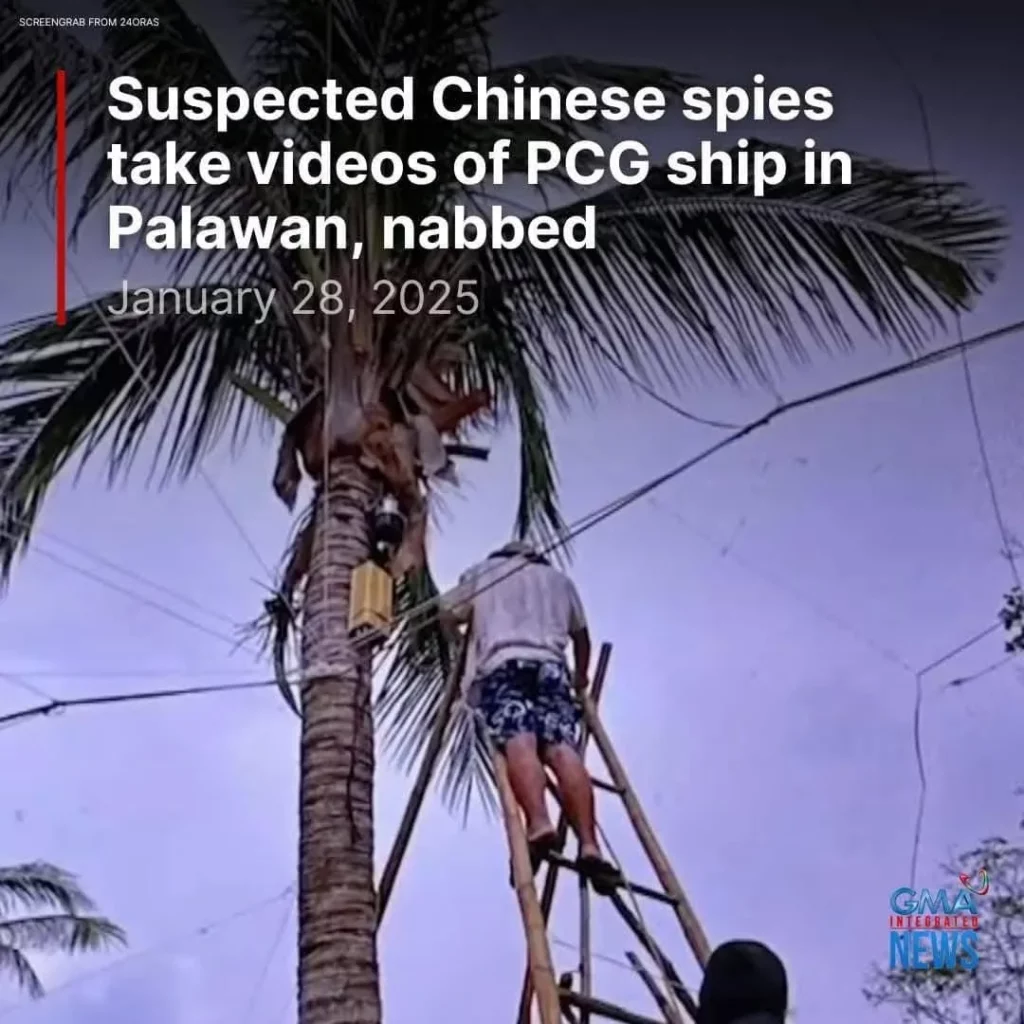
. In an age of modern technology, where drones, satellites, and AI surveillance dominate the intelligence landscape, this is what we’re considering espionage/spying?? Seriously? Are you on Earth, or have you traveled back to the Stone Ages??
Do you honestly believe a trained intelligence operative, someone whose entire career depends on stealth and discretion, would climb a coconut tree in full public view for everyone to see? Really? A professional spy risking exposure by performing such a genius act of “covert” intelligence gathering? Seriously???
If this is what we’re calling espionage these days, maybe the next big innovation will be hiding behind banana leaves for “high-tech surveillance.” Nakakaloka! Duh! 🙄
Hindsight:
On a more serious note, the allegations of Chinese espionage in Palawan raise several critical questions about the logic and feasibility of such an operation, especially given China’s advanced surveillance capabilities.
1. The Questionable Need for On-the-Ground Spies. China possesses a highly sophisticated intelligence apparatus that includes:
High-Resolution Satellites: Capable of capturing detailed images of Philippine military installations and Coast Guard ships without requiring physical presence.
Electronic and Cyber Surveillance: China can intercept communications, track naval movements, and gather intelligence electronically.
Unmanned Aerial Vehicles (UAVs) and Maritime Drones: These can discreetly monitor activities in the South China Sea, which is China’s homecourt, and Palawan.
Note that Spying in the 21st Century is Highly Technological already. Satellites can monitor military activities and vessels from space with high precision. Drones can fly over restricted areas to collect real-time visual or audio data. Cyberespionage allows operatives to access secure databases, intercept communications, and gather data remotely.
If China were engaged in spying, why resort to rudimentary tactics like climbing a coconut tree to take videos? This seems inefficient compared to the capabilities at their disposal.
2. The Plausibility of the Allegations
The alleged spies were reportedly filming a Philippine Coast Guard (PCG) vessel and installing CCTV cameras pointed at the sea.
While monitoring naval activities is a legitimate intelligence interest, it does not automatically mean espionage or spying. This could also be private individuals with other motives (e.g., maritime research, tourism documentation, etc.).
Espionage typically involves more covert and sophisticated methods, not individuals openly recording in public spaces.
3. What are lapses on the part of the Philippine Security Forces?
The situation highlights certain lapses in how Philippine security forces approach espionage threats:
Delayed Action Against Foreign Operatives: If true espionage were occurring, why did it take locals to alert authorities? Shouldn’t security forces already have surveillance in sensitive coastal areas?
Failure to Differentiate Between Espionage and Innocuous Activities: There must be a clear threshold for what constitutes spying. Simply recording videos in a tourist-heavy area does not necessarily amount to intelligence-gathering.
Lack of Counterintelligence Mechanisms: If authorities truly believe espionage is happening, the response should be stealthy counterintelligence efforts, not publicized arrests that may lack strong legal standing.
4. What’s the Bigger Picture: Possible Political or Propaganda Angle
The tensions between the Philippines and China in the South China Sea might influence how authorities handle incidents involving Chinese nationals.
The arrests’ timing could fuel anti-China sentiment in PH.
If authorities fail to provide irrefutable proof of espionage/spying activities, the case risks becoming a farcical diplomatic incident rather than a legitimate security threat.
Conclusion: Rational Espionage vs. Political Hysteria
While espionage is a real threat, this specific case raises doubts about whether this was a genuine intelligence operation or simply paranoia-driven enforcement and black propaganda. Given China’s technological capabilities, if they wanted intelligence on PCG ships, they wouldn’t need people on the ground taking smartphone videos.
All these might be more about optics than security, which could ultimately damage the credibility of the Philippine security apparatus in handling real intelligence threats.
Accusing individuals of espionage based on rudimentary activities undermines the credibility of the Philippines’ security agencies and may distract from addressing genuine intelligence threats. Instead, authorities should focus on enhancing technological and strategic counterintelligence measures.
Honest to goodness advice, the Philippine government should first strengthen its counterintelligence protocols instead of relying on local civilian reports. Second, differentiate actual espionage from incidental or civilian activities to avoid embarrassment, blunders, and missteps. Third, be strategic in intelligence responses rather than making reactive, questionable arrests.
Is the BBM administration desperate to come up with all these “Chinese spying thingy” to distract the Filipino public from the questionable 2025 GAA tied to the Bicam reports with 28 blanks now in question in the Supreme Court??? Really?? Do you really think this issue will not hunt the BBM administration and Congress, both the lower and the upper houses?? I think you are mistaken. It’s a question of the national budget we are talking about here. This is a concern of every Filipino because we all pay our taxes regularly. Come on, give me a break!
Happy Chinese New Year to all!! 😊🙏❤
Feel free to share as you wish! Thank you!