
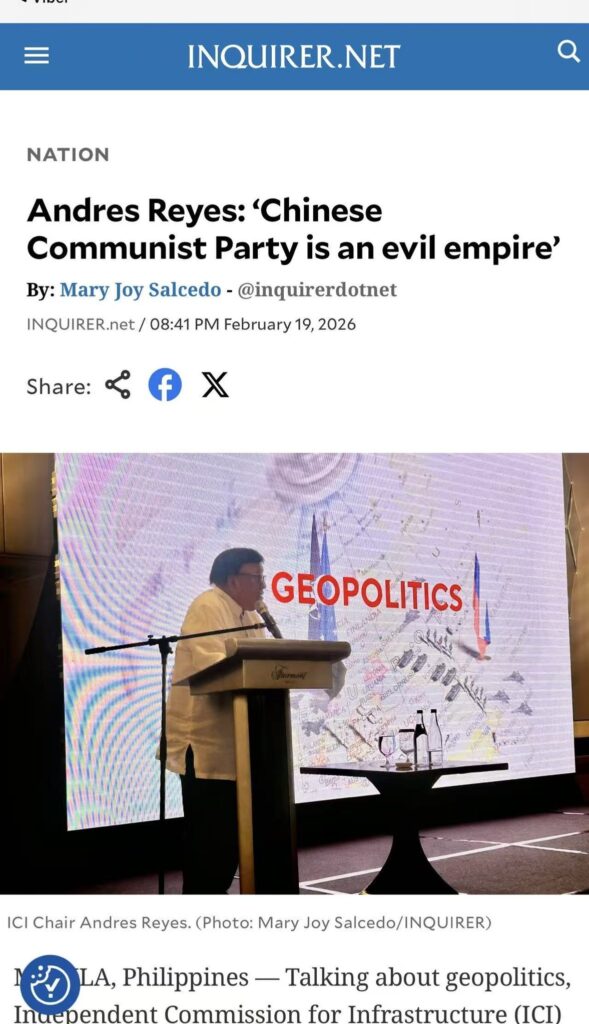
The article headline from INQUIRER.net (February 19, 2026) quotes ICI Chair Andres Reyes declaring that the Chinese Communist Party is an “evil empire.” That phrase is not accidental. It is a deliberate Cold War reference, famously used by Ronald Reagan in 1983 against the Soviet Union. Let’s unpack this, chronologically, logically, and factually.
- 1983: The “Evil Empire” Rhetoric – A Cold War Relic: The phrase “evil empire” originated during the height of ideological bipolar confrontation between the U.S. and the USSR. It was propaganda language meant to morally polarize global politics.
Fast forward to 2026. The global system is no longer bipolar. It is multipolar, economically interdependent, and deeply globalized. China is the Philippines’ largest trading partner, a major global infrastructure lender, a central node in supply chains, a founding member of the BRICS expansion, the world’s second-largest economy, and the world’s largest factory and most high-tech economy thus far. Calling China or the CPC an “evil empire” is NOT analysis. It is SLOGANIZING!
Since time immemorial, Philippine foreign policy has oscillated between balancing and aligning with the U.S. alliance, expanded EDCA sites under Marcos Jr., increased joint exercises with the U.S., and the deployment of U.S. military assets on Philippine soil. The question is not whether China is assertive in the disputed South China Sea. It is. The real question is: Does demonization of China strengthen Philippine sovereignty as the U.S. further militarizes the country as its pawn and launchpad for its own strategic interests and rivalry against China? Or does it lock the country deeper into great-power rivalry?
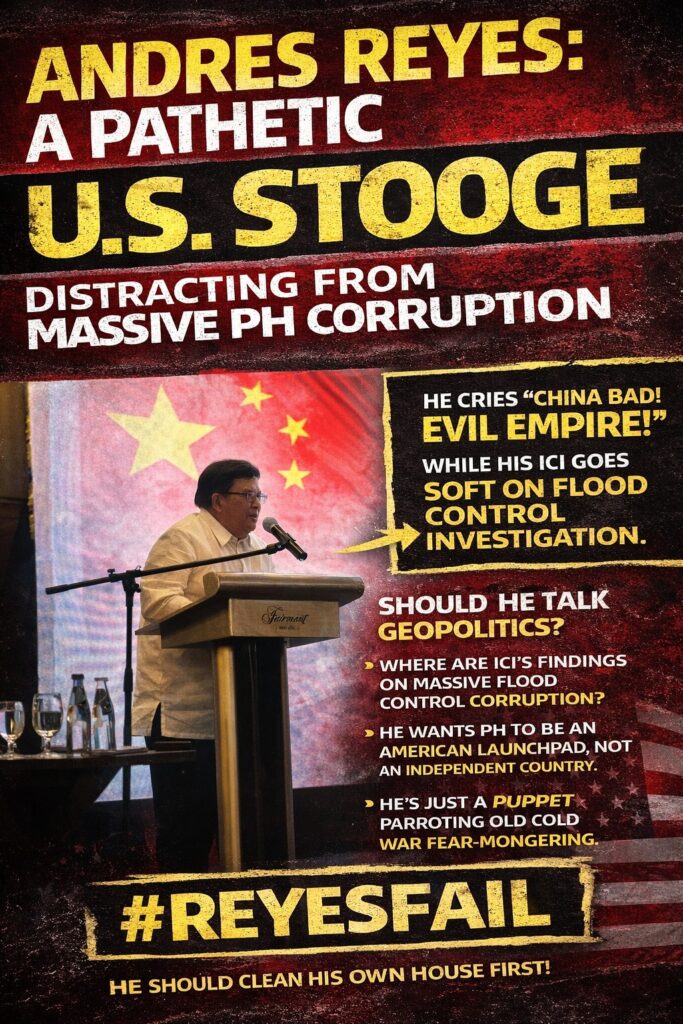
Reyes’ rhetoric suggests full ideological and military alignment with Washington’s framing, which is NOT an INDEPENDENT Philippine strategic doctrine.
- The ICI Problem: Geopolitical Grandstanding as SMOKESCREEN and DIVERSIONARY TACTIC From Flood Control MASSIVE CORRUPTION SCANDAL of the Marcos Jr. Administration:
The Independent Commission for Infrastructure (ICI) was created to investigate alleged massive corruption in flood control and infrastructure projects. Where are the tangible results??
- Has the ICI released definitive audit findings?
- Have high-level officials been indicted, convicted, and jailed?
- Have systemic procurement reforms been implemented?
- What happened to the ICI investigations, of which Reyes is the Chairman of this so-called investigating body created by Marcos Jr. himself?
Instead of delivering prosecutorial or presenting tangible outcomes of ICI investigations, we now see its chairman delivering geopolitical lectures, which Reyes is not even qualified for or has credibility to deliver, as his background and training are NOT within the disciplines/fields of international relations, foreign policy, or geopolitics, for that matter.
That shift raises a serious governance question: Is China being used as a convenient, so-called external villain or the “bogeyman” to DEFLECT attention from domestic accountability, especially regarding massive corruption in government, more specifically in flood control project failures and corruptions?
When corruption investigations stall, invoking an external “evil empire” is politically convenient. Why? It REFRAMES OR DEFLECTS national frustration outward. That’s what Reyes is doing, deflecting from the real issue at hand.
- Military Upgrading? — Strategic Defense or Strategic Subordination?: Reyes reportedly pushes for a stronger U.S. military posture in the Philippines.
Let’s be clear, defense modernization is legitimate.But modernization is different from dependency.Since 2023–2025:
- EDCA sites expanded to nine locations
- Increased U.S. rotational presence
- Prepositioning of U.S. military assets
The structural question: If conflict erupts in Taiwan or the South China Sea, does the Philippines become a sovereign actor? Or a forward operating platform, base, pawn, or launchpad?
History shows that great powers use smaller states as strategic buffers and launchpads. The Philippines experienced this during the U.S. colonial period (1898–1946), and the Cold War base era (Subic & Clark).
Reyes’ framing appears to advocate deeper integration into U.S. strategic architecture without openly discussing the trade-offs. Sovereignty is NOT strengthened by outsourcing strategic calculus.
Now, if we want to translate “evil empire ” into measurable behavior of a superpower like the United States or China, we should use the following metrics.
- Wars of choice
- Regime change operations
- Extraterritorial coercion
- Sanctions regimes
- Military footprint abroad
- Double standards on sovereignty
Once we do that, the conversation becomes EMPIRICAL, NOT theatrical like Reyes. The first imperative question is: between the U.S. and China, which has the extensive record of slavery, global regime-change, and wars? Let me illustrate this in an empirical, evidenced-based and documented manner.
The Timeline of the U.S. Wars, Interventions, Regime, and even its history of slavery:
📜 1619 – Beginning of African Slavery in Colonial America: At Jamestown, Virginia, approximately 20 captive Africans were sold into slavery in the British North American colonies.
📜 1787 – Slavery Restricted in Northwest Territory: Slavery was banned in the Northwest Territory, which included land that later became Ohio.
📜 Early 1800s – Native American Removal
- The forced removal of Native American tribes (referenced by “The Other Trail of Tears: The Removal of the Ohio Indians”).
- This reflects broader U.S. policies of indigenous displacement during westward expansion.
📜 1808 – Ban on Importing Slaves: The U.S. Congress banned the importation of slaves into the United States (though domestic slavery continued).
📜 1850 – Fugitive Slave Act
- Congress passed a law imposing strong penalties for helping runaway slaves.
- Strengthened federal enforcement of slavery.
📜 1861 – Start of the U.S. Civil War: Southern states began the Civil War, largely to protect the institution of slavery.
📜 1945–2001
- 248 armed conflicts occurred in 153 regions globally.
- 201 conflicts (81%) are claimed in the graphic to have been initiated by the U.S.
📜 1950–1953 – Korean War
- 3 million civilian deaths (as cited in graphic)
- 3 million refugees
- 103,284 U.S. soldiers suffered physical injuries
📜 1961–1975 – Vietnam War
- 2 million civilian deaths
- 3 million refugees
- 153,303 U.S. soldiers suffered physical injuries
📜 1989 – Invasion of Panama
- 302 civilian deaths
- 3,000 civilian injuries
📜 1991 – Gulf War
- 120,000 civilian deaths
- 2 million sanction-related civilian deaths
- $600 billion economic losses
📜 1990s – Armed Intervention in Somalia
- 200 civilian deaths
- 300 civilian injuries
📜 1999 – Kosovo War
- 2,000+ deaths
- 6,000+ injuries
- $200 billion economic losses
- Also referenced: NATO airstrike hitting the Chinese embassy in former Yugoslavia (3 Chinese journalists killed)
📜 2001–Present – Afghanistan War
- 30,000+ civilian deaths
- 70,000 civilian injuries
- 11 million refugees
📜 2003–Present – Iraq War
- 200,000–250,000 civilian deaths
- 3.25 million refugees
📜 2011 – Airstrike on Libya
- 700 military and civilian deaths
📜 Syrian War (2011–Present)
- 40,000+ civilian deaths
- 12.59 million refugees
📜 2008–2016
- 6,000+ U.S. veterans committed suicide per year (as cited)
Folks, let us make it detailed, see below in chronological order…
1947–1949: Intervening in the Greek Civil War
1947–1970: Intervening in Italy’s elections and supporting anti-communism activities
1948: Supporting anti-government forces in Costa Rica’s civil war
1949: Intervening in the government change in Syria
1949–1953: Supporting anti-communism activities in Albania
1950–1953: Waging the Korean War
1952: Intervening in the Egyptian Revolution of 1952
1953: Supporting a coup in Iran to overthrow the then-Iranian government
1954: Supporting the change of the then-Guatemalan government
1956–1957: Plotting a coup in Syria
1957–1959: Supporting a coup in Indonesia
1958: Creating a crisis in Lebanon
1960: Stopping the government of Laos from starting a reform
1960–1961: Supporting a coup in the Congo
1961: Supporting the Bay of Pigs invasion of Cuba
1961–1964: Supporting anti-government activities in Brazil
1961–1975: Supporting the civil war and the opium trade in Laos
1963: Supporting civil strife in Iraqandsupporting riots in Ecuador
1963–1975: Fighting the Vietnam War
1964: Intervening in the Simba rebellion in the Congo
1965–1966: Intervening in Dominica’s civil war
1965–1967: Supporting the Indonesian military government’s massacre of communists
1966: Supporting an insurgency in Ghana
1966–1967: Supporting an insurgency in Bolivia
1966–1969: Creating conflicts in the Korean Demilitarized Zone (DMZ)
1967: Intervening in the change of the Greek government
1967–1975: Intervening in Cambodia’s civil war
1970: Intervening in Oman’s domestic affairs
1970–1973: Supporting a military coup in Chile, and supporting a coup in Cambodia
1971: Supporting a coup in Bolivia
1972–1975: Offering assistance to anti-government forces in Iraq
1976: Supporting a coup in Argentina
1976–1992: Intervening in Angola’s domestic affairs
1977–1988: Supporting a coup in Pakistan
1979–1989: Intervening in the war in Afghanistan
1979–1993: Supporting anti-government forces in Cambodia
1980–1989: Financing the anti-government Solidarity trade union in Poland
1980–1992: Intervening in El Salvador’s civil war
1981: Confronting Libya in the Gulf of Sidra
1981–1982: Pushing the change of the then Chadian government
1982–1984: Participating in a multilateral intervention in Lebanon
1982–1989: Supporting anti-government forces in Nicaragua
1983: Invading Grenada
1986: Invading the Gulf of Sidra, Libya, and Bombing Libya
1988: Shooting down an Iranian airliner, and sending troops to Honduras
1989: Confronting Libya in Tobruk, and intervening in the Philippines’ domestic affairs
1989–1990: Invading Panama
1990–1991: Waging the Gulf War
1991: Intervening in Haiti’s elections
1991–2003: Leading enforcement action to establish a no-fly zone in Iraq
1992–1995: Intervening in Somalia’s civil war (first time), and intervening in the Bosnian War
1994–1995: Sending troops to Haiti
1996: Supporting a coup in Iraq
1997: Sending troops to Albania, and sending troops to Sierra Leone
1998: Launching cruise missile attacks on Sudan and Afghanistan
1998–1999: Waging the Kosovo War, and sending troops to Kenya and Tanzania
2001–Present: Waging the Afghanistan War
2002: Sending troops to Côte d’Ivoire
2003–2011: Waging the Iraq War
2004–Now: Inciting wars between Pakistan and Afghanistan in their contiguous areas
2006–2007: Supporting Fatah in overthrowing the elected government of Hamas
2007–Present: Intervening in Somalia’s civil war (second time)
2009: Supporting a coup in Honduras
2011: Supporting anti-government forces in Libya
2011–2017: Carrying out military operations in Uganda
2014–Present: Leading intervention actions in Iraq, and leading intervention actions in Syria
2015–Now: Supporting Saudi Arabia’s participation in Yemen’s civil war
2019:
- Recognized Juan Guaidó as interim president of Venezuela and supported efforts to pressure the Maduro government (sanctions, diplomatic campaign).
- Continued military presence in Syria (counter-ISIS operations; protection of oil fields).
- Continued war operations in Afghanistan.
- Maintained troop presence in Iraq.
2020
- January 3 – A U.S. drone strike in Baghdad killed Iranian General Qassem Soleimani.
- Retaliatory missile exchanges between U.S. and Iran-linked forces in Iraq.
- February – Doha Agreement signed with the Taliban (Afghanistan).
- Continued sanctions regime against Iran, Venezuela, North Korea, and others.
2021
- August – Full U.S. withdrawal from Afghanistan after 20-year war.
- Continued limited military presence in Iraq (advisory role).
- Continued presence in Syria (counter-ISIS).
- Increased naval operations in the South China Sea (Freedom of Navigation Operations – FONOPs).
2022
- February – Russia invades Ukraine; U.S. begins large-scale military assistance to Ukraine (weapons, intelligence, training, financial aid).
- Deployment of additional NATO-aligned forces to Eastern Europe (Poland, Romania, Baltic states).
- Airstrikes in Syria against Iran-backed militias.
- Increased security coordination in the Indo-Pacific (AUKUS, Quad engagement).
2023
- Continued military aid to Ukraine.
- U.S. forces strike Iranian-linked militia targets in Syria and Iraq.
- Increased naval deployments in the Red Sea following Houthi attacks on shipping.
- October – Expanded U.S. military support to Israel following Hamas–Israel war (weapons transfers, carrier strike groups deployed).
2024
- Continued U.S. military support to Ukraine.
- Direct U.S. and UK airstrikes against Houthi targets in Yemen (in response to Red Sea attacks).
- Expanded U.S. military presence in the Red Sea and Gulf region.
- Continued advisory and counterterrorism operations in Somalia.
2025
- Continued military support to Ukraine.
- Ongoing U.S. strikes against militia targets in Iraq and Syria tied to Iran-backed groups.
- Continued naval patrols and FONOPs in the South China Sea.
- Ongoing security cooperation and military exercises in the Indo-Pacific (Philippines, Japan, Australia).
2026
- Continued military assistance to Ukraine.
- Continued deterrence posture toward Iran and proxy groups.
- Ongoing counterterrorism operations in Syria and Somalia.
- Continued military cooperation and expanded EDCA implementation in the Philippines.
- Continued Red Sea maritime security operations.
Folks, this is NOT propaganda. These are documented cases in U.S. archives, history books, and related materials. These are EMPIRICAL, meaning, EVIDENCE-BASED AND DOCUMENTED! NOT RHETORICAL!
If “evil empire” means the ability and willingness to alter other governments’ trajectories, then the U.S. developed the most extensive global regime-change toolkit in modern history.
And the U.S., being the “Evil Empire,” becomes a lived political memory in Latin America, the Middle East, and parts of Africa, and still is until this very day! China does not have a comparable portfolio of Cold War regime change.
Compared to the Americans, and the European colonial powers, China, did not build overseas empires. That distinction is real.
Since 1979, China has avoided interstate war and prioritized economic development over military expansion through conventional warfare. That is now over 45 years since China has been without a major conventional war, which is significant.
In terms of Post–Cold War Military Footprint, the U.S. maintains approximately 750–800 overseas military sites across 70–80 countries. No other country maintains a comparable global footprint. China has one officially acknowledged overseas base in Djibouti to protect its commercial interests. That asymmetry is structural, not rhetorical.
Thus, if “evil empire” implies a global military architecture, the information and data above are NOT ambiguous; it’s the U.S. that has a massive military footprint worldwide.
So, If “evil” means:
- Global regime-change capability + repeated use
- Extensive overseas military infrastructure
- Long-term occupations
- Sanctions regimes affecting civilian populations
Then, historically, the United States fits more criteria than China.
Now, what’s the Real Geopolitical Question for the Philippines that the Filipino people must answer: Do we pursue strategic autonomy?Or continuously become a pawn and launchpad of the United States in its military adventurism in the Asia Pacific region, compromising our sovereignty, strategic autonomy, and independence?
On the other hand, does Reyes even define geopolitics correctly?
Geopolitics is NOT a moral condemnation. It is: Power distribution, Geographic constraints, Resource competition, Alliance structures, and economic interdependence.
If Reyes cannot articulate trade exposure ratios, military asymmetry metrics, escalation dominance calculus, and alliance entrapment risks, then his rhetoric is NOT geopolitical analysis; it is theater.
Conclusion: The real danger to Philippine sovereignty is not rhetorical labeling of China.The real danger is:
- Allowing domestic corruption investigations to lose credibility.
- Allowing foreign policy to be dictated by ideological narratives.
- Allowing the country to become strategically over-committed in a superpower rivalry that is detrimental to its sovereignty, independence, existence, and survival.
When officials like Reyes use Cold War language in a multipolar world, it signals intellectual stagnation.
The Philippines does not need emotional geopolitics. It needs a disciplined, independent, interest-based strategy.
Calling China an “evil empire” may generate applause in the pro-U.S. circles in the country, but that is NOT a strategy nor an analysis. It is simply an EMPTY Cold War rhetoric in a multipolar world. And most of all, it does NOT guarantee the Philippines strategic autonomy, independence, and sovereignty.