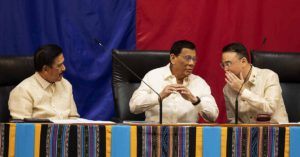

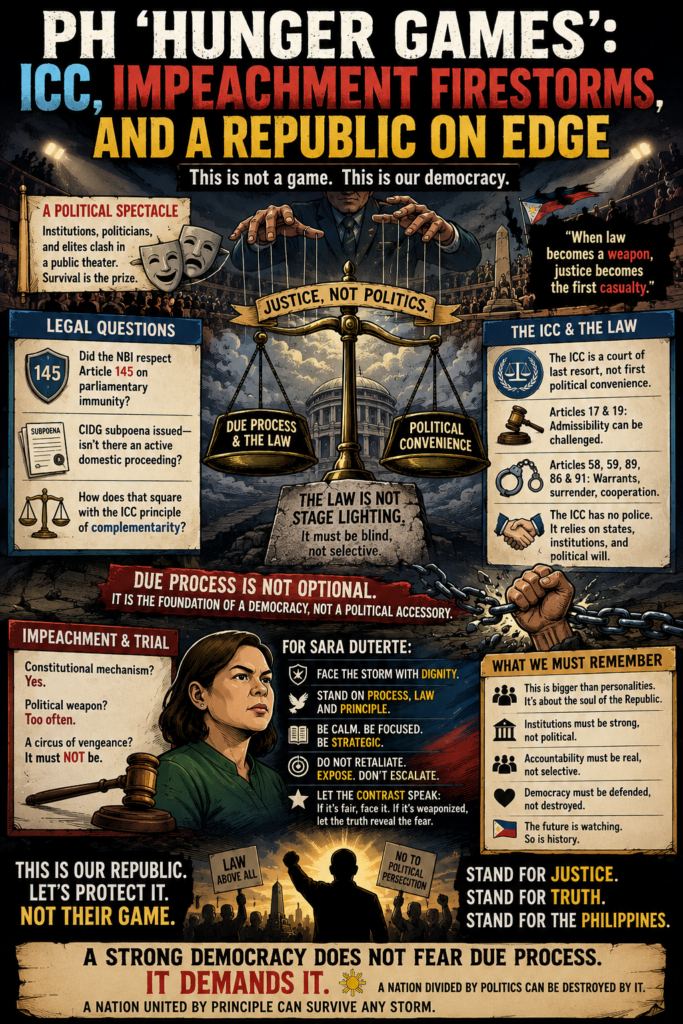
The latest ICC spectacle in the Philippines is being marketed, predictably, as a grand morality play about accountability, justice, and the rule of law. But scratch the surface, it’s actually a new franchise of the “Hunger Games” amongst political elites played in the domestic political theater dressed in international legal costume. It is a political spectacle in which institutions, politicians, and the political elite’s survival collide in full public view.
Justice or Political Sequencing?
At the heart of this spectacle are legal questions that cannot be drowned out by press conferences, moral slogans, or selective outrage.
First, if the National Bureau of Investigation (NBI) acted against a sitting senator, did it fully respect Article 145 of the Revised Penal Code on parliamentary immunity? Or have legal shortcuts become the new fashion accessory in the country’s “rule of law” department? In a democracy, the law is not supposed to be applied like stage lighting, bright when politically useful, dim when inconvenient.
Second, if the CIDG has already issued a subpoena involving alleged extrajudicial killing matters, does this not indicate an active domestic proceeding? And if there is already a domestic process, how does that square with the ICC’s principle of complementarity under the Rome Statute?
Complementarity is not a decorative clause. It is the central logic of the ICC system. The ICC is meant to be a court of last resort, not a court of first political convenience. Under Article 17 of the Rome Statute, a case may be inadmissible if a state is genuinely investigating or prosecuting the matter. Under Article 19, states and accused persons may challenge jurisdiction or admissibility precisely on that basis.
The Rome Statute also lays out the architecture of arrest warrants and surrender. Article 58 allows the Pre-Trial Chamber to issue a warrant when reasonable grounds exist, and arrest is necessary. Article 59 requires the custodial state to bring the arrested person before a competent judicial authority (a court) to verify identity, the warrant’s validity, and the rights of the person concerned. Article 89 governs surrender to the Court, while Articles 86 and 91 deal with cooperation and arrest-and-surrender requests.
But here is the inconvenient reality: the ICC has no police force. It relies on states, domestic institutions, executive cooperation, and political will. That is why ICC warrants are never merely legal instruments. They land directly in the middle of politics. And in the Philippines, that middle is already burning.
Due Process
If institutions are genuinely pursuing justice, then due process must be respected even for the politically inconvenient. Especially for the politically inconvenient. That is precisely the point of constitutionalism: it protects rights, especially when the accused is vulnerable, controversial, or politically targeted.
But if institutions are merely performing legal theater, then the ICC becomes another prop in the long-running circus of Philippine power politics, and justice starts to look like revenge, wearing a robe.
In a democracy, due process is not an accessory. It is not optional. It is not something to be worn when convenient and discarded when inconvenient. It is the foundation that separates a functioning republic from a mob with official letterhead.
This is why the ICC issue can no longer be viewed in isolation. It is now tied to the combustible politics of survival, vengeance, elite alliances, factional warfare, and succession. The danger is that law becomes less about justice and more about timing: who gets targeted, when, by whom, and for whose political benefit.
Impeachment and Trial
Against this backdrop comes the looming impeachment trial of Vice President Sara Duterte, a political earthquake poised to rupture the already fragile ground beneath Philippine governance.
Impeachment is a constitutional mechanism, yes. But in the Philippine setting, it is rarely just a constitutional exercise. It is also a weapon, a signal, a negotiation tactic, and sometimes, a public execution staged in legal language. The real question is not only whether impeachment complaints can prosper procedurally. The deeper question is whether the process will be conducted with fairness, sobriety, and constitutional discipline, or whether it will become another carnival of political vengeance.
For Sara Duterte, this ordeal must be faced with dignity, courage, and strategic calm. She must not treat the storm as merely a personal attack, nor should she reduce it to emotional retaliation. She must see it for what it is: a test of character, leadership, discipline, and endurance.
If her opponents want spectacle, she should offer steadiness. If they want provocation, she should offer composure. If they want to drag her into the mud, she should stand on process, law, and principle. The more chaotic the political environment becomes, the more important it is for her to be calm, focused, strategic, firm, sober, and statesmanlike.
She must stay steadfast, not recklessly defiant, but constitutionally grounded. Not noisy for the sake of noise, but clear-minded, disciplined, brave, and courageous. She should insist on due process, demand fairness, confront accusations directly where necessary, and refuse to be politically cornered into theatrics. In moments like this, dignity and courage are not weakness. It is armor.
The worst mistake she could make would be to respond to political fire with uncontrolled fire. The wiser path is to let the contrast speak: if the process is fair, face it; if it is weaponized, expose it; if it is politically motivated, let the public see who is truly afraid of democratic competition and a fair and square electoral process.
Addict to Crisis
Indeed, I am asking: What has become of the Philippines?
Once again, the country is splashed across global headlines, not for progress, dignity, economic strength, or statesmanship, but for scandal, institutional tension, and political firestorms. We are competing with major global power events for attention, and for all the wrong reasons.
It seems that the current political establishments in the country are addicted to crisis and chaos: one scandal after another, one institutional embarrassment after another, one political detonation after another. This is no longer normal political turbulence. It is national exhaustion and humiliation dressed up as governance.
While ordinary Filipinos are worried about prices, jobs, food, wages, debt, and daily survival, the current ruling political class is intoxicated and addicted to conflict. Instead of governing, they are maneuvering. Instead of stabilizing the country, they are staging the next act of the elite-driven political drama. This is political pyromania (obsessive impulse to start fires).
Conclusion
The Republic must not be reduced to a political theater. I refuse to believe that our beloved country is a failed state. The last time I checked, it is a sovereign republic with institutions that, though imperfect, must not be casually bypassed, manipulated, or internationally outsourced whenever politically convenient.
The country will not endure endless elite political warfare while pretending it is a democracy at work; the truth is, the political house is on fire.
The Filipino people must understand that this “Hunger Games” of the political elites for their own political survival and self-vested interests is the country’s doom that’s no longer knocking at the door, but already inside the house.