
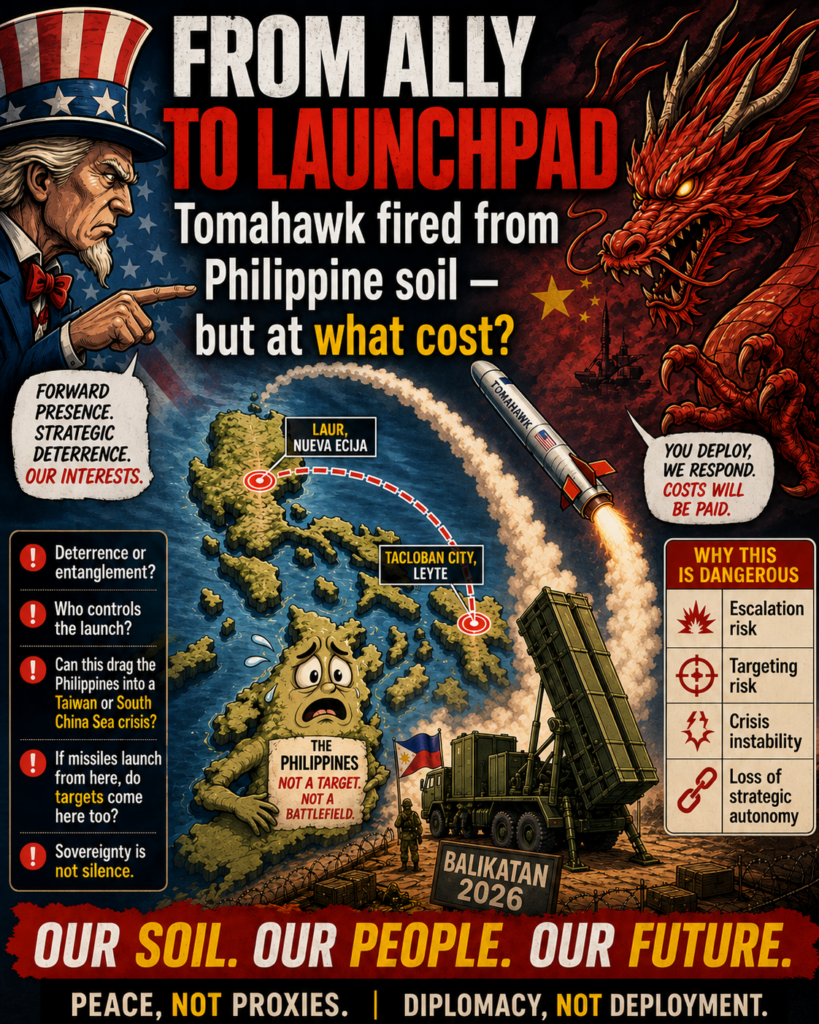
Officially, no: the Philippine government is not saying that Balikatan 2026 is a rehearsal for any contingency situation or military escalation in the Taiwan Strait. But strategic realities are NOT judged only by official statements. They are judged by geography, weapons range, deployment patterns, command arrangements, and crisis scenarios. And by those standards, the firing of a U.S. Tomahawk missile from Tacloban to Nueva Ecija is not an ordinary military exercise. It is a major political and strategic threshold.
The facts alone should disturb any serious Filipino policymaker and the Filipino people as a whole. A U.S. Army Tomahawk cruise missile was launched from Tacloban City and hit a designated impact area in Laur, Nueva Ecija, according to Philippine military confirmation, as reported. Defense News also reported that the missile was fired from a Typhon launcher and struck a target roughly 600 kilometers away.
This matters because the Typhon Mid-Range Capability system is not a symbolic asset. The U.S. Army Pacific describes it as a land-based, ground-launched system capable of firing both the SM-6 and the Tomahawk Land Attack Missile. Reuters has reported that Tomahawks in Typhon launchers can hit targets in China and Russia from the Philippines, while SM-6 missiles can strike air or sea targets more than 200 kilometers away.
That is why the usual reassurance — “it is defensive” — is STRATEGICALLY INSUFFICIENT! A weapon system is not interpreted by adversaries according to press releases. It is interpreted according to range, mobility, payload, targeting architecture, and operational context. A land-based missile system capable of striking beyond Philippine territory inevitably blurs the line between territorial defense and offensive power projection.
The greater danger is not that war is inevitable. It is that the Philippines is becoming more useful to U.S. war planning and therefore more SRATEGICALLY EXPOSED to Chinese or Russian counter-military planning. Reuters previously reported that the U.S. maintained the Typhon system in the Philippines while testing its feasibility for use in a regional conflict; the same report noted that the Philippines would be an important staging point for the U.S. in any Taiwan contingency.
This is where the Taiwan question enters. The official statement states that the Balikatan Exercises between the U.S. and the Philippines, with the active participation of Japan and other U.S. allies, are about interoperability, deterrence, and territorial defense. Functionally, however, many of its most sensitive activities are taking place in precisely the geography that would matter in a Taiwan contingency: northern Luzon, Batanes, the Luzon Strait, and the wider First Island Chain. Reuters reported that U.S. and Philippine forces showcased the NMESIS anti-ship missile system in Batanes, around 100 miles south of Taiwan, with Philippine officials saying such deployments test feasibility and rehearse deployment “when need arises.”
Note that China is a strong, not a passive, actor in this equation. It maintains a vast and increasingly sophisticated missile arsenal, far exceeding the Typhon system in scale, range, diversity, and technological maturity. With its advanced naval, air, cyber, space, and electronic warfare capabilities, China is already a major military power capable of projecting force and imposing costs on its perceived adversaries. Thus, the strategic reality remains: China has the capability to respond, retaliate, and escalate if it perceives Philippine territory as being converted into a forward platform for U.S. long-range strike operations against it.
This is why Beijing’s warnings should be read with caution and taken seriously. The thing is not simply that China sent warnings. The risk is that China has both the military means and geopolitical will to act if it believes its core security, safety, and national interests are being threatened. That makes the Typhon deployment not merely a matter of alliance cooperation, but a serious test of Philippine strategic judgment, sovereignty, and crisis-management capacity.
Hence, the strategic problem is real: once Philippine territory hosts long-range strike systems, those locations may become priority targets in a U.S.-China crisis.
This is why the issue cannot be reduced to a “pro-U.S.” versus “pro-China” dichotomy. The real issue is Philippine sovereignty, strategic autonomy, and democratic accountability. Who controls the Typhon system? Who authorizes a launch? Will it be used in a Taiwan contingency? Were local governments informed? Did Congress debate the risks? What protections exist for communities near launch sites? What happens if the Philippine territory becomes a target because weapons launched from it threaten another major power?
The Tomahawk firing changed the meaning of Typhon in the Philippines. Before, officials could say it was merely present for exercises. Now, it has been operationally demonstrated from Philippine soil. That is NOT routine. That is NOT minor. That is not just another Balikatan photo opportunity.
Yes, the Philippines has every right to defend itself. But genuine sovereignty means making defense decisions based on Filipino national interest, NOT merely absorbing the strategic requirements of a declining and insecure superpower ally.
Deterrence may be necessary, but deterrence without transparency becomes entanglement. And entanglement without public consent is NOT a strategy. It is gambling with the nation’s territory while asking the people to trust a game whose rules they were never allowed to see.