

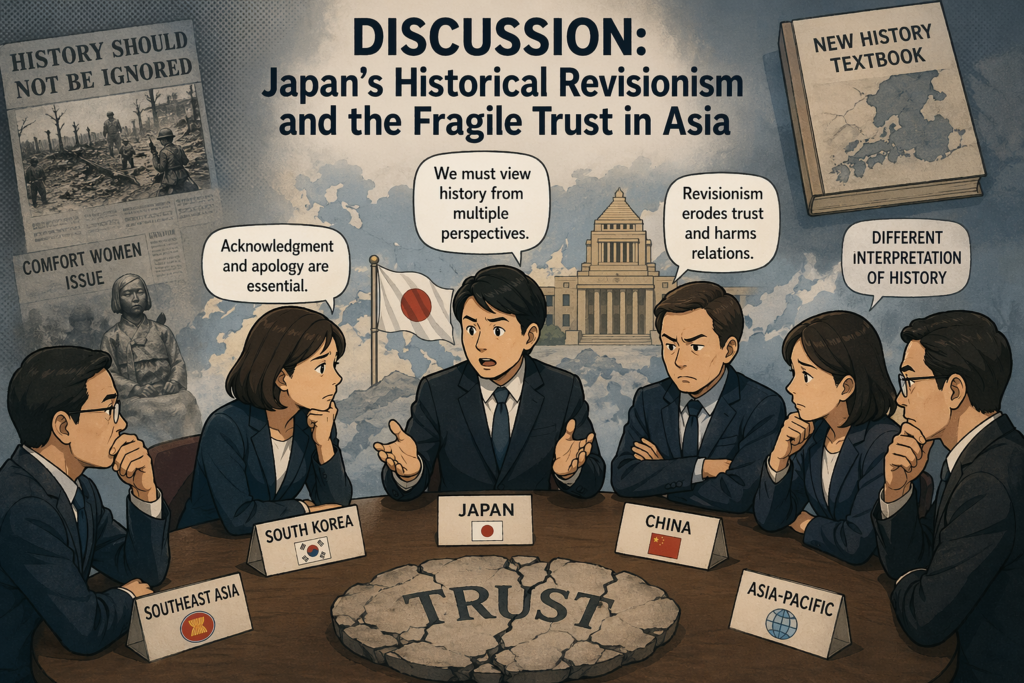
In the evolving geopolitical landscape of the Indo-Pacific, Japan has re-emerged as a proactive strategic actor, expanding its defense posture, deepening security partnerships, and positioning itself as a guardian of a so-called “rules-based order.” Yet beneath this outwardly normative posture lies a deeper and unresolved tension: the ideological roots of historical revisionism and its enduring consequences for regional trust, diplomacy, and stability.
Ideological Roots of Japanese Historical Revisionism
Japanese historical revisionism is neither accidental nor purely academic. It is rooted in a post-World War II identity struggle that seeks to reconcile Japan’s imperial past with its modern national self-image.
After World War II, Japan underwent a U.S.-led reconstruction that emphasized pacifism, economic development, and alliance with Washington. However, this transformation also created a paradox. While Japan embraced a pacifist constitution, segments of its political and intellectual elite resisted what they perceived as a “victor’s justice” narrative imposed by the Allied powers.
From this perspective, revisionism emerged as an ideological countercurrent—seeking to:
- Reframe Japan’s wartime actions as defensive or liberatory
- Downplay or contest atrocities such as forced labor and sexual slavery
- Promote a narrative of national victimhood, particularly regarding the atomic bombings
This ideological strand is not dominant throughout Japanese society, but it remains influential within certain political circles, educational institutions, and nationalist organizations.
The result is a persistent ambiguity in Japan’s historical posture. Official apologies coexist with contradictory statements. Textbooks are periodically revised. Visits by political leaders to controversial war shrines send mixed signals to neighboring countries.
For many in Asia, especially China, Korea, and even the Philippines, this inconsistency undermines trust. Reconciliation is not merely about issuing apologies; it requires sustained, coherent acknowledgment of historical responsibility. When that acknowledgment appears conditional or reversible, diplomatic credibility erodes.
Nationalism, Militarism, and Strategic Normalization
Japan’s evolving security posture cannot be separated from its internal ideological debates. Over the past decade, Tokyo has moved toward what it calls “strategic normalization,” a gradual departure from strict pacifism toward a more assertive defense policy. This shift manifests in several ways:
- Constitutional Reinterpretation and Defense Expansion: Japan has reinterpreted its pacifist constitution to allow collective self-defense, significantly increased defense spending, and enhanced its military capabilities.
- Deepening Security Alliances: Tokyo has strengthened ties with the United States and expanded cooperation with partners such as Australia and the Philippines. Its growing involvement in the South China Sea, despite being a non-claimant, reflects this outward strategic turn.
- Narrative Alignment With “Rules-Based Order” Discourse: Japan frames its actions as defending international law. Yet this framing often obscures the strategic reality: Japan is seeking relevance in a rapidly polarizing region.
Domestically, these changes are accompanied by a subtle but notable rise in nationalist sentiment. Political rhetoric increasingly emphasizes pride, sovereignty, and security. While far from the overt militarism of the pre-1945 era, this trend reflects a shift in national consciousness—from post-war restraint to cautious assertiveness.
Internationally, however, these developments are received with skepticism. For countries that experienced Japanese occupation, militarization, regardless of its stated defensive intent, triggers historical memory. The issue is not simply capability, but credibility. Without full historical reconciliation, even defensive measures can be interpreted as signals of potential resurgence.
Trust Deficit in Regional Diplomacy
Trust in international relations is cumulative, fragile, and historically conditioned. In East and Southeast Asia, Japan’s trust deficit stems not from a single policy, but from the interaction between historical ambiguity and contemporary strategic behavior. This deficit manifests in three key ways:
- Skepticism Toward Japan’s Normative Claims: When Japan invokes international law while selectively interpreting its own past, its normative stance appears instrumental rather than principled.
- Heightened Sensitivity to Military Expansion: Even incremental increases in defense capability are viewed through the lens of historical experience.
- Complications in Multilateral Diplomacy: Efforts to position Japan as a stabilizing force in regional disputes, such as the South China Sea, are complicated by its identity as a former imperial power with unresolved historical issues.
All these deepen suspicion and strategic anxiety rather than stabilizing the region.
Role of the International Community
The question then arises: what role should the international community play in addressing Japan’s historical revisionism and promoting genuine reconciliation? The answer lies not in coercion, but in consistent normative engagement.
- Encouraging Historical Accountability Through Dialogue: International institutions, academic networks, and civil society platforms can foster open historical dialogue. This includes supporting archival research, oral history projects, and cross-national scholarship.
- Avoiding Selective Amnesia in Strategic Partnerships: Major powers, particularly the United States, must avoid downplaying historical issues for the sake of strategic alignment. When allies ignore or excuse revisionism, they inadvertently legitimize it.
- Promoting Education and Memory Preservation: Regional cooperation in education can help ensure that historical narratives are not erased or distorted. Shared remembrance initiatives—museums, memorials, and cultural exchanges—can build empathy across societies.
- Supporting Reconciliation Without Instrumentalization: Historical memory should not be weaponized for contemporary political gain. At the same time, it should not be suppressed in the name of geopolitical convenience. The balance lies in principled engagement.
Conclusion
The lesson of history is clear: power without trust is inherently unstable. The future of regional stability in Asia will not be determined solely by military balance or legal arguments. It will also depend on how history is remembered and acknowledged.
Japan’s historical revisionism is not merely a domestic issue; it is a regional concern with direct implications for diplomacy, trust, and peace. Its evolving security posture, while understandable in strategic terms, cannot be divorced from its historical legacy.
The path forward is neither denial nor perpetual grievance. It is an honest reckoning. Reconciliation does not weaken a nation. It strengthens its legitimacy.
If Japan seeks to lead in shaping regional order, it must first confront the unresolved shadows of its past, not selectively, not rhetorically, but consistently and unequivocally. Only then can its vision of order be seen not as a strategic ambition, but as a credible commitment to peace.