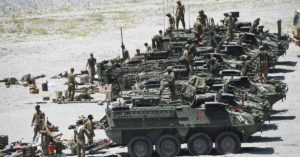

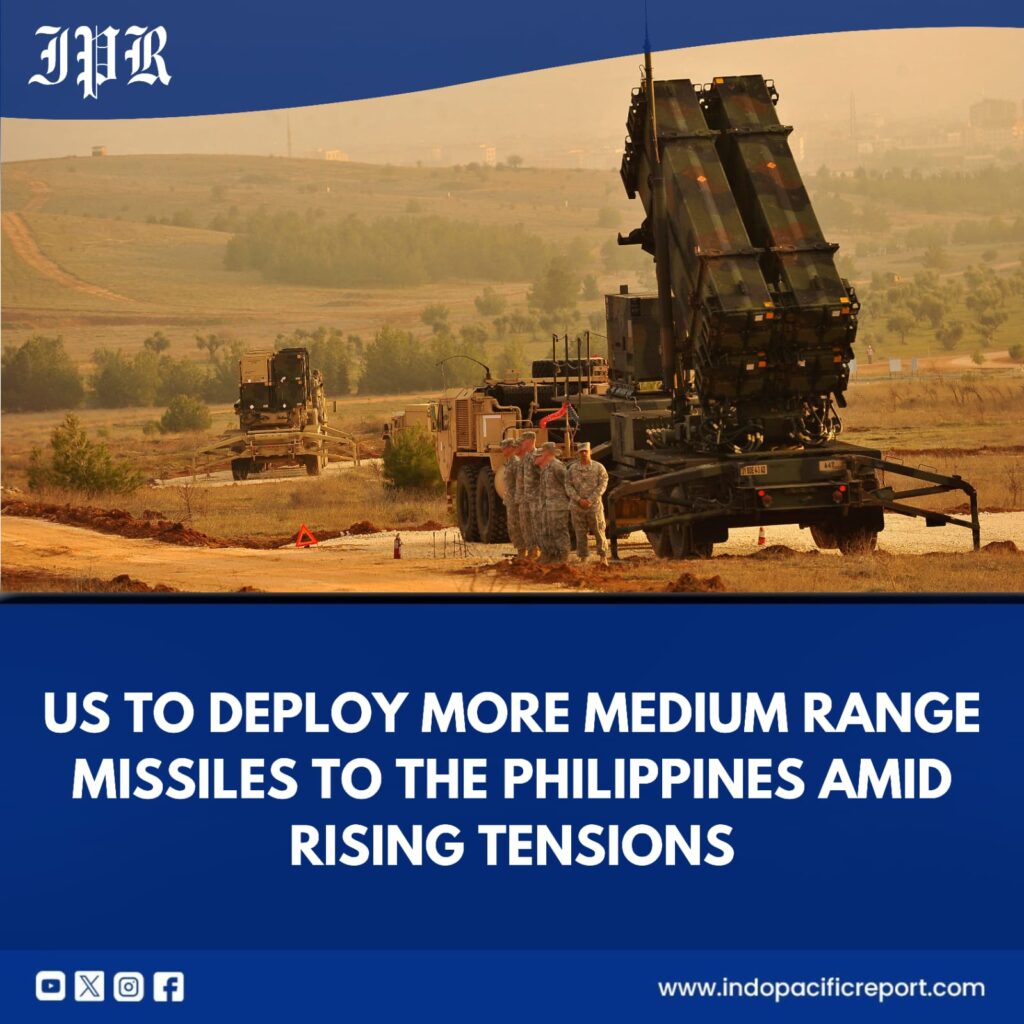
The image tells a story that official press releases carefully try to soften. Trucks carrying U.S. medium-range missile systems positioned in open terrain are not merely symbols of cooperation; they represent the physical projection of American military power into Philippine territory. Regardless of the diplomatic vocabulary used—training, rotational deployment, or interoperability—the strategic implication is unmistakable: the Philippines is increasingly being positioned as a forward operating platform/base in the evolving U.S.–China strategic rivalry.
For decades, Manila’s alliance with Washington was framed primarily around mutual defense and deterrence. But the deployment of medium-range missile systems, plus the already deployed Typhoon missile system, which may have an additional deployment during the upcoming Balikatan exercises between the United States, its allies in the region, and the Philippines, introduces a qualitatively different dimension. These are NOT humanitarian assets or defensive coast-guard vessels. Missile systems extend strike capability, surveillance integration, and operational reach. Once positioned within Philippine territory, they inevitably enter the strategic calculations of other regional powers, particularly China.
From Ally to Launch Platform: The concern is not merely whether these missiles are owned by the United States or temporarily or permanently hosted by the Philippines. The deeper issue is strategic function. In military planning, geography matters. A missile system placed on Philippine soil effectively expands the operational envelope of U.S. forces in the Western Pacific. That transforms the Philippines from a traditional treaty ally into something closer to a forward-operating node/base in the US military and strategic architecture of the Indo-Pacific.
For planners in Washington, this may be seen as strengthening deterrence. But from the perspective of strategic stability in Southeast Asia, it raises difficult questions:
- Does this make the Philippines a primary operational platform in a potential military conflict?
- How might this reshape regional perceptions of threat?
- What are the domestic political and economic risks of becoming more deeply embedded in great-power competition?
These are NOT abstract concerns. In any crisis scenario, military assets deployed on a country’s territory inevitably become strategic targets of retaliation in the calculations of rival powers.
The “Training” Narrative and Strategic Reality: Officials often frame these deployments as part of military exercises or capability development. Yet the scale and sophistication of modern missile systems make such explanations increasingly difficult to separate from broader strategic objectives.
Training does not normally require deployable missile batteries capable of projecting force across hundreds of kilometers. Their presence signals something more consequential: prepositioning capability and operational readiness, by which this is where the EDCA sites (US military bases) come into the picture.
And once such systems are introduced, even temporarily, they establish precedents that gradually normalize deeper military integration.
The Strategic Dilemma for Small States: The Philippines now sits at the crossroads of two competing imperatives and dilemmas:
- Strengthening deterrence through alliance commitments or
- Avoiding entanglement in great-power confrontation
History shows that small and middle powers often struggle with this balancing act. When major powers compete intensely, allied territories can quickly become geostrategic staging grounds.
The danger is not immediate war but structural escalation, in which each incremental step, missile deployments, expanded bases (EDCA sites/US bases), and integrated command structures, gradually transform the strategic landscape.
What is the Question that Manila Must Confront? The real and critical question for the Philippines is this: At what point does deterrence begin to blur into strategic exposure?
Missiles on Philippine soil may strengthen military coordination with the United States. But they also signal that the archipelago, long defined by its strategic location in maritime Southeast Asia, is increasingly being drawn into the FRONTLINE GEOMETRY OF THE 21ST CENTURY GREAT – POWER RIVALRY.
And once that geometry takes shape, it becomes far harder for any small state to step back from it.
The Filipino people must be aware of this and see this with eyes wide open!
#Philippines
#USMilitary
#SouthChinaSea
#TyphonMissiles
#MidrangeMissile
#ChinaUSConflict
#IndoPacific
#RegionalSecurity
#MaritimeTensions