
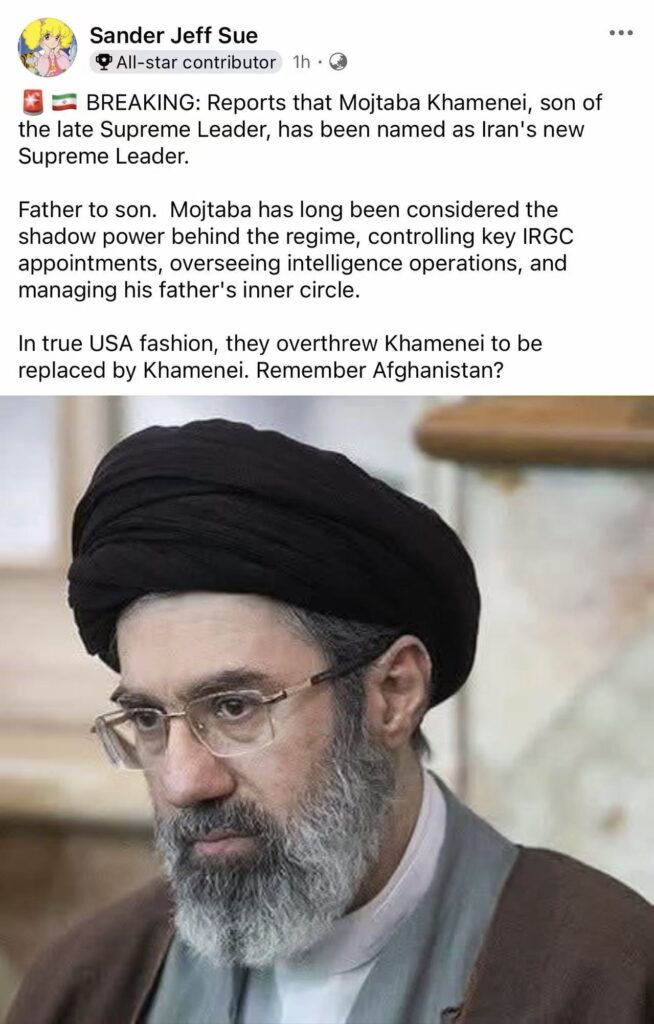
Now, there’s news spreading that Mojtaba Khamenei has already been installed as Iran’s new Supreme Leader.
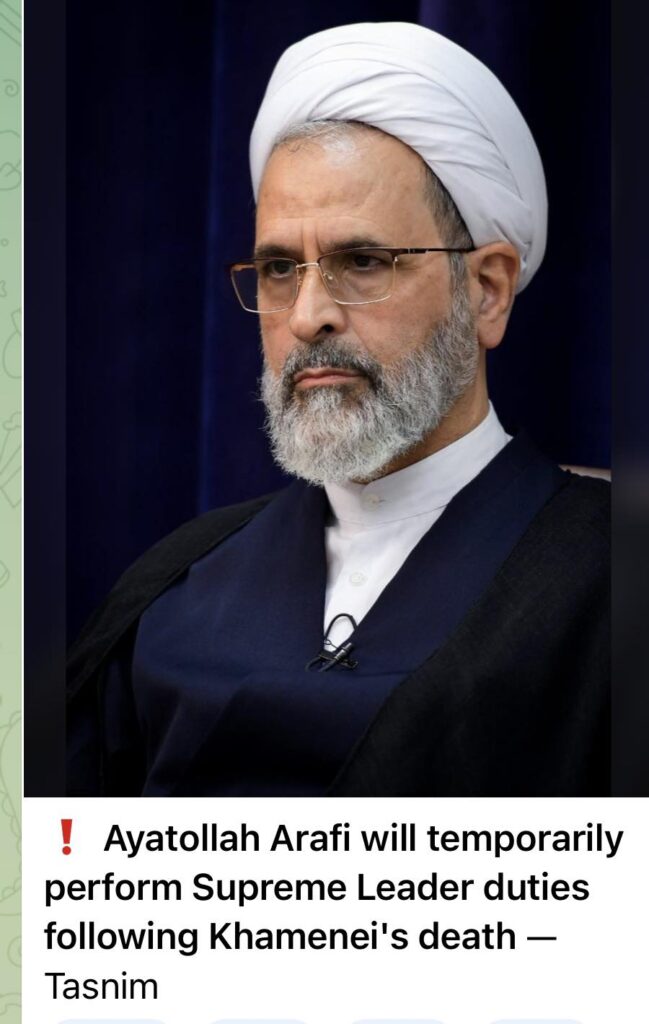
Under Iran’s constitution, the next Supreme Leader must be formally chosen by the Assembly of Experts, and a temporary leadership structure is expected to govern during the transition. While Mojtaba has long been viewed as influential behind the scenes, with deep ties to the Revolutionary Guard and security networks, his succession remains speculative rather than automatic. But beyond the factual question of succession lies a deeper geopolitical reality.
What’s the Real Implication: This Is Not Just a Regime Conflict
Western strategic thinking often frames Iran as a state actor, a regime, and a government to be pressured or replaced. But Iran is NOT merely a political system. It is a CIVILISATIONAL-RELIGIOUS STATE, rooted in Shia Islamic legitimacy, where political authority is fused with theological authority.
The office of the Supreme Leader is not simply:
 Head of State
- Commander-in-Chief
- Political Executive
It is:
- A religious guardianship
- A theological authority
- A symbol of Islamic resistance and continuity
The Islamic Revolutionary Guard Corps (IRGC), in fact, derives its legitimacy not from the state bureaucracy but from its role as the protector of the Islamic Revolution and its spiritual leadership. Which means targeting Iran’s leadership is perceived not just as an attack on governance but as an assault on religious legitimacy.
Why This Matters Strategically? If Mojtaba or any successor emerges, the system DOES NOT collapse. Because, unlike secular states, Iran’s power structure is designed for continuity of religious ideology, NOT personality. The ruling doctrine is:
- Velayat-e-Faqih — Guardianship of the Jurist
- A belief system
- A sacred-political mandate
The U.S.-Israel axis can remove an Iranian supreme religious leader through its ongoing unprovoked and unilateral military actions, a war waged against Iran as a sovereign state, but the U.S. and Israel CANNOT REMOVE the belief or the religion that legitimizes the system.
And historically, external pressure tends to strengthen religious-national cohesion, not weaken it.
The Strategic Miscalculation: If military action is framed purely as regime containment but is experienced internally as civilizational-religious assault, then the effect is the opposite of deterrence. It becomes:
- A mobilizing force
- A unifying grievance
- A theological validation of resistance
Which is precisely why succession, whether Mojtaba or someone else, DOES NOT necessarily signal instability. Instead, it may:
- consolidate hardline cohesion
- deepen ideological resolve
- transform political conflict into existential struggle
Hence, what is unfolding is not merely a leadership transition. It is a moment where geopolitics intersects with theology. And history has shown that states can be destabilized. But belief systems, especially those institutionalized into governance, are far harder to break.
Leadership can be replaced. Revolutionary legitimacy cannot be bombed away.
Moreover, this belief system does not exist in isolation within Iran’s borders. Recent demonstrations in Kashmir and other territories/localities where protesters took to the streets in Srinagar, Baramulla, and Budgam, expressing solidarity with Iran following the reported killing of its Supreme Leader, underscore how Iran’s religious-political identity resonates beyond the state itself. Protesters carried images of Ayatollah Khamenei and declared support rooted NOT in geopolitics but in shared religious conviction. Similar solidarity actions and protests have surfaced in other parts of the world, reflecting that what is at stake is perceived by many communities not merely as a political struggle, but as an affront to a broader Islamic identity. In this sense, any attempt to weaken Iran through force risks amplifying transnational religious solidarity rather than isolating the state, transforming a strategic confrontation into a wider civilizational grievance.