
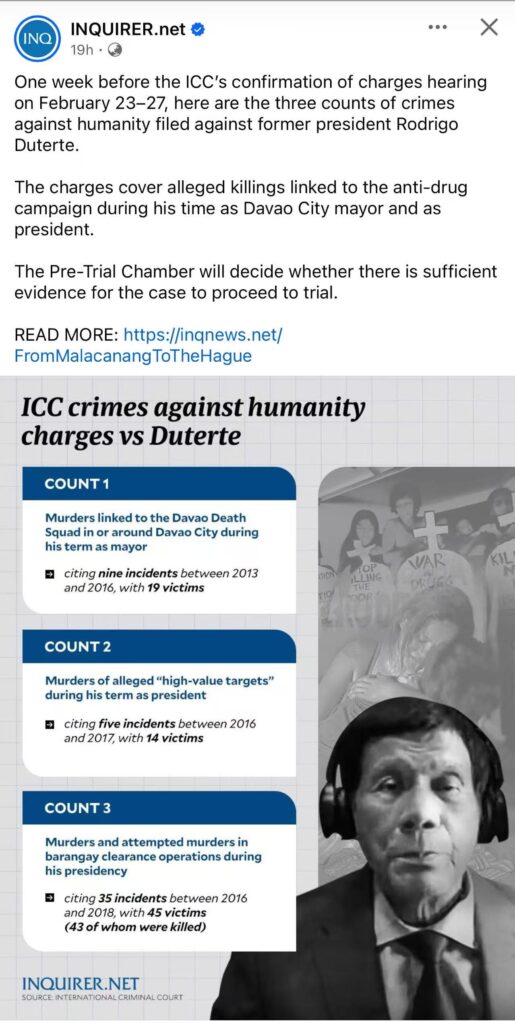
By now, the headlines are familiar. Three counts of murder as “crimes against humanity.” Nine incidents in Davao. Five “high-value target” cases early in the presidency. Thirty-five barangay clearance operations. The International Criminal Court’s Pre-Trial Chamber will soon decide whether the case moves forward.
But let us be clear about something fundamental. The ICC confirmation hearing is NOT a moral referendum. It is NOT a popularity contest. And it is NOT a trial about whether one approves or disapproves of Rodrigo Duterte’s war on drugs. It is a NARROW LEGAL INQUIRY: Is There Sufficient Evidence to Proceed to Trial Under the Rome Statute? That distinction matters because much of the public debate is legally confused.
Crimes Against Humanity? What the Law Actually Requires? Under Article 7 of the Rome Statute, murder becomes a “crime against humanity” not because of who the victims are, but because of context. The prosecution must prove that the killings were committed:
- As part of a widespread or systematic attack, not just murders,
- Directed against a civilian population. The charging set is a limited, selected incident universe; the ICC must show it represents a broader “attack,” not merely discrete criminality.
- Pursuant to or in furtherance of a State or organizational policy,
- With knowledge of that attack.
Notice what is NOT required: sainthood of the victims.
“Widespread” generally relates to a large-scale nature and number of victims, while “systematic” relates to organized, patterned violence that is unlikely to be random.
With 76 so-called victims, could it be that the prosecution is trying to upgrade homicide allegations into “crimes against humanity” using a limited charging set?
The Rome Statute requires the attack to be pursuant to or in furtherance of a State/organizational policy. Thus far, there has been NO state policy under the Duterte administration to attack civilians. Was there a systematic attack that these so-called 76 victims were part of, and can the prosecution prove that there was a pattern and that it was organized and repeated in nature, especially the leap from Davao allegations to nationwide “clearance operations” and tie that coherently to Duterte’s responsibility?
Again, “Widespread” refers to scale and number. “Systematic” refers to organized, patterned conduct unlikely to be random.
Can the prosecution really establish legally the contextual elements required for “crimes against humanity”? Anything less is political theater masquerading as law.
But what’s the Deeper Issue? The Philippines’ deeper scandal is institutional: Why did this have to be litigated abroad at all, and what does that say about governance under Marcos Jr.’s presidency? What is the uncomfortable truth?
The real defendant in this moment is not merely Rodrigo Duterte. It is the Republic of the Philippines.
When a sovereign state allows its former head of state to be arrested and transferred abroad for prosecution, the world does not only ask, “Did he commit crimes?” It also asks: “Why could the country not adjudicate this itself?”
The ICC operates on the principle of complementarity. It steps in when a state is unwilling or unable to genuinely prosecute. Whether that threshold was met is a separate legal debate. But the optics are brutal. It looks as if we needed outsiders to handle what we could not resolve ourselves.
We now stand before the world as a nation whose internal institutions could not resolve one of the most consequential accountability questions in our modern history. That is NOT a small matter.
Sovereignty vs. Applause: The Marcos administration may receive nods of approval from Western capitals for cooperating with the ICC. But applause abroad is not always legitimate at home. History can record this NOT as a triumph of justice, but as a confession of institutional weakness.
The Philippines once prided itself on constitutional processes, on an independent judiciary, on sovereign competence. Today, we risk projecting that we require foreign validation to settle our deepest political wounds. Sovereignty is NOT merely territorial. It is institutional self-confidence.
There is also the credibility issue that refuses to disappear. The ICC has been accused for years of disproportionately targeting leaders from the Global South. Whether fair or not, that perception exists. If Duterte remains detained while powerful Western-aligned actors like Netanyahu of Israel, accused of grave crimes, evade arrest, critics will frame this case as further evidence of selective enforcement. Perception shapes legitimacy. And legitimacy sustains international law.
If the ICC wishes to silence accusations of political instrumentalization, it must demonstrate scrupulous procedural fairness, including humane treatment and the application of impartial standards. International law loses moral force when it appears vindictive. It gains authority when it respects the dignity of even the accused. Justice must never resemble vengeance.
What Is Truly on Trial? This case will test more than legal doctrine.It will test whether the ICC can prove that the contextual elements required for crimes against humanity hold insofar as the charges against Rodrigo Duterte are concerned. It will also test whether the defense can dismantle those elements with evidence rather than slogans. And it will test whether the Philippines still believes it can govern itself without seeking moral certification abroad.
The true crime, perhaps, is not what the ICC alleges. The deeper question is whether we have become a nation so hollowed by factionalism and elite rivalry that we mistake submission for virtue and foreign applause for legitimacy.
Rodrigo Duterte may be answering three counts. But history is judging something larger: whether the Philippine state still has the institutional backbone to police its own power, punish abuse, and deliver justice without outsourcing legitimacy. And that judgment won’t be handed down in The Hague. It will be written in our own political record, by what we failed to do at home, and what we had to ask others to do for us.