
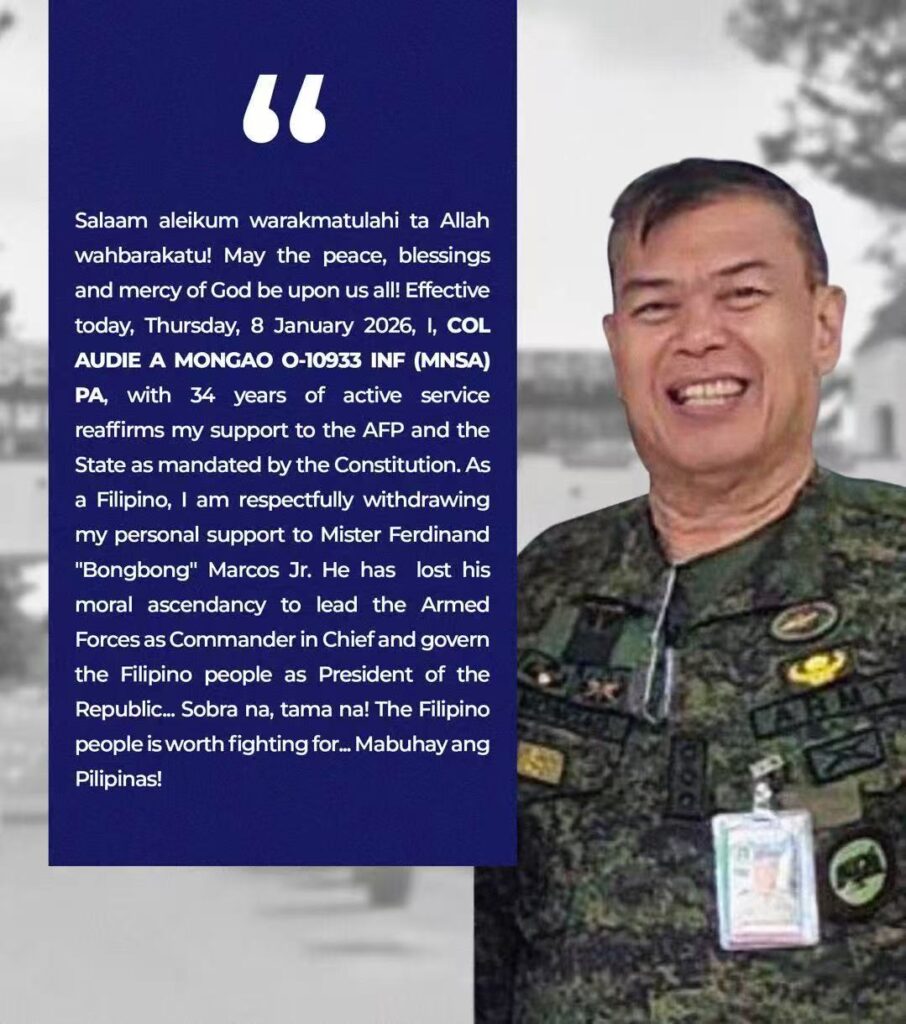
The image of a decorated Philippine Army colonel publicly withdrawing his personal support from the sitting President should give every Filipino pause. It is NOT the act of a reckless man. It is the act of a soldier who has reached the moral limit of silence.
Colonel Audie A. Mongao’s statement is carefully worded and measured. He does not renounce the Armed Forces. He does not renounce the Republic. He explicitly reaffirms his loyalty to the Armed Forces of the Philippines and to the State, to the Republic, as mandated by the Constitution. What he withdraws is something far more revealing: his personal support for Ferdinand “Bongbong” Marcos Jr. as Commander-in-Chief, on the grounds that Marcos has “lost the moral ascendancy” to lead. That distinction matters.
In a constitutional democracy, loyalty is owed not to personalities but to institutions, law, the constitution, and to the people. Colonel Mongao’s words are not rebellious, FAR FROM THAT! They are a reminder of the very oath that every soldier, police officer, and civil servant swears:
- The code of honor of every soldier – “We do not lie, cheat, steal—
nor tolerate those who do; and
- To uphold and defend the people, the state, and the Constitution of the Republic of the Philippines. And that Constitution does not require blind obedience to a president who has lost public trust, political legitimacy, and capital.
A Crisis of Legitimacy, Not Just of Governance
The Philippines today is not merely suffering from poor economic performance, massive corruption in government, rising debt, or extreme currency weakness. We are suffering from something more corrosive: a crisis of political legitimacy.
Surveys in 2025 and early 2026 show falling trust and approval ratings not only for President Marcos Jr., but for his entire cabinet. Investors have pulled back. The peso has weakened. Public works have stalled. Floods have exposed ghost projects and infrastructure failures that were supposed to protect communities. This pattern reveals that corruption points not to isolated wrongdoing, but to SYSTEMIC ROT!
This is what Colonel Mongao is reacting to. NOT politics! But MORAL COLLAPSE!
When a government loses credibility, it begins to rely on silence rather than consent, and on fear rather than trust. That is when institutions begin to fracture.
Why Colonel Mongao’s Words Matter to the Armed Forces
The Armed Forces of the Philippines is not a private army of the president. It is the armed protector of the people and the constitutional order.
That is why Colonel Mongao’s statement resonates so deeply. He may be, and particularly articulating what many in uniform feel but hesitate to say: That loyalty to the Republic does not require loyalty to a president who has forfeited moral authority and lost political legitimacy, integrity, credibility, and capital.
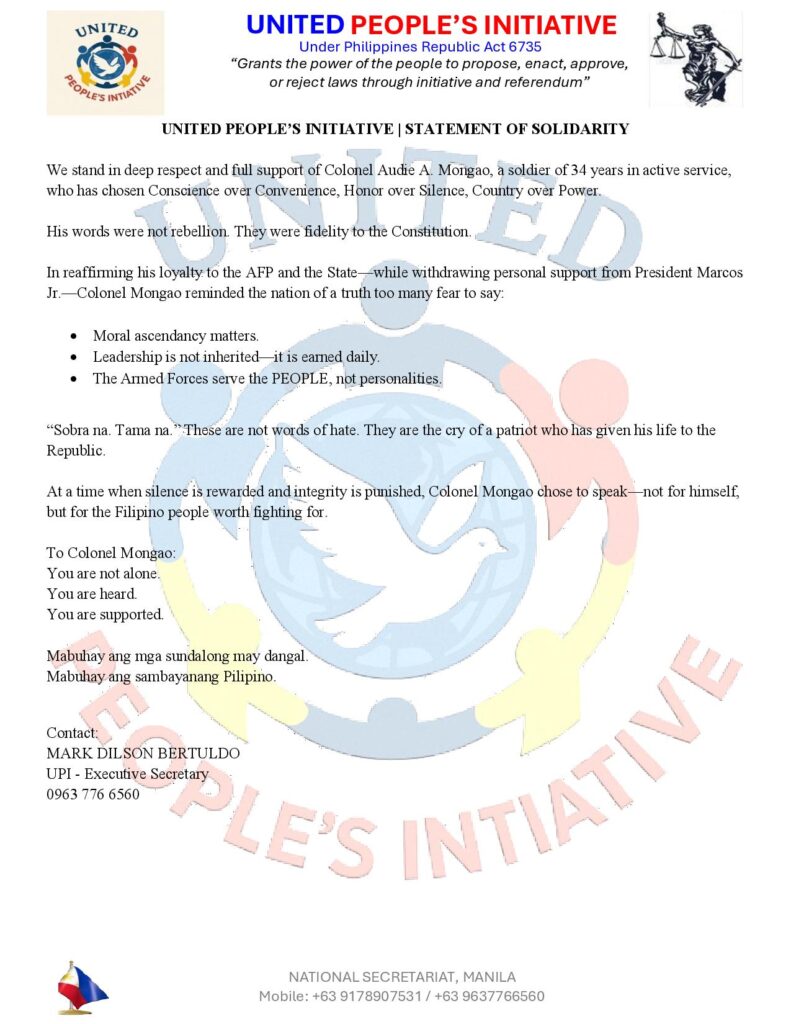
The United People’s Initiative (UPI) captured this perfectly when it said: “His words were not rebellion. They were fidelity and faithfulness to the Constitution.” That is NOT rhetoric. That is doctrine. History teaches us that the gravest danger to a republic is not criticism from within, but silence in the face of massive corruption that holds the Republic and the people in a dire situation.
Moreover, we are witnessing something deeply troubling in Philippine political life: the attempt to redefine patriotism as obedience to whoever holds Malacañang. This is FALSE in every sense!
Patriotism is loyalty to the nation, not to a family name.
To the flag, not to a faction.
To the people, not to power.
When a soldier says “Sobra na. Tama na,” (It’s Too Much! Enough is Enough), he is not calling for chaos. He is calling for accountability. And when accountability becomes dangerous, democracy itself is in danger.
Why This Is a National Turning Point?
What makes this moment extraordinary is not that a colonel spoke. It is that millions of Filipinos recognized themselves and can relate to his words. They are tired of floods that kill because dikes were never built. Tired of roads that collapse because funds were stolen. Tired of leaders who blame storms, geopolitics, and global forces, while refusing to confront corruption at home. Colonel Mongao did not tell soldiers to disobey orders. He told them something far more radical and more Filipino: DO NOT ABANDON YOUR OATH!
Hence, every Filipino must now ask: If corruption becomes state-protected, if accountability is blocked by power, if justice is delayed by design, who will defend the Republic? The Constitution was not written for times of comfort. It was written for moments exactly like this.
To our fellow Filipinos, the Men and Women in Uniform
You are not the weapons of a politician in power.
You are the shield of the Filipino people.
Your loyalty is not to a surname. It is to a nation… to a Republic.. to a people…
History does not remember those who stayed silent.
It remembers those who stood when standing was hard. Colonel Mongao stood.
And now the country is listening.
The Road Ahead
The Philippines is approaching a crossroads. Either corruption is confronted and legitimacy restored, or we slide deeper into cynicism, instability, and institutional decay. There is still time to choose the Republic and the Constitution. But I guess that choice begins with courage.
Mabuhay ang Sandatahang Lakas ng Pilipinas!
Mabuahy ang mga Sundalong may dangal!!!
Mabuhay ang Sambayanang Pilipino!!!
Mabuhay ang Pilipinas!!!!