
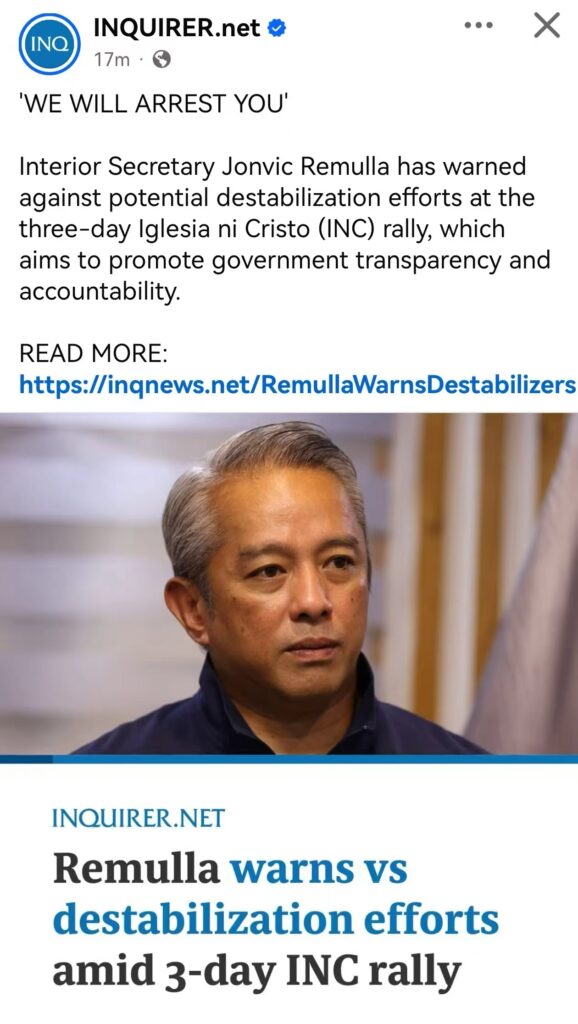
Interior Secretary Jonvic Remulla’s latest warning—“We will arrest you”—aimed at supposed/so-called “destabilizers” during the upcoming INC-UPI-led three-day rally alongside other groups and Filipinos this November 16 to 18, reveals something far more destabilizing than any protest, and that’s Marcos Jr.’s government’s increasingly fragile relationship with the 1987 Constitution. One might wonder whether the Constitution has been quietly replaced by a new doctrine: Thou shalt not criticize Marcos’ administration, lest you be accused of destabilization.
Let us begin with the obvious: there is no crime called “destabilization” in Philippine laws. Please correct me if I am mistaken. The Revised Penal Code does not list it. Special penal laws do not define it. The Anti-Terrorism Act—controversial as it is—does not include it. Unless Congress secretly passed a “Thou shalt not criticize Marcos administration Act of 2025,” Remulla’s threat is legally hollow. And dangerous.
In fact, the 1987 Constitution is crystal clear; the people have the right to peaceful assembly and to petition the government for redress of grievances (Article III, Section 4). The State does not just grant the right; it is protected from the State. It presumes precisely those situations where citizens gather, criticize, complain, or demand accountability and transparency. Yet here comes a Cabinet secretary redefining constitutional rights as potential criminality. Goodness!
Is expressing dissent now a crime in the Philippines? Judging by the tone of Remulla’s warning, one would think we are back in the 1970s—except now with better cameras and worse excuses.
The irony is painful. The upcoming November 16 to 18 rally itself is about a call for government transparency and accountability—the very things that should make any democracy breathe. But Remulla turns it into a security threat: “We will arrest you!” Give me a break!!
What Sec. Remulla’s remark actually reveals the securitization of dissent—the creeping tendency of this administration to equate criticism with rebellion, sedition, rallies with sedition, and discontent with conspiracy. This is not just rhetoric; it shapes police behavior. When a senior official publicly frames peaceful protests as a threat that must be “arrested,” it signals to law enforcement that apprehending critics is not only allowed but encouraged. Isn’t it?
The implications are chilling. First, it delegitimizes constitutional rights by casting suspicion on anyone who exercises them. Second, it de-territorializes accountability, turning the citizens of this republic into suspects. Third, it normalizes a culture of fear, where people must think twice before joining rallies or posting political opinions online. Is this how Philippine democracy has become under a Marcos Jr. government?
And finally, it reveals a far deeper truth: a government that fears public assembly, dissent, and criticism fears its own people.
The constitutional right to dissent exists precisely for moments like this—when those in power become too thin-skinned to accept scrutiny. The tragedy is that Remulla’s statement does not protect stability; it exposes insecurity. It does not strengthen the rule of law; it undermines it. And definitely it will not silence the Filipino people from expressing their dissent and clamor for accountability and transparency, because the greatest destabilization comes not from the streets, but from officials like Jonvic who treat constitutional rights as inconveniences to be managed.
If expressing dissent is now being treated as a threat, then the real destabilizers are those who trash the Constitution and disrespect it.