

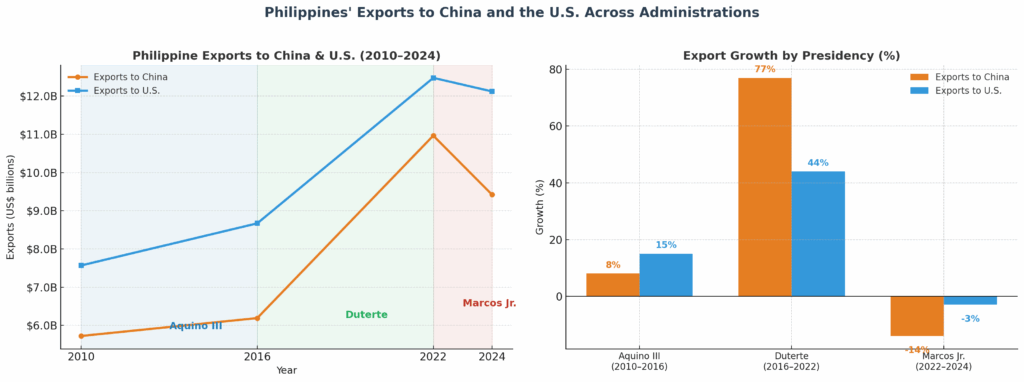
At present, I am immersed in my Ph.D. dissertation in Economics at Peking University, with a focus on international trade, naturally encompassing aspects of bilateral trade. While my main study does not center exclusively on the Philippines’ export dynamics, my review of UN Comtrade data has drawn me into a comparative analysis of the country’s export flows to China and the United States under three administrations: Aquino III (2010–2016), Duterte (2016–2022), and Marcos Jr. (2022–2024).
This exercise, though tangential and peripheral to my dissertation’s core, provides valuable context: it reveals how shifts in foreign policy orientation and geopolitical alignment translate into measurable trade outcomes. By cross-referencing export data across these administrations, a clear pattern emerges, one that not only reflects domestic economic choices but also exposes the vulnerabilities of a trade-dependent economy navigating between two major powers. What I uncovered is telling: the Philippines’ export trajectory under these leaders mirrors not just market forces but also the strategic posture and foreign policy choices each administration adopted toward Washington and Beijing.
Before the comparative analysis of the Philippines’ exports to China and the U.S. under Aquino III, Duterte, and Marcos Jr., let me first explain why exports are significant for a lower-middle-income economy like the Philippines.
Exports are crucial for the Philippine economy, particularly as a lower-middle-income country (LMIC), because they are not just about earning foreign exchange; they shape structural transformation, resilience, and long-term development trajectory. Exports are the engine of growth in a consumption-heavy economy like the Philippines. Exports facilitate job creation and industrial linkages. Exports are the largest source of foreign exchange earnings aside from remittances. In a country like the Philippines with high external debt and trade deficits, strong exports are essential for currency stability, debt servicing, and maintaining reserves. Weak Exports lead to → peso depreciation, higher import costs (fuel, food), inflationary pressure—hitting poor households the hardest.
Exports can also drive industrial upgrading from raw commodity dependence to value-added manufacturing. If exports stagnate while imports rise, the Philippines risks a widening trade deficit and dependence on remittances and debt, which is the current trajectory of the Philippines. This perpetuates the “middle-income trap,” where the economy fails to industrialize and remains stuck in low-value sectors.
For a lower-middle-income economy like the Philippines, exports are not optional; they are a strategic lifeline for growth, employment, stability, and global relevance. Weak export performance constrains upward mobility in the development ladder, while robust export growth provides the leverage to transition into a more resilient, diversified, and high-income economy.
Comparative Analysis of the Philippines’ Exports to China and the U.S. under Aquino III (2010–2016), Duterte (2016–2022), and Marcos Jr. (2022–2024), using the data from UN Comtrade
1. Aquino III (2010–2016): Modest Growth, Conservative Engagement
During PNoy Aquino’s presidency, Philippine exports grew but at a relatively modest pace:
- To China: +8% (2010–2016)
- To the U.S.: +15% (2010–2016)
PNoy Aquino’s foreign policy leaned heavily toward the U.S. and was marked by tensions with China (e.g., the Scarborough Shoal standoff and arbitration case). The trade growth was steady but not transformative, reflecting limited gains in exports despite the Philippines’ pivot to Washington and adversarial stance toward Beijing.
2. Duterte (2016–2022): Hedging Strategy (independent foreign policy) Equals Export Boom
Under Duterte, the Philippines pursued an independent foreign policy and a hedging strategy, balancing relations with both China and the U.S. despite geopolitical tensions. The results were strikingly positive in favor of the Philippine economy:
- To China: +77% (2016–2022)
- To the U.S.: +44% (2016–2022)
This growth was achieved despite the COVID-19 pandemic, which crippled global trade. Duterte’s pragmatic engagement with both Beijing and Washington allowed the Philippines to maximize economic benefits on both ends. Exports surged, generating substantial gains for the Philippine economy, particularly in manufacturing, agriculture, and electronics. Duterte’s rapprochement policy towards China and his ability to compartmentalize geopolitical disputes from economic relations with China stand out as a major success.
3. Marcos Jr. (2022–2024): Decline Despite U.S.-Leaning Foreign Policy at the Expense of the country’s bilateral relations with China
In sharp contrast, the first two years of Marcos Jr.’s administration saw a decline in exports:
- To China: –14% (2022–2024)
- To the U.S.: –3% (2022–2024)
This decline is not only paradoxical but unfortunate. Marcos Jr. has tilted Philippine foreign policy toward the U.S., prioritizing military, defense, and security alignment. However, this U.S.-leaning orientation did not translate into export gains. Trade with Washington shrank. Meanwhile, relations with Beijing soured, reflected in declining exports to China, which had previously been a growth driver. This suggests a disconnect between Marcos Jr.’s foreign policy and the Philippines’ trade interests, with the economy bearing the costs of geopolitical choices.
4. Comparative Insights:
- Aquino III delivered modest export growth, constrained by geopolitical friction with China.
- Duterte achieved the highest export surge, leveraging hedging diplomacy to simultaneously expand trade with both superpowers (+77% China, +44% U.S.).
- Marcos Jr. oversaw a double decline (–14% China, –3% U.S.), showing that aligning too closely with one superpower (the U.S.) while alienating the other (China) undermines trade performance.
The comparative data highlight that the economic pragmatism and balanced diplomacy of the Duterte Presidency have generated far better outcomes than policies overly tilted to one side (Aquino toward the U.S., Marcos Jr. toward the U.S. but at China’s expense).
5. What’s the Importance of Foreign Policy Choices?
1. Duterte’s Independent “Hedging” Policy
Duterte pursued an independent foreign policy, balancing between the U.S. (traditional ally) and China (rising superpower and neighbor). The results:
• Economic Dividends: This hedging allowed the Philippines to benefit simultaneously from both partners:
- Exports to China surged by 77% (2016–2022).
- Exports to the U.S. rose by 44% (2016–2022).
• Implication: Duterte’s pragmatism insulated the Philippine economy from geopolitical rivalries, proving that economic diplomacy can yield tangible benefits even during crises like COVID-19.
2. Marcos Jr.’s U.S.-Leaning Policy
Marcos Jr.’s foreign policy has leaned strongly toward the U.S., prioritizing defense, military cooperation, and strategic alignment.
• Trade Consequences: Despite this tilt, exports to the U.S. fell by 3% (2022–2024), while exports to China plunged by 14%.
• Implication: Overdependence on one partner (and antagonism toward the other) weakens trade resilience. U.S. security promises did not translate into increased U.S. market access or export growth. At the same time, worsened ties with Beijing undermined economic opportunities with China, the Philippines’ largest trading partner.
3. Strategic Implications
• Economic Vulnerability: By abandoning hedging, the Philippines exposed itself to trade contraction on both fronts, losing the leverage Duterte previously created.
• Geopolitical Risk: Manila’s over-identification with Washington risks further economic retaliation from Beijing (reduced imports, barriers to Filipino goods, investment pullback).
• Missed Opportunities: While ASEAN neighbors (Vietnam, Malaysia, Indonesia, and others) maintain balanced diplomacy to benefit from both China and the U.S., the Philippines risks isolation by narrowing its options.
• Policy Lesson: Hedging not only secured trade but also enhanced bargaining power. Marcos Jr.’s tilt demonstrates the risks of foreign policy choices misaligned with economic imperatives.
The Bottom Line? Duterte’s hedging demonstrated that balanced diplomacy yields economic resilience and growth, while Marcos Jr.’s U.S.-leaning approach has so far produced trade decline and strategic vulnerability. The Philippines risks becoming geopolitically useful to Washington but economically disadvantaged at home.
6. Conclusion:
The Philippines’ trade trajectory underscores a critical lesson:
- Independent “hedging” foreign policy → stronger export growth (Duterte)
- Overdependence on one superpower (U.S.) → trade stagnation or decline (Aquino and Marcos Jr.)
If current trends continue under Marcos Jr., the Philippines risks eroding the economic gains of the Duterte years, precisely when exports and trade diversification are most needed amid global uncertainties, most especially the Trump 2.0 Tariff Trade War.
Furthermore, the Marcos Jr. administration is staring at a two-front squeeze on trade: a hostile U.S.–PH balance and a fraying China–PH channel. Under “Trump 2.0,” Washington is imposing a 19% tariff on Philippine exports, keeping U.S. goods effectively duty-free in the Philippine market, and even pushing a blanket 100% tariff on imported semiconductors entering the U.S. market. For an economy whose export lifeblood is electronics, especially semiconductors, over half of shipments in 2024, and whose single largest customer is the U.S. (≈16–17% of exports), this isn’t a tremor; it’s a body blow to the manufacturing core.
Manila now faces textbook “sandwich pressure”: economic coercion from the U.S. above, domestic industry fragility below, and security escalation risks with China on the flank. The irony is stark. By leaning hard into Washington’s orbit and antagonizing Beijing, the Philippines has ended up both overexposed to U.S. trade punishment and vulnerable to Chinese retaliation. History is unkind to small states that bet everything on one patron; they become chips in other countries’ bargains.
In effect, the country is walking a tightrope while someone else shakes the rope. Pleasing Washington has not bought protection; it has invited a “kick in the teeth.” If this trajectory holds, Marcos Jr. may be remembered less for “strategic clarity” than for a case study in how not to do statecraft: – trading sovereignty, independence, policy and strategic autonomy for promises that vanish at the first tariff notice.