
The Department of Foreign Affairs (DFA), under the Marcos Jr. administration, alongside the Palace’s press officer, has voiced protests to what it calls “inaccurate” travel advisories issued by the Chinese government. These advisories, released by China’s Ministry of Education and Ministry of Foreign Affairs, warned Chinese nationals, particularly students, about an alleged rise in crimes specifically targeting Chinese citizens in the Philippines.
This advisory reflects growing concerns within Beijing over the safety and treatment of its nationals abroad, especially in light of recent incidents involving law enforcement operations and reports of alleged abuse and detention. This diplomatic exchange underscores deeper tensions not only over public safety but also over the broader climate of bilateral relations between the two nations.
The travel advisory/warning urged Chinese students, both those planning to study and already studying in the Philippines, to carefully assess safety risks and strengthen their awareness and precautions when considering pursuing studies in the Philippines.
Moreover, DFA reacted through a statement stating that the so-called travel advisory issued by the Chinese Ministry of Education through the Ministry of Foreign Affairs of China “mischaracterizes” the situation in the Philippines.
According to the DFA statement, it has conveyed its concerns regarding the “inaccuracies” in the advisory issued by the Chinese government through diplomatic channels. It is hoped that the Chinese side will undertake the necessary corrections,” the DFA said.
DFA added that, “All instances of crimes, including those involving Chinese and other foreign nationals, as well as those perpetrated by foreign nationals against their own, are being addressed by relevant law enforcement authorities.”
Given these developments, it is imperative to place China’s travel advisory in its proper context. Rather than hastily dismissing it as mere “inaccurate or misrepresentation.” The DFA and official spokespersons of the Philippine government should thoroughly investigate the basis of the advisory before issuing blanket denials, which only risk making the Republic of the Philippines appear ill-informed, or worse, embarrassing (“nakakahiya,”), indifferent, in the eyes of China and the broader international community.
It is worth emphasizing that, based on my close observation of China as a scholar, observer, and China specialist, it is highly unusual for the Chinese Ministry of Education to issue such advisories, particularly directed at one specific country, such as the Philippines. Such warnings are not released lightly. Their issuance likely signals a culmination of serious concerns, possibly/potentially including rising incidents of crime, discriminatory treatment, or illegal detention affecting Chinese nationals, especially students under the Marcos Jr. government. This rare move should raise red flags, not defensive walls.
Instead of resorting to diplomatic indignation, Philippine authorities should reflect deeply on why such a warning was deemed necessary by Beijing in the first place. Treating it as “inaccurate” without introspection undermines both our credibility and our commitment to the safety of all foreign nationals residing in our country.
News Report Incident Involving Chinese Students in PH:
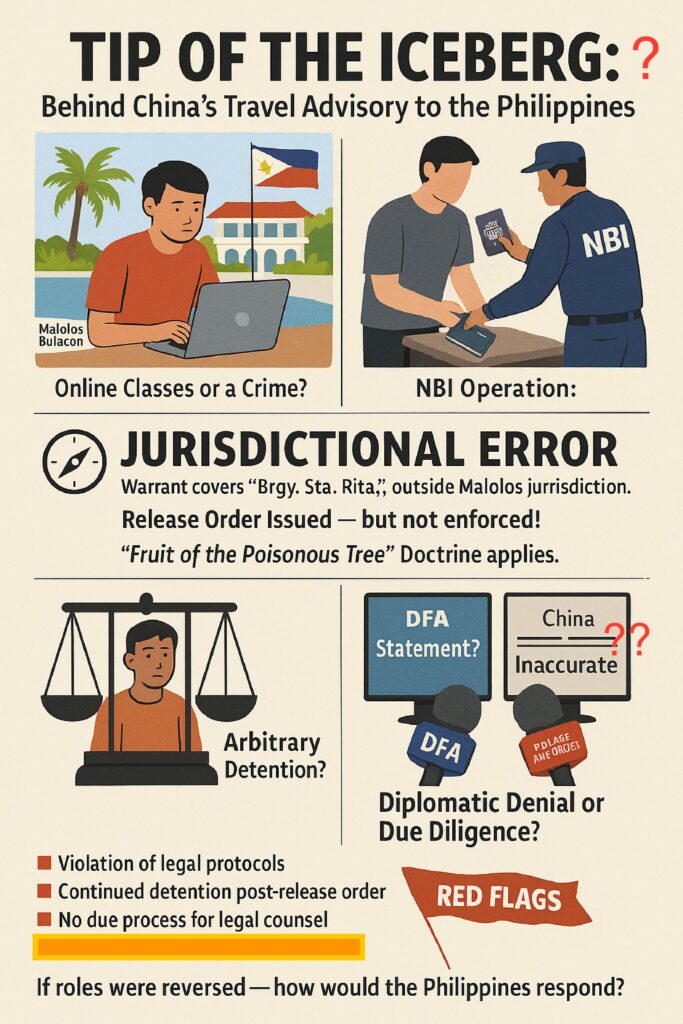
From the Chinese Commercial News Report based in Manila, published today with the title “Chinese Students Taking Online Classes at a Resort Detained Unlawfully, Even Their Relatives Held for Days Without Release”, it says that, on July 14, 2025, the National Bureau of Investigation (NBI), – Special Task Force (NBI-STF) conducted an operation at the “Bahay ni Kuya Leisure Resort” in Malolos City, Bulacan province, arresting nine Chinese nationals and confiscating their passports and personal belongings. Although the prosecution later dismissed the case, citing “invalid evidence” and ordered the release of the individuals, as of this writing, the NBI-STF has not implemented the release order, raising questions about the legality of the law enforcement procedures.
According to a statement by the legal representative of the arrested individuals, Atty. Joromy Ace D. Tabios, the NBI-STF operation was based on a search warrant (No. 25-249) issued by Branch 148 of the Makati Regional Trial Court under Republic Act 10175 (Cybercrime Prevention Act), authorizing a search of the resort premises allegedly involved in “computer-related fraud.”
Around 8:30 p.m. that evening, NBI-STF agents entered the rooms of the Chinese nationals and arrested them for alleged violations of the Cybercrime Law. Agents confiscated CCTV SD cards, cash, and electronic devices from the rooms and demanded that everyone present show their passports and visas.
The statement emphasized that all nine arrested Chinese nationals — LI ZHANXIN, LI ZHUOWEI, HE FENG, NI CHUNHONG, ZHU ZHENYU, WANG XIUMEI, FEI JUNQIAN, TENG GAOHAI, and GENG TIANZE (names romanized)- held valid visas and were “not engaged in any illegal activity.” Several MINORS (as indicated in their Chinese passports) were also in the rooms. They were separated by NBI-STF agents and later released.
Initially arrested for alleged “computer-related fraud,” the charges were subsequently changed to violations of the 1982 Education Act and the 1994 Philippine Teachers Professionalization Act, based on claims that “attending online classes and answering questionnaires” constituted unlawful conduct.
The legal team rebutted the accusations, arguing that the search warrant only covered cybercrimes and that studying is a lawful activity, questioning the NBI-STF’s overreach.
On July 16, the Malolos City Prosecutor ruled that the address on the search warrant, “Barangay Sta. Rita,” falls outside the court’s jurisdiction. Thus, any evidence obtained is considered “fruit of the poisonous tree” and legally inadmissible. The case (NPS Case Nos. III-07-25G-00322 to 00324) was dismissed, and a release order was issued. Despite the order being delivered to the NBI-STF the same day, the detainees remain held at the NBI-STF office instead of a formal detention facility, a move said to violate NBI internal protocols.
Filipino Legal Team of Chinese Nationals Raises Concerns:
The lawyers further stated that the NBI-STF did not notify the detainees’ private legal counsel during questioning, instead assigning public defenders and internal interpreters, potentially undermining due process. Among the detainees, two were identified as master’s students at San Sebastian College-Recoletos, while the rest were reportedly parents or relatives of the minors who had already been released. None of the Chinese were involved in criminal acts.
A source told this paper that the relatives were in the Philippines for tourism and had accompanied the three students to the resort, where the students attended online classes and took examinations. It remains unclear whether someone reported to the NBI about Chinese nationals using computers for classes, prompting the raid.
The legal team has since petitioned relevant agencies to intervene, urging the immediate release of the detainees and the return of their passports, visas, and personal belongings.
China Reacts: Issues Warning to Students
China’s Ministry of Education issued a travel alert today, warning Chinese students about studying in the Philippines, citing a surge in crimes targeting Chinese citizens. The Ministry of Foreign Affairs also urged the Philippine government to take concrete measures to safeguard the safety, dignity, and rights of Chinese students.
On July 18, the Ministry of Education’s “Education Foreign Supervision Information Network” released Alert No. 2 of 2025, stating that public safety in the Philippines is deteriorating, with increasing crimes targeting Chinese nationals. It advised students planning to study in the Philippines to assess safety risks and enhance precautionary awareness.
At a regular press briefing later that day, Foreign Ministry spokesperson Lin Jian was asked about the warning. He responded that the increase in incidents of crime and harassment against Chinese citizens in the Philippines prompted the government to issue the warning as a responsible measure to protect Chinese students. He reiterated the call for risk assessment and urged the Philippine side to take real steps to ensure the safety, dignity, and legal rights of Chinese students in the country.
Malacañang Responds:
The Office of the President maintained that the Philippines remains a safe destination for foreign students and described the statement from China’s Ministry of Education as “unfair.”

Cross-Referencing:
By the way, incidentally, the original news report was written in Chinese, and I translated it into English using an efficient translation machine. I cross-referenced the report with a formal letter submitted by the Filipino legal counsels representing the detained Chinese nationals dated 17 July 2025, addressed to the NBI Director Santiago, concerning the unlawful detention of several Chinese nationals allegedly including minors (students including their relative/sparents) in the Philippines, copy furnished, the office of President Marcos Jr, Justice Secretary Remulla, the Consul General and the Chinese Ambassador in the Philippines, including a Makati RTC Branch 148, which is a reliable source forwarded to me.
Attached to the said letter I obtained is the Resolution dated 16 July 2025, in which the Office of the City Prosecutor of Malolos, Bulacan, categorically stated that the address in Search Warrant No. 25-249 was non-existent, as Barangay Santa Rita is outside the territorial jurisdiction of Malolos City. Thus, any evidence obtained at the scene is deemed the fruit of the poisonous tree; consequently, the charges against the so-called Chinese nationals were dismissed. A Release Order dated July 16, 2025, was then issued to the NBI-STF. The Resolution and Release Order, both dated 16 July 2025, was issued by the Office of the City Prosecutor of Malolos, Bulacan. These were electronically transmitted to the NBI-STF on 16 July 2025 at 5:07 p.m.
In addition, based on the letter, the Filipino legal counsels argued that following are alleged irregularities insofar as the NBI-STF’s alleged arrest, detention, and operations are concerned;
- The NBI-STF confiscated personal property without returning legal documents, including passports and visas.
- Charges were converted from computer-related fraud to alleged violations of:
- Education Act of 1982
- Philippine Teachers Professionalization Act of 1994, Section 6 of R.A. No. 10175
- Article 177 (Usurpation of Authority) of the Revised Penal Code
- Legal counsel for the accused was ignored, and the inquest proceeded with PAO (Public Attorney’s Office) lawyers instead, using an NBI-appointed interpreter.
On the Dismissal of Charges:
- The City Prosecutor of Malolos found that:
- The address in the search warrant was outside the court’s jurisdiction.
- Therefore, any evidence was considered “fruit of the poisonous tree”
- On 16 July 2025, the prosecutor issued a resolution dismissing the charges and a release order, which was sent to the NBI-STF the same day at 5:07 PM.
On Continued Detention & Protocol Violations:
- Despite the release order, the clients remain detained.
- They are being held not in the NBI Detention Facility, but at the NBI-STF Office, which is an unauthorized detention area, a clear violation of internal protocol and possibly the law.
Concerning Legal References:
- Articles 124 & 126 of the Revised Penal Code: Punish arbitrary detention and delayed release.
- Section 3(e) of R.A. No. 3019 (Anti-Graft and Corrupt Practices Act): Public officials causing undue injury or acting in bad faith or gross negligence are criminally liable.
The Demands of the Filipino Legal Counsel and the Chinese nationals (students and parents):
- Immediate release of the detained individuals.
- Return of all confiscated personal belongings, including passports and visas, both of the arrested individuals and others who were not arrested.
Critical Insights:
Insofar as Due Process Violations are concerned, the NBI-STF appears to have acted beyond the scope of the search warrant, detaining individuals and escalating charges without proper legal grounds. The failure to recognize legal counsel and appointing their own interpreter suggests serious procedural breaches and potential misrepresentation before the prosecutor.
Concerning Jurisdictional Error, the venue specified in the search warrant was outside the jurisdiction of the court that issued it, a fatal flaw in the operation, and all evidence obtained.
Regarding Detention Without Legal Basis, post-dismissal, continuing to detain individuals violates their fundamental rights and may constitute arbitrary detention and abuse of authority.
Insofar as potential diplomatic fallout is concerned, detaining Chinese nationals, including students, without sufficient evidence or due process, especially after dismissal, could strain and intensify the already problematic and challenging bilateral relations between the Philippines and China, particularly given that Chinese diplomatic authorities are formally notified.
When it comes to Systemic Accountability, the pattern of overreach by NBI-STF raises questions about institutional accountability, transparency, and respect for human rights and the rule of law.
Final Thought:
This incident involving Chinese nationals (students and their parents) highlights serious legal and procedural lapses by the NBI-STF in its operation on July 14, 2025. It reveals overreach, jurisdictional error, continued illegal detention, and potential abuse of authority, all of which undermine due process and raise serious legal and diplomatic red flags. The appeal calls for urgent intervention by the NBI Director to ensure compliance with lawful orders, uphold civil liberties, and prevent further escalation of the matter. Failure to act could result in another INTERNATIONAL EMBARASSMENT for the REPUBLIC OF THE PHILIPPINES! Goodness gracious!
In addition, just a caveat, this is merely the tip of the iceberg. Beneath the surface are troubling allegations: cases of alleged extortion involving Chinese nationals in detention, and even instances of kidnapping incidents that, conspicuously, have either been downplayed or omitted entirely from mainstream Philippine media coverage.
Now imagine if the tables were turned, if the same courtesy would be accorded to fellow Filipinos working, studying, and living across various regions of the PRC territories that include mainland China, Hong Kong, and Macau. How would the Philippine government under Marcos Jr. respond, be accountable, and be responsible?
This is precisely why our DFA and the palace’s press officer must exercise both due diligence and discernment before dismissing Beijing’s travel advisory as “inaccurate.” These are not just press statements; they are matters of STATE CREDIBILITY and human dignity. The Filipino taxpayer deserves more than defensive posturing. We expect competent, fact-based responses, not knee-jerk reactions that only embarrass the Republic further on the global stage.
Goodness! Please! Let’s NOT make diplomacy another casualty of poor homework.