
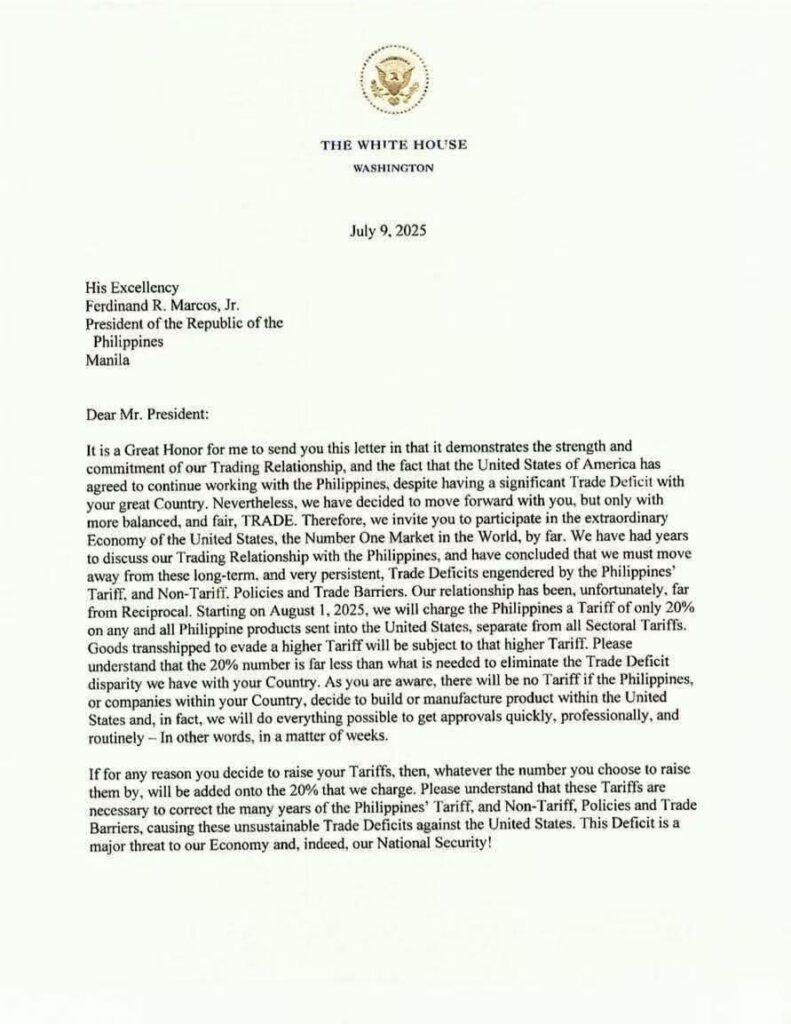
Amid the blaring horns of “America First,” where friendship is now measured in tariff percentages, the Philippines got its latest reward: a 20% levy on its exports, a steep price for loyalty. This is a sharp rebuke to the illusion of U.S.-Philippine “friendship.” Framed under the “America First” banner, this act of economic punishment belies the very notion of alliance solidarity. It’s not just the irony that stings, but the deliberate inversion of diplomatic norms: the Philippines is rewarded not despite its loyalty, but because of it, with tariffs instead of trust and economic incentives.
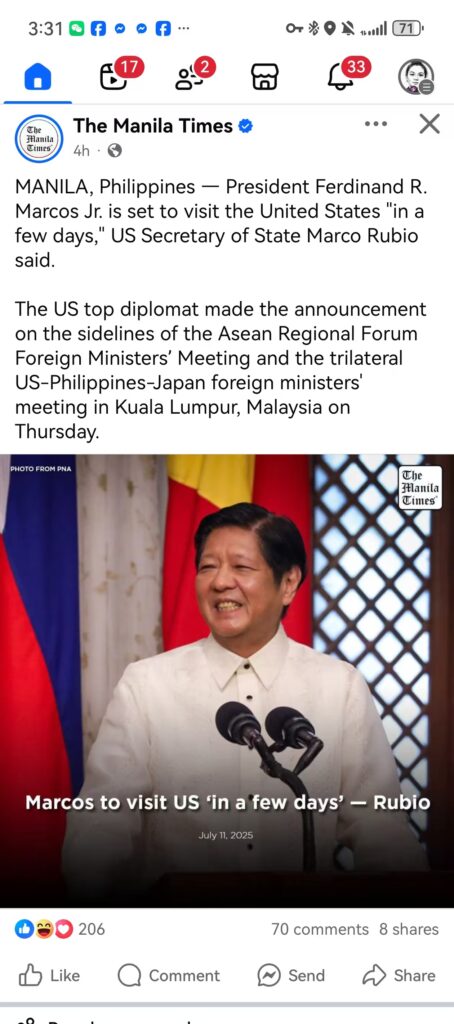
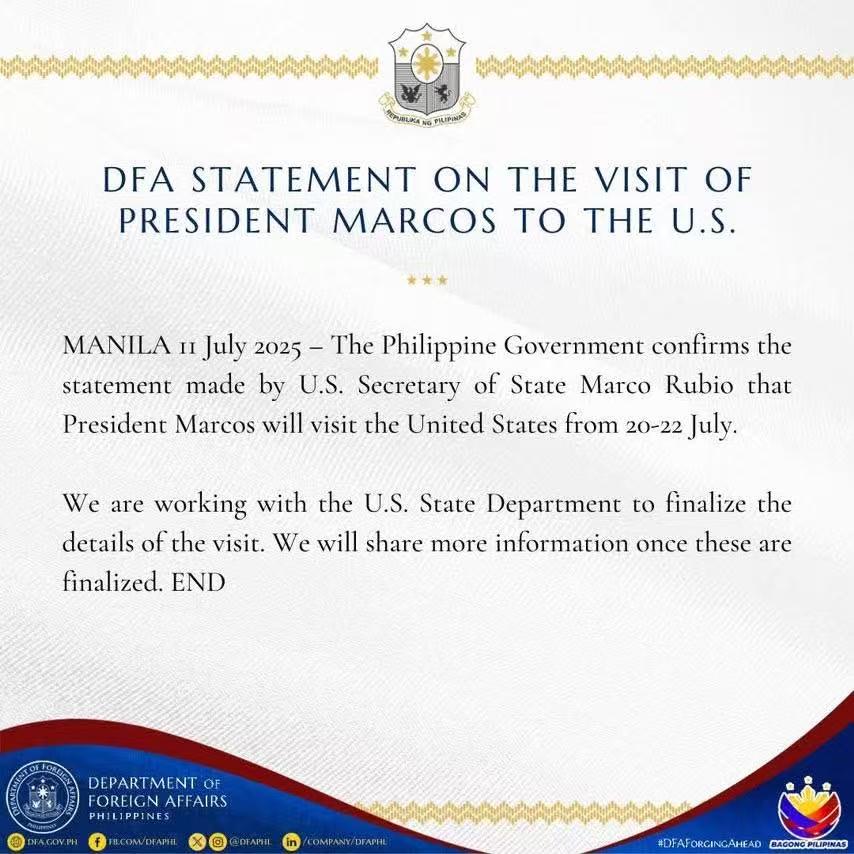
Washington parades Manila as a major non-NATO ally, crowing about shared defense treaties such as the Mutual Defense Treaty (MDT), the Enhanced Defense Cooperation Agreement (EDCA), the Visiting Forces Agreement (VFA), U.S. troops rotate in and out, missiles are prepositioned, and military assets are stationed. And right on cue, on July 10, in Kuala Lumpur, Malaysia, during the U.S.-PH-Japan foreign ministers’ meeting, Secretary of State Marco Rubio took center stage, not to de-escalate tensions, but to proudly showcase Manila’s deepening entanglement in the burgeoning U.S.-Philippines-Japan trilateral defense architecture. He even hinted at President Marcos Jr.’s upcoming pilgrimage to Washington “in a few days,” where, presumably, he’ll flash a smile, nod solemnly under yet another “ironclad” banner, and reaffirm loyalty to a so-called ally that just handed him a tariff trade war invoice.
One may ask, what kind of friendship demands unwavering defense cooperation on one hand, while imposing economic penalties on the other? If this is alliance solidarity, it’s a one-sided affair, military intimacy in exchange for economic subjugation. The dissonance is deafening.
And what exactly is the message here? Well, behold the grand gesture of American friendship: “Thank you, Philippines, for the free real estate, the US military bases dressed up as EDCA sites, the expanding U.S. military footprint planted firmly on your soil, the prepositioned stockpiles of high-grade weaponry and missile systems, and of course, the regular rotation of American boots on your supposedly sovereign ground. Your hospitality and your sovereignty are deeply appreciated.” And now, as a token of this ‘ironclad’ alliance and friendship”, please cough up a 20% tariff on your exports to the U.S.
Contradictions and Ironies
The irony? Thicker than the Manila smog and twice as toxic. The contradiction? It isn’t just glaring, it’s blinding. When the cameras are off, the “ally” is billed like a subordinate client state. The 20% tariff wasn’t imposed in spite of the alliance, but precisely because of it.
Indeed, the contradiction is crystal clear. On the one hand, the U.S. receives free real estate as part of its Indo-Pacific containment strategy. On the other hand, the Philippines pays the toll through punitive tariffs, punishment disguised as policy. What’s being sold as strategic cooperation is increasingly looking like a modern-day form of tribute extraction.
In truth, the U.S. gains military leverage and regional positioning, while the Philippines receives vague promises of protection, backed more by rhetoric than real assurance. This unequal exchange, where economic subjugation follows military dependence, reveals a more profound imbalance in the alliance: one rooted in control rather than mutual benefit.
Illusion of Friendship and Alliance
Ultimately, this isn’t a partnership or a friendship; it’s a master-client arrangement masquerading as an alliance. The dissonance between America’s lofty talk of “shared values” and its transactional behavior is more than just hypocrisy; it’s an insult to the Philippines and the intelligence of the Filipino people. If this is the cost of being an ally and friend of the U.S., in that case, Philippine policymakers and politicians must begin to ask: Is the price of friendship with Washington worth the erosion of the country’s sovereignty, strategic autonomy, independence, integrity, and dignity?
Indeed, in the grand tradition of lopsided alliances, this is Washington’s idea of gratitude and friendship: military occupation and subjugation disguised as defense cooperation, and economic penalties masquerading as policy realignment. All at the expense of a supposed strategic partner that keeps giving, and rarely receives benefits in equal terms that truly benefit its people tangibly.
Again, this isn’t diplomacy, nor friendship, nor alliance solidarity; it’s daylight robbery dressed as an alliance. What kind of “friendship” demands complete military access, foreign policy alignment, and geopolitical obedience, yet punishes you on the economic front? The MDT may bind both nations, but let’s be honest: one party gains strategic leverage and forward bases, while the other receives “paper tiger” promises of protection and an invoice. It’s as if the Philippines is expected to offer its sovereignty and strategic autonomy on a silver platter in exchange for military intimacy, which is traded for economic exploitation, tariff trade wars, and flattery. If this is alliance solidarity and friendship, it’s clearly built on a foundation of subordination. The dissonance between the rhetoric of “shared values” and the reality of transactional punishment is not just deafening; it’s abusive and contemptuous.
US Growing Military Arsenal in PH
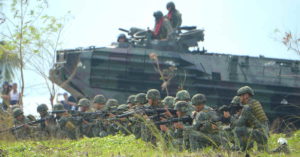
Note that under the presidency of Marcos Jr., the Philippines has witnessed an unprecedented expansion of U.S. military presence, functionally transforming it into a forward operating platform for American power projection in the Indo-Pacific. Lest we forget, under EDCA, the U.S. now has access to nine key military sites, with strategic upgrades, rotational troop deployments, and increasingly sophisticated military assets prepositioned across Philippine soil. What’s taking shape is not just a deepening alliance, but the remilitarization of the Philippines as a launchpad in the event of a U.S.-China confrontation, particularly over Taiwan or the South China Sea (SCS).
Although the U.S. has not permanently deployed long-range missile systems in the Philippines, it has rotationally deployed and likely prepositioned several key missile platforms, such as the HIMARS (High Mobility Artillery Rocket System), which is regularly deployed during joint military exercises like Balikatan and is likely staged at EDCA sites. Naval Strike Missiles (NSM), deployed via U.S. Littoral Combat Ships visiting Philippine ports. Patriot and THAAD Systems, while not yet deployed, are under serious consideration, whose potential presence would shift the Philippines from a support role to a ballistic missile engagement zone, a red line as far as Beijing is concerned. The Typhon Missile System, which could directly threaten mainland China from Philippine soil, would dramatically escalate regional risks.
However, the remilitarization of the Philippines is not limited to missile capabilities. There’s rotational deployments of F-22 Raptors, F-35s, and surveillance drones (MQ-9 Reaper, P-8 Poseidon) have become routine. Runway upgrades at Lumbia and Antonio Bautista Air Bases further accommodate large U.S. aircraft as well. Likewise, U.S. Navy ships, destroyers, amphibious vessels, and submarines frequently call at Subic Bay, Manila Bay, and Ulugan Bay, reinforcing U.S. maritime presence near Taiwan and the SCS. Additionally, as far as ground forces are concerned, U.S. Army and Marine units rotate through Fort Magsaysay and other EDCA sites, conducting joint training in amphibious warfare, jungle operations, and urban combat, thereby preparing the Philippine soil for a range of military contingencies. Fuel depots, engineering gear, mobility assets, and ammunition stockpiles have been quietly established, ensuring fast mobilization for any regional flashpoint.
Note that EDCA sites are strategic launchpads, which the U.S. enjoys access to. These include Basa Air Base (Pampanga), close to the SCS, Fort Magsaysay (Nueva Ecija), logistics hub and ground training, Camp Melchor Dela Cruz (Isabela) & Naval Base Camilo Osias (Cagayan) geared toward Taiwan Strait scenarios, Balabac Island (Palawan) a staging area near the Spratlys, Antonio Bautista, Lumbia, Benito Ebuen, and Lal-lo Airbases, covering Luzon to Mindanao. These are not random locations; they’re chosen by the U.S. for proximity to key geopolitical chokepoints, effectively placing the Philippines in the direct trajectory of conflict scenarios.
What’s at Stake for the Philippines
The Marcos administration must resist the temptation to appease Washington at the cost of its sovereignty, both in the geopolitical and geoeconomic realms. What is needed is not submission, but strategic clarity: that the Philippines has the right to protect key sectors, to industrialize, and to seek diversified partnerships beyond Washington’s orbit.
A world where economic coercion masquerades as alliance is a world ripe for realignment, and Manila should not be afraid to look elsewhere for fairer, non-punitive trade relationships.
Conclusion: Reclaiming the Meaning of Partnership
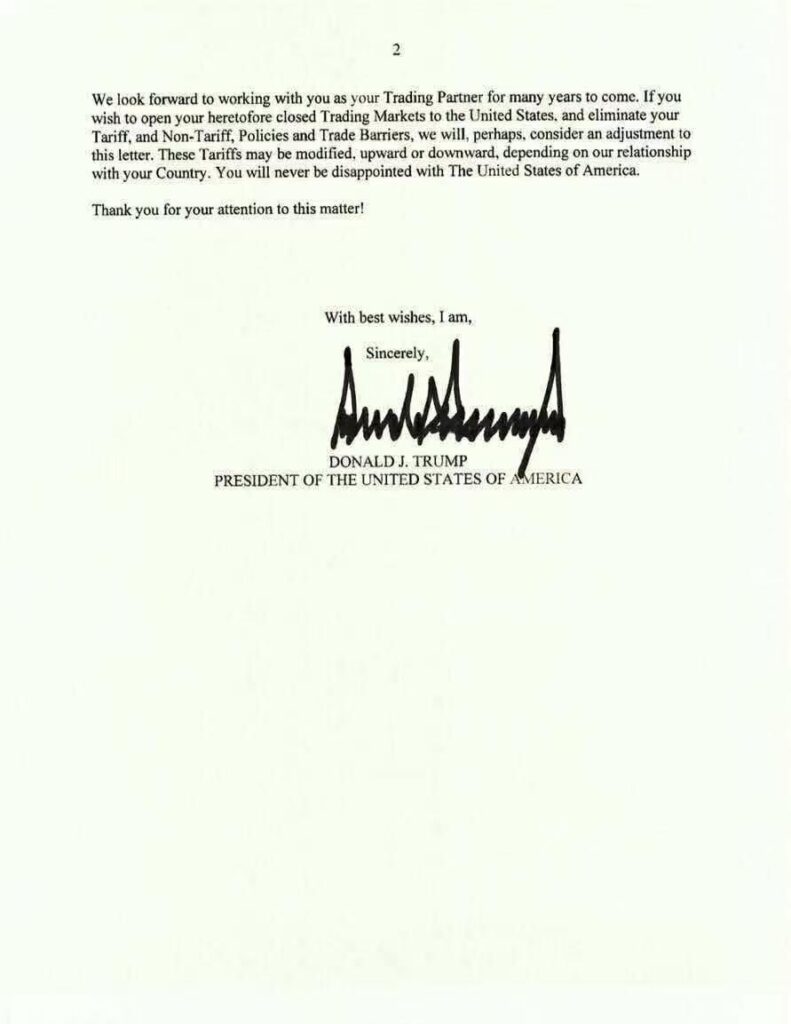
Trump’s letter to Marcos Jr., though dressed in the language of cooperation, reflects a fundamental misalignment between rhetoric and reality. It exposes the hollowness of alliances that claim mutuality but demand subservience.
Trump’s tariff threat is not just an economic issue; it’s a sovereignty issue. It challenges the Philippines to choose between submitting to the pressures of a dominant power or asserting its right to chart a developmental path rooted in equity, partnership, and respect. Philippine policymakers and politicians must ask: Are these alliances still serving national interest, or merely reinforcing dependence?
If the U.S. truly values its alliances, it must abandon the illusion that fairness is measured by numeric symmetry or trade surpluses. Real partnership is about growth, together. And real friendship, whether between individuals or nations, is not about how much you can extract, but how much you are willing to build and grow together, sadly, something that is not within the vocabulary of the “empire of chaos.”