
June 12, 2025, marks the 127th anniversary of the Philippines’ historic proclamation of independence, a defining moment that continues to shape the nation’s collective memory and identity. The first declaration was made on June 12, 1898, when General Emilio Aguinaldo unfurled the Philippine flag from the balcony of his ancestral home in Kawit, Cavite, accompanied by the stirring first rendition of the national anthem. This act symbolized the end of more than three centuries of Spanish colonial rule and the birth of a nation aspiring to chart its own destiny.
However, it wasn’t until 1962 that this date was officially recognized as Independence Day, following a historic shift by then-President Diosdado Macapagal. He moved the celebration from July 4, the date tied to the Philippines’ independence from American rule in 1946, back to June 12, reclaiming a more authentically Filipino milestone rooted in the revolution against Spain. This gesture was more than symbolic; it was a political and cultural reassertion of national pride and anti-colonial struggle.
Neocolonialism
As the Philippines commemorates the 127th Anniversary of its declaration of independence, we should ask ourselves, – Is the Philippines independent in the full sense of the word?
The withdrawal of American troops in 1946 did not end colonialism; it merely changed its form. Today, we live under a system best described as colonialism without the flag, a condition where U.S. influence persists, even deepens, not through overt rule but through military agreements, economic dependencies, and strategic narratives skillfully embedded into the Filipino psyche and statecraft. What we are witnessing today is not the culmination of emancipation, but the continuation of a struggle obscured by the illusions of genuine sovereignty.
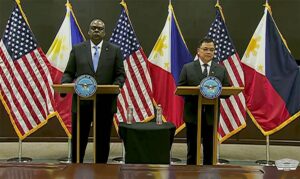
The Mutual Defense Treaty (MDT), Enhanced Defense Cooperation Agreement (EDCA), and Visiting Forces Agreement (VFA) are not symbols of sovereign partnership but reminders of structural subordination. The permanent rotation of U.S. forces, the forward deployment of weapons, and the use of Philippine territory as a platform for American projectionism in Asia only reinforce the fact that the archipelago remains a pawn on Washington’s geopolitical chessboard.
This is colonialism without the flag, old master but new playbook. The tools are no longer direct administration but rather military agreements, defense aid, strategic narratives, and elite capture. U.S. influence permeates Philippine policymaking through think tanks, military indoctrination, and economic dependencies. Hence, the post-colonial state remains structurally aligned with U.S. interests. This is not a break from our colonial past, but its modernized version, neocolonialism with better public relations (PR).
Conclusion
Indeed, the challenge of our time is whether we can reclaim authentic independence grounded in strategic autonomy, economic self-determination, and an independent foreign policy anchored on neutrality and the country’s national interests. Thus, the 127th year of our so-called independence must be a call to reimagine the nation not as a client state but as a sovereign actor shaping its own future.
Source: The Lobbyist
https://www.thelobbyist.biz/perspectives/article-details/prime%20insight/colonialism-without-a-flag