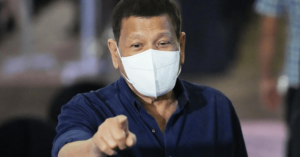

THE May 12, 2025, midterm elections in the Philippines were far from an ordinary democratic exercise; they were widely interpreted as a proxy war between two dominant political families, President Ferdinand Marcos Jr. and former president Rodrigo Duterte. Far from mere ballot casting, this electoral showdown became a de facto referendum on the political future of both camps. Remarkably, despite being detained at The Hague under the weight of an International Criminal Court (ICC) warrant, Rodrigo Duterte defied the odds by running for mayor, and the Dutertes still clinched a sweeping landslide victory in Davao City. This outcome sends a powerful message: that political persecution has not dismantled the Duterte power base but, in fact, may have galvanized it. Their electoral success underscores the enduring legitimacy and resilience of Duterte’s populist appeal, defying institutional efforts to marginalize them. By contrast, the Marcos camp now finds itself increasingly isolated, its legitimacy eroding amid declining approval ratings and internal fractures. The Dutertes’ landslide win is not merely local but symbolic of a broader political undercurrent that may reshape the national landscape heading into the 2028 presidential/national elections.
Impeachment trial
Moreover, the looming impeachment trial of Vice President Sara Duterte cast a long shadow over the 2025 midterm elections, effectively transforming the polls into a high-stakes referendum on her political survival. Many observers viewed the impeachment proceedings as a calculated maneuver by the Marcos administration, engineered through its allies in the House of Representatives, led by the President’s cousin, the Speaker Martin Romualdez, to politically neutralize the Dutertes ahead of the 2028 presidential race.
In response, Duterte loyalists and supporters framed the election as a struggle not merely for seats but vindication. To them, this was a battle to preserve the legacy of the former president and shield Sara Duterte from what they perceived as a weaponized, partisan assault masquerading as accountability. As a result, the senatorial race assumed exceptional importance. With conviction in the Senate requiring a two-thirds vote (16 out of 24), the vice president needs only nine senators to block her removal, making every seat a potential lifeline, meaning that every seat won or lost in this election tipped the scales.
Based on a conservative but informed assessment, the vice president currently commands the support of seven to eight senators, a formidable core that could prove decisive when the Senate trial unfolds. The composition of the new Senate in the upcoming 20th Congress, shaped by this election, may thus serve not as a rubber stamp for the administration’s agenda but as a critical firewall against political overreach. In this context, the senatorial race outcome, though not an overwhelming sweep, can be interpreted as strategically favorable to the Duterte camp, an outcome that complicates efforts to execute a clean political takedown. More importantly, the strengthened position and numbers of Duterte’s allies in the Senate enhance her prospects of surviving the impeachment trial, potentially positioning her as a formidable contender in the 2028 presidential election.
Lame-duck presidency
Furthermore, while Marcos’ administration has sought to consolidate power through strategic appointments and political alliances, it is increasingly evident that he has already expended much of his political capital. The President appears to have played his strongest cards early, only to find himself now boxed in, with dwindling options and shrinking maneuvering space. By contrast, VP Duterte seems to hold more in reserve, not just allies, but potentially damning revelations that may shift the political terrain during the impeachment trial.
Indeed, the signs of a lame-duck presidency are growing unmistakably. With three years remaining in his term, Marcos is already confronting the specter of political irrelevance. The clearest indicator lies in the dramatic collapse of his public support. According to a recent Pulse Asia survey conducted in late March, only 25 percent of Filipinos approved of his performance, plummeting 17 points from 42 percent in February. By contrast, VP Duterte’s approval rating rose from 52 percent to 59 percent during the same period, suggesting a reversal of political momentum.
This trend is echoed in the Pahayag First Quarter 2025 survey by PUBLiCUS Asia, which confirms a precipitous decline in Marcos’ trust and approval ratings. His approval rating nosedived from 33 percent in Q4 2024 to a mere 19 percent in Q1 2025. His disapproval rating ballooned to 57 percent, with only 24 percent remaining neutral. Even more damning, his trust rating dropped to 14 percent, down from 23 percent, while 63 percent of respondents expressed low or no trust in the President.
This collapse in public confidence can be traced to a confluence of issues: relentless inflation, rising unemployment, declining foreign direct investments, unstable peace and order, flawed foreign policy and an increasingly palpable perception of massive corruption among others under his watch. But perhaps the most politically fatal decision was Marcos’ controversial move to facilitate the ICC’s arrest warrant against former president Duterte, a move that alienated a significant segment of the population, especially in Mindanao, where Duterte retains a deep reservoir of support.
In stark contrast, Sara Duterte’s ratings have gained notable traction. Her approval rating climbed. Her rising popularity amid impeachment proceedings and the arrest of her father reflects a powerful narrative of victimhood and political persecution.
Taken together with the results of the 2025 midterm elections, widely viewed as a referendum on the Marcos administration vis-à-vis the Dutertes, these shifts expose a weakening of the Marcos-Romualdez faction’s political base/foundation and a sharp erosion in the legitimacy of Marcos’ presidency. The changing tides in public opinion are not mere statistical noise; they signal a deeper recalibration of power and alliances within the Philippine political establishment.
As political winds shift, traditional power brokers and opportunistic politicians are likely to reorient their loyalties. The Marcos administration’s slipping grip on power and plummeting credibility, integrity, political legitimacy and currency may prompt defections and a reshuffling of allegiances, setting the stage for a fierce and complex battle leading up to the 2028 presidential/national elections. In this unfolding political saga of “Game of Thrones,” the Marcos name may no longer be the currency it once was, and Sara Duterte, paradoxically strengthened by political adversity and persecution, could emerge as a formidable contender in the next chapter of Philippine politics.
Conclusion
Indeed, the 2025 midterm elections have decisively reshaped the Senate’s composition and recalibrated the nation’s political fault lines, setting the stage for intensified factional maneuvering as the 2028 presidential race looms. At the heart of this unfolding drama is Sara Duterte, whose potential acquittal in the forthcoming impeachment trial could transform her from embattled incumbent to front-runner, a political resurrection that would reaffirm the enduring power of the Duterte brand of leadership and politics. Yet, beneath the surface, what’s truly at stake is far more consequential: the capacity of the Republic to safeguard its democratic institutions, uphold the rule of law and reclaim a politics rooted in legitimacy rather than dynastic brinkmanship. Hence, the balance between power and principle teeters dangerously in this high-stakes political reckoning.
Source: The Manila Times
https://www.manilatimes.net/2025/05/17/opinion/columns/between-retribution-and-resurrection-the-2025-midterms-and-the-fight-for-2028/2115342