
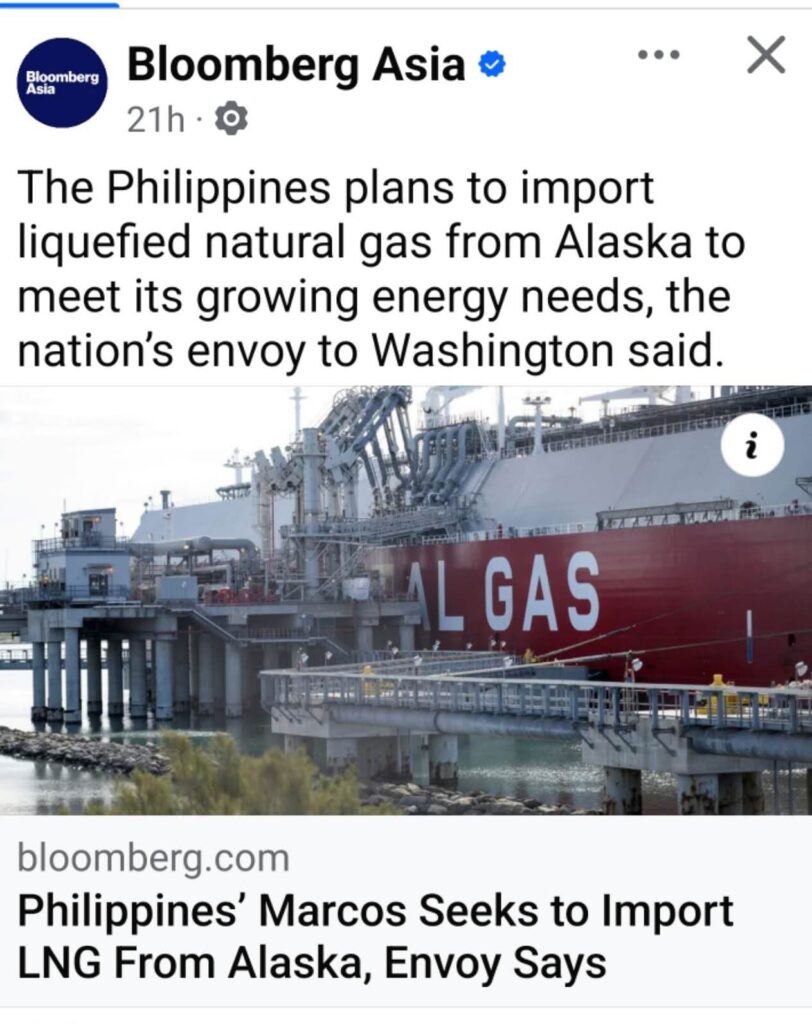
The article (see photo below) raises pertinent questions regarding the Philippines’ potential LNG importation plans from Alaska, notably under the Marcos Jr. administration. While it is clear that Alaska holds considerable natural gas reserves, it is crucial to critically assess whether this strategy is financially sound, economically viable, and ultimately cost-effective for the Philippines. A more nuanced perspective would consider both the immediate benefits and long-term repercussions of such an energy policy.
Moreover, there is a potential geopolitical undertone to this move. The involvement of Babes Romuladez, the Philippine Ambassador to Washington and President Marcos Jr.’s cousin, signals a possible strategic maneuver aimed at strengthening U.S.-Philippine defense relations under Trump 2.0. Given the context of the Philippines’ relation to the South China Sea dispute against China, it raises the possibility that LNG imports from Alaska could be leveraged as a political-diplomatic tool to secure a favorable U.S. stance on military/defense cooperation and to get the attention of POTUS Trump. However, the question remains whether this is a genuine effort to diversify the Philippines’ energy sources or if it serves as part of a broader geopolitical strategy to engage the Trump 2.0″ Presidency.
Ultimately, it would be essential to scrutinize not only the economic and fiscal impacts of this potential LNG deal but also the possible hidden agenda, particularly in the context of Marcos Jr. seeking an audience with Trump and concessions in the name of US-PH defense agreements and military cooperation/financing.
The Role of Trump 2.0 in the Equation
Again, I have said many times that the Trump administration’s approach to foreign policy is generally characterized by a more transactional style, prioritizing bilateral trade and security deals over multilateral cooperation. With this, it seems that Marcos Jr. is trying to leverage energy imports as a way to strengthen its position in this transactional framework/approach of Trump. By offering a strategic energy partnership, Marcos Jr. could seek better concessions in defense, trade, and security from the U.S.
From Marcos Jr.’s administration perspective, the exchange for buying LNG from Alaska could be seen not only as a move to diversify energy sources but also as a potential bargaining chip in negotiating favorable terms for defense cooperation, military access, and political support, especially in the contentious South China Sea (SCS) dispute with China. In exchange for its energy purchases, the Philippines could seek enhanced and sustained military aid, as well as access to U.S. military facilities and assets.
However, this approach demands a critical analysis. While energy deals may offer the Philippines access to natural gas resources, there is a need to scrutinize the potential economic costs and benefits in relation to the country’s long-term strategic interests. The trade-off between the potential energy deal with the U.S. and possible geopolitical, military/defense considerations could have significant ramifications for the Philippines at the cost of undermining the country’s economy and economic growth over geopolitical considerations, which may not fully align with the country’s long-term national interests.
Important Considerations
Considering whether outsourcing LNG from Alaska to the Philippines would be cost-effective, factoring in travel (transit cost), logistical complexities, infrastructure, market relations/conditions/demand, and tax implications (tariffs structures and regulations) raises several considerations when assessing the fiscal and economic implications.
First, on the issue of Cost-Effectiveness. Alaska is geographically located much farther from the Philippines than other LNG-exporting regions like Qatar, Australia, Malaysia, Indonesia, and even Russia. Shipping LNG over such a long distance could increase transportation costs, which may raise the overall price of LNG imported from Alaska, making it potentially less competitive than closer suppliers.
Second, the Philippines would need to invest in specialized LNG carriers, potentially increasing logistical costs. These carriers would need to navigate across the Pacific, which could make it more expensive than importing from regional suppliers closer to the Philippines, like Malaysia, Indonesia, and Qatar. Thus, when it comes to competitive pricing, neighboring LNG suppliers like Qatar or Malaysia may offer more competitive prices due to proximity and established trade routes, making Alaska’s LNG potentially more expensive.
Third, the global LNG market is volatile, and the Philippines would need to assess whether the price of LNG from Alaska remains competitive compared to other sources. If Alaska’s LNG is more expensive, it may not be a sustainable or cost-effective source for long-term energy security.
Fourth, LNG prices are influenced by global supply and demand factors, meaning LNG prices are generally volatile, especially considering the geopolitical and economic factors affecting the energy market.
Implications
Obviously, importing LNG from Alaska is unlikely to be the cheapest option for the Philippines. Hence, such an energy deal could be financially challenging not only due to high transportation costs, infrastructure investments, and potential price volatility but also because the Philippine peso is weak against the dollar.
The current weakness of the Philippine peso against the U.S. dollar is another critical factor. As LNG imports would be denominated in dollars, the exchange rate disparity exacerbates the financial burden on the Philippines. A weaker peso means that more pesos are needed to purchase the same amount of LNG, further increasing the effective cost of energy imports. This makes LNG imports from Alaska, or any other U.S.-based source, even more expensive, especially for a country already facing fiscal constraints.
Thus, if the importation of LNG from Alaska is not cost-effective for the Philippines, it could have several significant impacts on both the Filipino people and the business community. One of the immediate consequences of importing LNG from Alaska if it is not cost-effective is that the price of LNG could rise. This likely leads to higher electricity and fuel costs for Filipino consumers, as natural gas is a key source of energy for power generation in the country. Higher energy prices could directly affect household budgets, particularly for lower-to-middle-income families who spend a larger portion of their income on energy and basic goods.
For businesses, particularly those energy-intensive industries such as manufacturing, transportation, and heavy industries, could see an increase in their operating costs. If energy costs rise significantly, this could lead to higher prices for goods and services across the board, which could be passed on to consumers. It may also impact the competitiveness of Philippine businesses in the global market, especially in comparison to other countries with lower energy costs.
Furthermore, higher energy costs and the potential lack of cost-effective energy sources could deter foreign and domestic investment in energy-intensive industries such as manufacturing, agriculture, and services. Investors typically seek stable and predictable energy prices to ensure long-term profitability, and rising energy costs could discourage investment in the Philippine economy.
In sum, if LNG from Alaska is not cost-effective for the Philippines unless Babes Romualdez can prove otherwise, it could lead to higher domestic energy costs for consumers and businesses, potentially harming the country’s economic growth, energy security, and environmental sustainability. Likewise, such a scenario could disproportionately affect lower-to-middle-income households, which would require careful consideration of how to balance economic growth with energy affordability.
Moreover, if Babes Romualdez can show with certainty, backed up by a well-researched and well-thought feasibility study, that importing LNG from Alaska could be a sound policy move for the Philippines under Marcos Jr. by proving it to be competitive in terms of price and logistics when compared to other suppliers, and if it aligns with the Philippines’ long-term energy security goals, why not, then do it. However, if this move leads to higher costs or undermines the country’s long-term economic growth and sustainability goals, it might not be the most strategic move. The government would need to carefully weigh the economic costs, as well as the broader geopolitical context, before committing to this move as an energy strategy.
Conclusion
Indeed, the potential energy deal between the Philippines and the U.S., specifically through LNG imports from Alaska, presents a complex strategic opportunity. While it could provide the Philippines with access to valuable natural gas resources, it requires a thorough examination of the economic, fiscal, and geopolitical trade-offs. The central concern is whether the potential benefits of this energy agreement outweigh its costs, particularly considering the possible long-term implications for the country’s economy and growth.
In the context of rising tensions in the South China Sea (SCS) and broader Indo-Pacific geopolitical dynamics, President Marcos Jr. may be leveraging the LNG deal to strengthen ties with the U.S. in countering China’s in the SCS. Through this deal, Marcos Jr. might be seeking political and defense/military-related concessions from the U.S. under Trump, including increased and sustained military cooperation, defense funding, boots on the ground, and access to advanced military technology or assets, thinking that these could possibly enhance the Philippines’ strategic positioning against China in the SCS dispute.
However, this strategy raises important questions: How much will the Philippines have to sacrifice economically and politically in exchange for these military and defense concessions? The Philippines must carefully assess whether securing energy resources from the U.S. aligns with its broader national interests and if it does not disproportionately prioritize geopolitical considerations over economic stability and growth. In essence, while the LNG deal offers a potential pathway for Marcos Jr. to get a military/defense concession with Trump, it is critical to evaluate whether this policy is truly sound, viable, cost-effective, and sustainable for the Philippines in the long run.
In sum, while importing LNG from Alaska may align with geopolitical or strategic interests, from a purely economic perspective, it may not be the most efficient or affordable option for the Philippines. The government must carefully weigh these costs against other alternatives for energy procurement that could better serve the country’s long-term energy needs and fiscal stability.