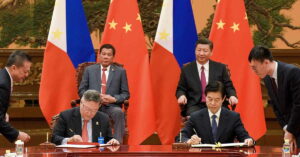

President Ferdinand R. Marcos Jr. challenged China to halt its so-called coercive and aggressive actions in the South China Sea (SCS) in exchange for the country’s return of the Typhon missile system deployed by the United States in Philippine soil back to the U.S. Note that the US Typhon missile system was deployed to the Philippines in April 2024 as part of the Balikatan military exercises, which was supposedly removed by around September 2024 but remains in Philippine soil.
However, the question is whether Marcos has substantial leverage, especially considering China’s military might and strategic posture in the region. Compared to China’s military capabilities, the Philippines, despite being a key US ally, is clearly at a disadvantage in terms of sheer power and military strength, and that’s the fact of the matter.
Military Superiority vs Mediocrity:
China has one of the world’s largest and most advanced military forces, especially in the context of the SCS. Its naval presence, air defense systems, and anti-access/area denial (A2/AD) capabilities are highly sophisticated. These capabilities include a large fleet of aircraft carriers, destroyers, and submarines, as well as advanced missile systems, such as anti-ship and anti-air missiles capable of striking deep into regional waters, and cyber warfare and electronic warfare capabilities that could disrupt adversaries’ operations, among others.
The Philippines, on the other hand, has a relatively modest military force that is bordering mediocrity. While the Typhoon missile system could bolster its defense capabilities, it’s minuscule when compared to China’s defense and military arsenal. The US-Philippines alliance, while important, doesn’t entirely offset the power imbalance between the two countries, especially since the U.S. has strategic commitments elsewhere in the world.
Conclusion:
Given the disparity in military power and strength, Marcos would need to be cautious about overplaying his hand. China has extensive options for retaliation, including economic measures (e.g., sanctions, and restricting trade). Thus, the Philippines’ leverage lies in diplomatic, peaceful, and strategic avenues rather than direct military influence.
While China is assertive in its territorial claims in the SCS dispute, it is unlikely to change its core stance on its claims over the SCS even at the expense of a Typhoon Missile system, however, China is very much invested and has a great interest in regional peace and stability due to its Belt and Road Initiative (BRI) and energy interests. This could create a window for diplomacy and negotiations where the Philippines could extract some economic or strategic concessions with China. The Philippines should attempt to gain some concessions on low-political issues such as fishing rights and joint resource exploration while peacefully and diplomatically resolving high-level political issues with China, like sovereignty and territoriality in the SCS.
Moreover, truth be told, while the US Typhoon missile system might be valuable for the Philippines’ defense posture, it’s only a small part of the broader US-China strategic and geopolitical balance.
Source: The Lobbyist
https://www.thelobbyist.biz/perspectives/article-details/prime%20insight/the-typhoon-missile-in-the-balance-marcos-high-stakes-gambit-with-china-in-the-scs