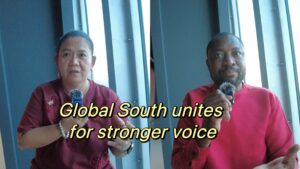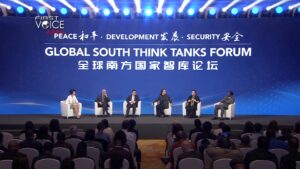

LAST October 18, I had the opportunity to serve as a panel speaker at the high-level Global South Think Tank Forum in Beijing, China. The forum, themed “Peace·Development·Security: Jointly Building a Prosperous World with a Shared Future,” provided a critical platform for discussing collaborative pathways toward global prosperity and collective security, with a focus on enhancing cooperation among nations in the Global South.
The forum aimed to unite influential voices from across the Global South to deliberate on pivotal issues ahead of this year’s Brics (Brazil, Russia, India, China, South Africa, later joined by Iran, Egypt, Ethiopia and the United Arab Emirates) summit, fostering dialogue on constructing a more secure and prosperous global future. It underscored the vital role that Global South countries now play in shaping the international landscape. As a key platform for exchanging ideas, the forum facilitated discussions on addressing pressing security challenges, promoting economic growth and achieving sustainable prosperity through enhanced cooperation in an increasingly complex global environment. Central themes included the challenges and opportunities facing the Global South, its active engagement in global governance, the strategic advancement of South-South cooperation, and how technological innovation and cultural exchange can foster mutual trust and collaboration.
In addition to myself, the high-level panel featured distinguished experts and speakers from diverse fields, including: Prof. Grzegorz Kolodko, director of the Tiger think tank at Kozminski University, and former deputy prime minister and finance minister of Poland; Prof. Wang Dong, executive director of the Institute for Global Cooperation and Understanding at Peking University; Prof. Wang Wen, executive dean of the Chongyang Institute for Financial Studies at Renmin University of China; Yoro Diallo, executive director of the Center for Francophone Studies and director of the African Museum at Zhejiang Normal University; and Ms. Larissa Wachholz, co-founder of the Institute of Government Relations and senior fellow at the Brazilian Center for International Relations. The forum was moderated by China Global Television Network anchor Xin, providing a dynamic platform for exchanging ideas and perspectives on South-South cooperation and development.
The forum was a collaborative effort jointly organized by the international department of the Chinese Communist Party (CCP) central committee and China Media Group (CMG). It brought together representatives from 40 think tanks across the Global South to address shared challenges and opportunities facing the global majority in this era of profound change, shifts and global challenges. The event also saw the participation of 96 journalists and media professionals from 87 countries, including from Asia-Pacific, Africa, Latin America, the Caribbean, Eurasia and the Arab world. These media professionals and practitioners are currently participating in the 2024 four-month media program of the China International Press Communication Center, where I am also participating as a media practitioner, further enriching the South-South dialogue and collaboration on the various issues discussed at the forum.
The forum began with opening remarks from Liu Jianchao, minister of the international department of the CCP central committee, followed by CMG President Shen Haixiong. Liu emphasized that the Global South has emerged as a crucial force driving a new wave of globalization that is universally inclusive and beneficial. He highlighted the Global South’s role in underpinning an equal and orderly multipolar world and promoting greater democracy in international relations. Liu reaffirmed China’s commitment by stating, “Going into the future, China will stand united with other Global South countries as always to shoulder responsibility and play an active role.”
Shen Haixiong reinforced this sentiment, noting that the Global South is on the rise and is increasingly shaping the new global governance order. He stressed that China champions the cause of the Global South and actively explores developmental paths that benefit it, offering both wisdom and strength to improve global governance. On the other hand, Erik Solheim, former undersecretary-general of the United Nations and co-chairman of the Europe-Asia Center, echoed these sentiments in his remarks, calling the rise of the Global South “an enormous positive development.” He predicted that this shift would lead to a much fairer world, a much greener world, “highlighting the transformative potential of the Global South’s ascendancy.”
Global South initiative
A significant highlight of the forum was the launch of the “Initiative of Global South Think Tanks to Jointly Build a Prosperous World with a Shared Future.” This statement, endorsed and backed by 40 think tanks from Global South countries, reflects a broad consensus and collective commitment to strengthening development cooperation, promoting fairness and justice, and collectively building a shared and prosperous future. The initiative underscores the critical role of think tanks in harnessing their expertise to foster synergy and advance the Global South agenda toward an effective path to development, prosperity and equitable governance. By fully leveraging the capabilities of these institutions, the initiative aims to drive progress in creating a fairer and more just global order. The initiatives are as follows:
1. Join hands for common development to promote modernization in Global South countries. In the era of economic globalization, think tanks across the globe should embrace the trend of open development by strengthening forward-looking research and sharing intellectual achievements. This will help countries explore modernization paths suited to their national realities. We, think tanks throughout the Global South, advocate countries to enhance economic and trade cooperation, promote innovation exchanges and encourage them to find mutually beneficial solutions. By expanding the breadth and depth of South-South cooperation, we aim to help countries jointly pursue development and prosperity, improve people’s well-being and share the benefits of development.
2. Promote peace and security, uphold fairness and justice, and be true advocates of multilateralism. We firmly uphold mutual respect between nations, noninterference, independence and self-determination in international relations. Each country should be free to explore its own development path suited to its national realities. We advocate safeguarding the fundamental principles of international relations, promote both South-South cooperation and North-South dialogue, uphold fairness and justice, and ensure all nations are treated equally regardless of size, strength and wealth. We promote openness and inclusivity, and aim to create a more just and reasonable international order while advancing toward a multipolar world.
3. All for one: Build a community with a shared future of peace, security, prosperity and progress for mankind. We are committed to a global governance model based on consultation, joint efforts and shared benefits. Upholding the principles of equality, mutual learning, dialogue and inclusiveness, we are committed to providing global public products and will work to amplify the voice of the Global South. Together, we will strive to build a community with a shared future of peace, security, prosperity and progress for mankind.
Conclusion
Indeed, in an era of unprecedented global challenges, the unity of the global majority stands as a beacon of hope. By fostering cooperation and shared responsibility, Global South countries are paving the way for a future marked by mutual development and security, ensuring a more balanced and equitable global order. As they continue to harness collective strength through dialogue, innovation and shared resources, the Global South is shaping its own future and contributing to a more stable, just and prosperous multipolar world for all.
Source: The Manila Times
https://www.manilatimes.net/2024/10/19/opinion/columns/global-south-unites-collaborative-path-to-common-development-and-security/1987340